
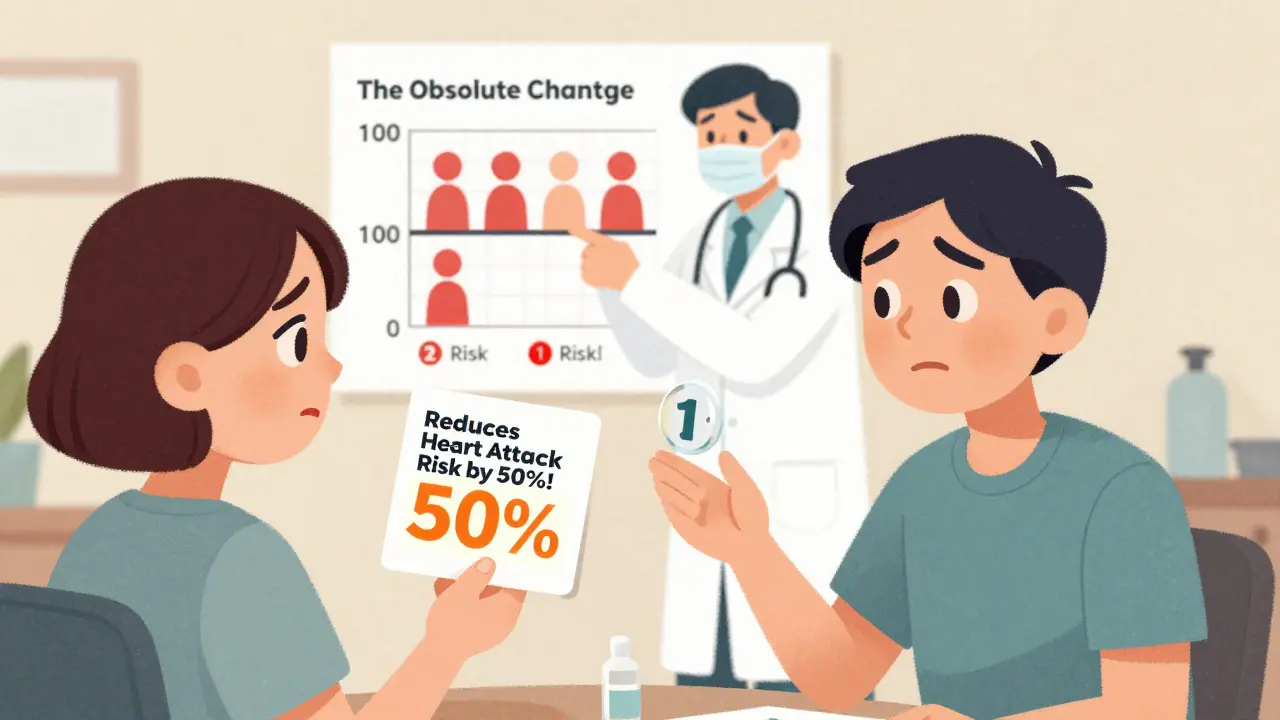
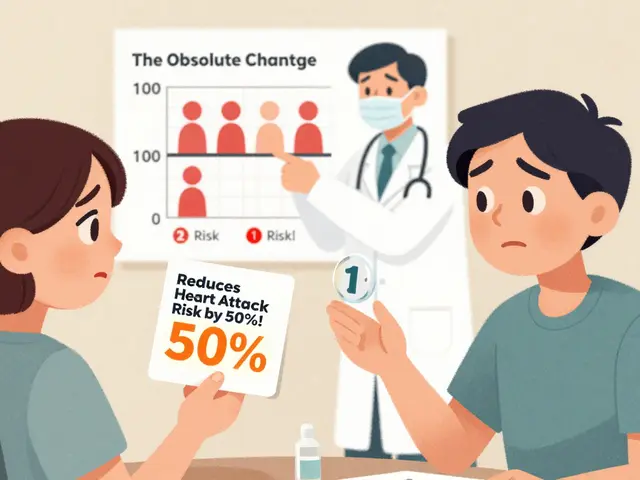
Have you ever read a drug ad that said, "This medicine cuts your risk of heart attack in half"? It sounds amazing-until you realize that if your original risk was 2%, cutting it in half means going down to 1%. That’s not a miracle. It’s a small change. And that’s the problem. Most people, even doctors, mix up two simple numbers: absolute risk and relative risk. One tells you what actually happened. The other makes it sound like a game-changer. Knowing the difference could change how you decide whether to take a drug-or avoid it.
What Absolute Risk Really Means
Absolute risk is the plain, real number. It answers: "Out of 100 people like me, how many will have this side effect?" It doesn’t compare groups. It just shows what happens in real life.
For example, let’s say a drug causes severe nausea in 5 out of every 100 people who take it. That’s an absolute risk of 5%. Simple. No tricks. If you’re one of those 100, you have a 5% chance of feeling sick. That’s it.
Same goes for benefits. If a statin reduces your chance of having a heart attack from 4% to 3%, the absolute risk reduction is just 1 percentage point. That’s not nothing-but it’s not a 75% win, either. Absolute risk doesn’t lie. It’s the baseline. And if you don’t know your baseline, you can’t tell if a treatment actually helped.
How Relative Risk Tricks Your Brain
Relative risk is where things get slippery. It’s not about what happened. It’s about comparing two groups: those who took the drug vs. those who didn’t. It’s a ratio. And ratios can make tiny changes look huge.
Take that same statin. Your heart attack risk drops from 4% to 3%. Absolute risk reduction? 1%. Relative risk reduction? 25%. Here’s how: (4% - 3%) ÷ 4% = 0.25, or 25%. That’s the number you’ll see in ads: "Reduces heart attack risk by 25%!"
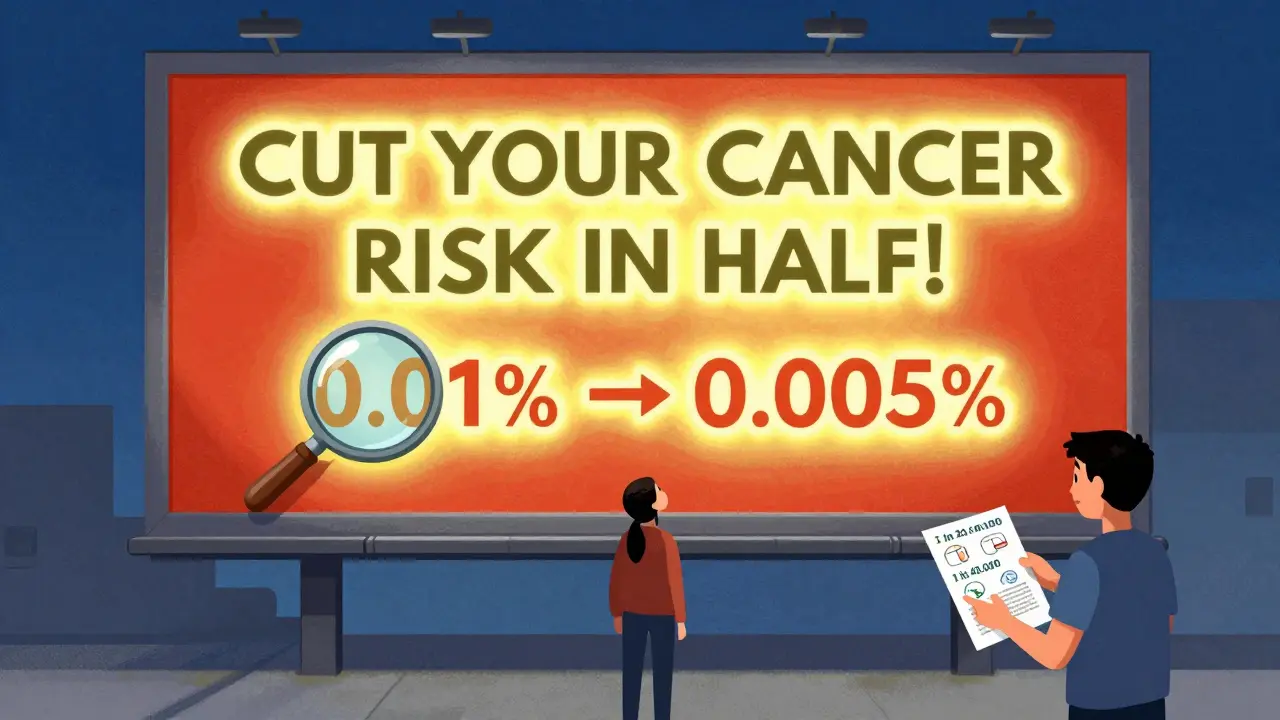
Now imagine a drug that cuts cancer risk from 0.01% to 0.005%. Absolute change? Just 0.005%. But relative? 50% reduction. That’s a 50% win-on a risk so small, it’s practically invisible. And yet, companies will still say: "Cut your cancer risk in half!"
Relative risk doesn’t lie. But it doesn’t tell the whole story. It’s like saying, "I doubled my savings!"-when you went from $2 to $4. It’s mathematically true. But it doesn’t mean you’re rich.
Why This Matters in Real Life
Let’s look at a real case. A 2022 Reddit thread from a primary care doctor in Sydney shared this: a patient refused statins because they’d read online that the drug "cuts heart attack risk in half." The patient thought it meant half of all people taking it would avoid heart attacks. That’s not what it means. It meant their personal risk went from 2% to 1%. The patient was scared off by a misleading number.
Another example: venlafaxine, an antidepressant. Studies show 20% of users get sexual side effects. On placebo? 8.3%. The relative risk? 2.41-meaning you’re more than twice as likely to have this side effect. Sounds scary. But the absolute difference? Only 11.7 percentage points. So out of 100 people, 12 more will have this issue because of the drug. That’s not trivial. But it’s not a 241% chance of disaster. It’s a 12% increase.
Pharmaceutical ads love relative risk because it sounds impressive. A 2021 study found 78% of U.S. direct-to-consumer drug ads used relative risk without mentioning absolute numbers. Meanwhile, in Europe, regulators require both. Here, you’re left guessing.
How to Read the Numbers Right
You don’t need to be a statistician. Just ask two questions:
- What was the original risk? If the ad says "50% reduction," ask: "50% reduction from what?" If they don’t say, walk away.
- How many people actually benefit-or get hurt? Look for numbers like "1 in 100," "5 out of 1,000," or "10% more likely." Those are absolute. They’re real.
Here’s a trick: always convert relative risk into absolute terms. If a drug says it "reduces risk by 30%," and you know your baseline risk is 10%, then the absolute reduction is 3 percentage points (30% of 10% = 3%). So instead of 10 in 100 getting the problem, now it’s 7 in 100. That’s helpful. But not earth-shattering.
And if you’re worried about side effects? Look for the absolute increase. If a drug raises your chance of a rare side effect from 0.1% to 0.2%, that’s a 100% relative increase. Sounds scary. But in real terms? One extra person out of 1,000. That’s not nothing-but it’s not a reason to panic either.
What Doctors and Regulators Are Doing About It
It’s not just patients who get confused. A 2019 study found that 60% of doctors couldn’t correctly convert relative risk to absolute terms. That’s alarming. If clinicians don’t understand it, how can they explain it?
Thankfully, things are changing. The FDA issued draft guidance in January 2023 saying direct-to-consumer ads must show both absolute and relative risks. The Cochrane Collaboration now provides standard templates for risk communication, used by 37 major journals. Harvard Medical School added a mandatory course on interpreting medical stats in 2022. And in Australia, the TGA (Therapeutic Goods Administration) requires both numbers in patient information leaflets for prescription drugs.
But enforcement is still patchy. Many ads still hide the absolute numbers. And many websites still push relative risk as the main story.
What You Can Do
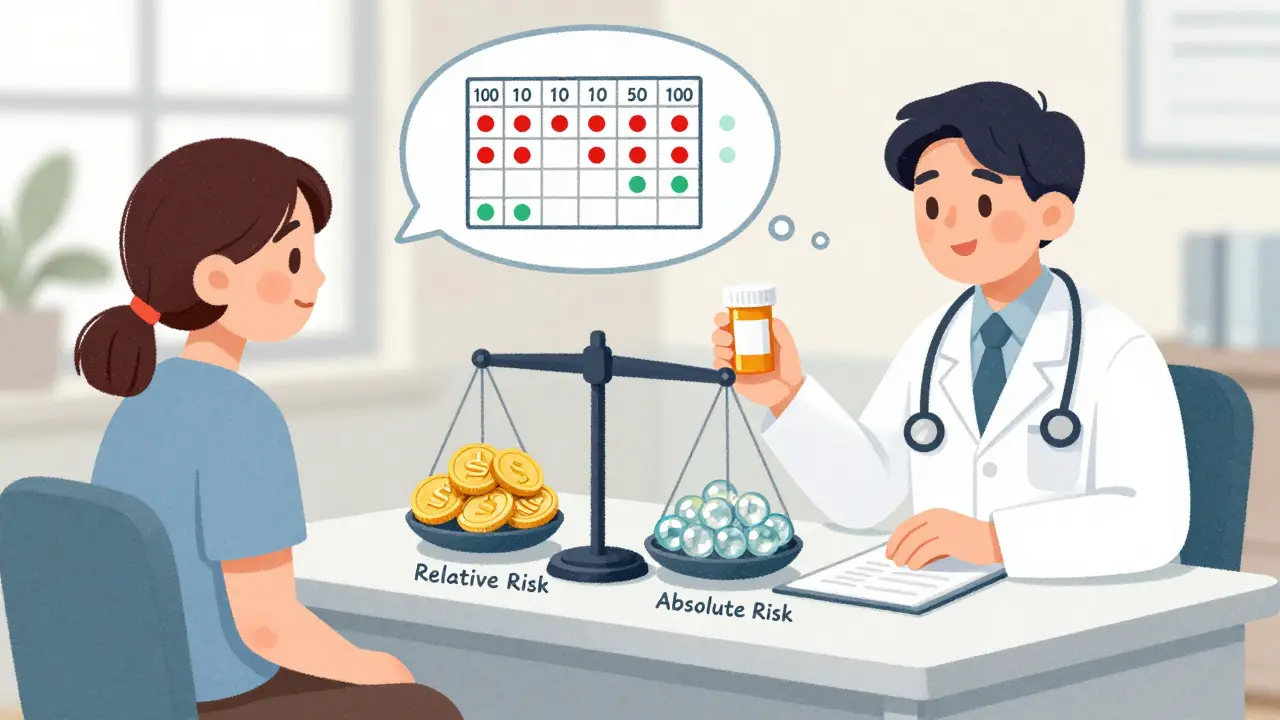
Here’s your checklist before you start a new medication:
- Ask your doctor: "What’s my baseline risk?" (e.g., "How likely am I to have a stroke without this drug?")
- Ask: "How much does this drug reduce that risk?" (They should give you a percentage point number, not just "50%.")
- Ask: "What’s the absolute increase in side effects?" (Not just "twice as likely.")
- Ask: "How many people need to take this for one person to benefit?" (That’s called Number Needed to Treat, or NNT. If it’s 50, that means 49 people get no benefit-and might still get side effects.)
And if you see a number like "reduces risk by 40%" without context? Don’t trust it. Demand the numbers behind it.
Why This Isn’t Just About Drugs
This isn’t just about statins or antidepressants. It’s about how we make decisions based on numbers. The same trick is used in nutrition ads ("Boosts immunity by 200%!"), insurance plans ("Save 50% on premiums!") and even fitness products ("Lose 70% more fat!").
When you learn to spot the difference between absolute and relative risk, you’re not just becoming a smarter patient. You’re becoming a smarter consumer. You stop being swayed by flashy percentages. You start asking: "What does this actually mean for me?"
Because in medicine, as in life, the biggest risks aren’t the ones that sound scary. They’re the ones no one tells you about.
What’s the difference between absolute risk and relative risk?
Absolute risk tells you the actual chance of something happening-like a 5% chance of nausea from a drug. Relative risk compares two groups: for example, saying the drug doubles your risk of nausea (from 2% to 4%). Absolute risk shows what happens. Relative risk makes the change sound bigger.
Why do drug ads use relative risk instead of absolute risk?
Relative risk numbers are usually larger and sound more impressive. A 50% reduction sounds better than a 1% reduction-even if both describe the same drug. Companies use it because it drives prescriptions. But it’s misleading without context.
Can a drug have a high relative risk reduction but little real benefit?
Yes. If your baseline risk is very low, even a large relative reduction might mean almost no real benefit. For example, reducing cancer risk from 0.01% to 0.005% is a 50% relative drop-but only a 0.005% absolute change. That’s not meaningful for most people.
What is Number Needed to Treat (NNT)?
NNT tells you how many people need to take a drug for one person to benefit. If the absolute risk reduction is 10%, the NNT is 10. If it’s 2%, the NNT is 50. A high NNT means most people won’t benefit-and may still get side effects.
How can I find absolute risk numbers for my medication?
Check the patient information leaflet that comes with your prescription. Look for phrases like "X out of 100 people experienced..." or "risk reduced from Y% to Z%." You can also ask your pharmacist or doctor directly. Reputable sites like the Cochrane Library or the TGA website also publish this data.



10 Comments
Charlotte Dacre February 13, 2026
So let me get this straight - a drug company says 'cuts risk in half!' and suddenly I'm supposed to be thrilled? Meanwhile, my actual risk went from 2% to 1%. That’s not a miracle, that’s a rounding error with a PR team. I swear, if I had a dollar for every time I was sold a '50% reduction' that meant nothing... I’d have enough to pay for the damn statin and still have change for coffee.
And don’t even get me started on ads that say 'boosts immunity by 200%' - like, cool, so now I’m twice as likely to sneeze? Thanks, Big Pharma.
Mike Hammer February 15, 2026
Honestly? I used to fall for this stuff too. Then I had a doctor who just sat me down and said, 'Look. You're 35, healthy, no family history. Your baseline risk of a heart attack in 10 years? 3%. This pill drops it to 2.4%. That’s a 0.6% drop. So if 1000 people like you take it, 6 people might avoid a heart attack. The other 994? They just got a pill that made them feel weird and gave them muscle pain.
That’s not scary. That’s just math. And if you’re not asking for the numbers behind the hype, you’re letting someone else decide what matters to you.
Erica Banatao Darilag February 15, 2026
I work in healthcare, and I still find myself confused sometimes. It’s not just patients - even seasoned nurses I work with will say things like, 'Oh, this drug cuts stroke risk by 60%!' and I have to gently ask, 'From what baseline?'
One elderly patient refused anticoagulants because she thought '60% reduction' meant she’d be 60% less likely to ever have a stroke. She didn’t realize her risk was 0.5% to begin with. That’s a drop to 0.2%. Not life-changing. Just... statistically meaningful. We need better education. Everywhere.
Kapil Verma February 16, 2026
This is why India is ahead of you Americans. We don’t get flashy ads. Our government forces pharma to show absolute risk. You think 1 in 100 people get side effects? Fine. Show me the number. Not some '50% reduction' nonsense. Here, we know what 1% means. You guys are too busy chasing dopamine hits from marketing slogans to understand your own body.
Stop being manipulated. Ask for the real number. Or don’t take the pill. Simple.
Betty Kirby February 18, 2026
I once took a supplement that claimed to 'increase energy by 300%' - turns out it was just caffeine. Same energy. Just more jitters. This isn’t a medical issue. It’s a psychological one. We crave transformation. We want the miracle. But medicine doesn’t work that way. It’s incremental. It’s quiet. It’s 1% here, 0.5% there. And the companies? They know that. They sell dreams. We buy them. And then we wonder why we’re still tired.
Sarah Barrett February 19, 2026
The most disturbing part? This isn’t just about drugs. It’s about how we process information in the digital age. We’ve been trained to respond to percentages, ratios, and headlines - not context, not nuance, not baseline data. A 50% reduction sounds urgent. A 0.8% absolute change? Boring. But the boring truth is what saves lives. We’ve outsourced critical thinking to ad agencies. And now we’re confused when our bodies react to the math we never learned.
Esha Pathak February 19, 2026
There’s a deeper layer here - one that’s rarely discussed. We don’t just misunderstand risk. We fear the unknown more than we fear the known. A 50% reduction sounds like control. A 1% absolute change feels like randomness. And so we cling to the illusion of power - even if it’s built on a lie. We’d rather believe we’re being saved by a number than accept that health is messy, probabilistic, and deeply personal. This isn’t about statistics. It’s about existential comfort.
Daniel Dover February 20, 2026
I just read the leaflet for my blood pressure med. It said: 'Reduces stroke risk from 2.4% to 1.9% over 5 years.' No fluff. Just numbers. I appreciated that. I wish more places did that. Simple. Clear. No drama.
Joe Grushkin February 21, 2026
You people are so obsessed with absolute risk you forget that relative risk tells you how effective the intervention is. If a drug cuts your risk from 0.0001% to 0.00005%, sure - the absolute difference is negligible. But the relative reduction is 50%. That means the drug works. Maybe not on you. But on someone. And if we stop using relative risk, we stop innovation. Progress is built on ratios, not raw numbers.
Chiruvella Pardha Krishna February 22, 2026
The real tragedy isn’t the misleading ads. It’s that we’ve stopped trusting our own intuition. We’ve been told to rely on experts, on data, on percentages - but we’ve lost the ability to ask: Does this feel right? Do I feel better? Am I healthier? Or am I just taking a pill because a graph made me feel safe? Numbers don’t live in your body. You do. Maybe the most important risk isn’t in the leaflet. It’s in your silence.