
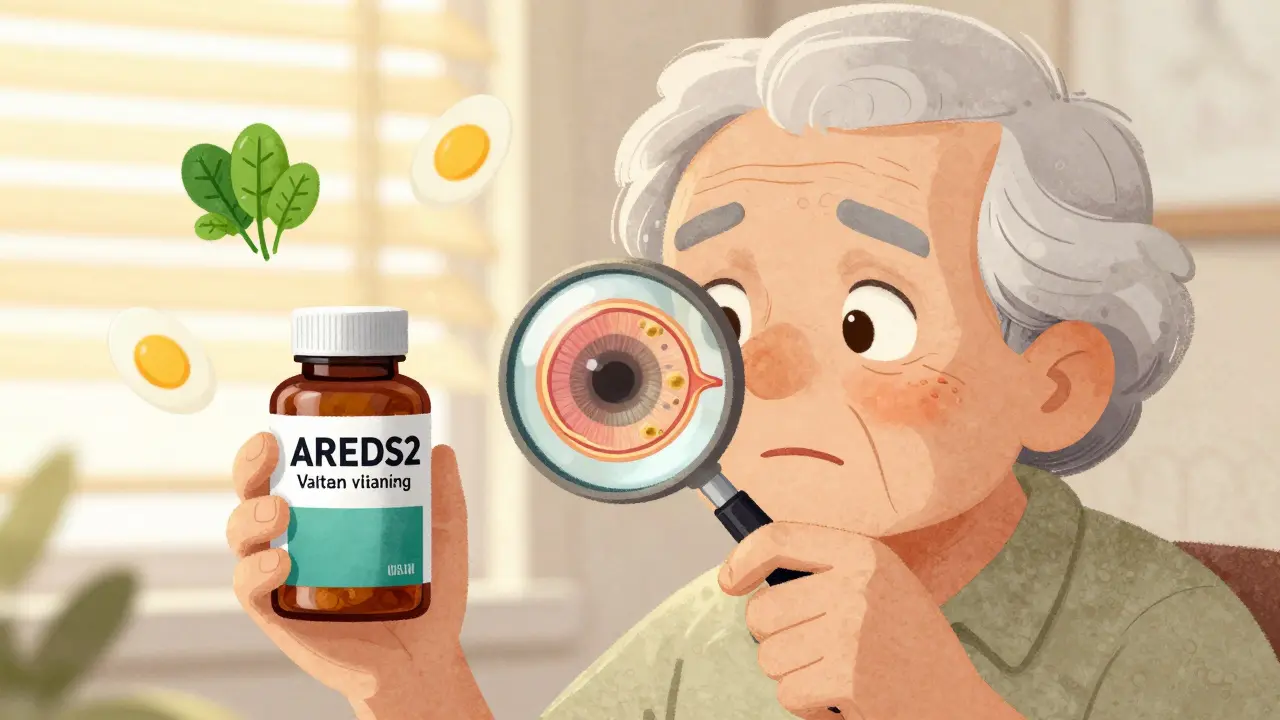
If you’ve been told you have age-related macular degeneration (AMD), you’ve probably heard about AREDS2 vitamins. But do they work? Who should take them? And can they stop your vision from getting worse? The answers aren’t simple, and taking them without knowing the facts could waste your money-or even put you at risk.
What Exactly Are AREDS2 Vitamins?
AREDS2 isn’t a brand name. It’s the name of a major clinical trial run by the National Eye Institute. The study looked at what combination of vitamins and minerals could slow down the progression of AMD, a leading cause of vision loss in people over 50. The original AREDS formula (from 2001) included high doses of vitamin C, vitamin E, beta carotene, zinc, and copper. But researchers later found beta carotene increased lung cancer risk in smokers and former smokers.
The AREDS2 study, which ended in 2013, replaced beta carotene with two nutrients found in leafy greens: lutein (10 mg) and zeaxanthin (2 mg). The final formula became the new standard:
- 500 mg vitamin C
- 400 IU vitamin E
- 10 mg lutein
- 2 mg zeaxanthin
- 80 mg zinc (as zinc oxide)
- 2 mg copper (as cupric oxide)
This isn’t your average multivitamin. These are high-dose, pharmaceutical-grade nutrients. You can’t get this much from food alone. And you shouldn’t take them unless your eye doctor says you need them.
Who Should Take AREDS2 Vitamins?
The answer is simple: only people with intermediate AMD or advanced AMD in one eye with intermediate AMD in the other.
Let’s break that down. AMD has stages:
- Early AMD: Small drusen (yellow deposits under the retina). No vision loss. No benefit from AREDS2.
- Intermediate AMD: Many medium-sized drusen or at least one large drusen. Some people notice mild blurring. This is where AREDS2 helps.
- Advanced AMD: Either geographic atrophy (dry AMD) or neovascular (wet AMD). Vision loss is significant.
If you have early AMD, taking AREDS2 won’t stop you from progressing. It won’t prevent AMD. It won’t improve your vision. A 2023 review from Vision-and-Eye-Health.com put it bluntly: “The AREDS2 formula does not offer benefits for individuals with early AMD, nor does it prevent the onset of the condition.”
And if you don’t have AMD at all? Don’t take it. There’s zero evidence it protects healthy eyes. People buy these supplements thinking they’re a shield against aging eyes. They’re not. They’re a targeted treatment for a specific stage of disease.
What Does the Evidence Actually Show?
The original AREDS formula reduced the risk of progression to late AMD by 25% over five years. The AREDS2 formula improved on that.
A 10-year follow-up published in JAMA Ophthalmology in May 2022 tracked 3,882 participants. Those who took lutein and zeaxanthin instead of beta carotene had a 26% lower risk of progressing to late-stage AMD. That’s not just a slight improvement-it’s a meaningful one. The hazard ratio was 0.88, meaning a statistically significant drop in risk.
And here’s something important: the benefits lasted. Even after 10 years, people who took lutein and zeaxanthin still showed lower progression rates. The formula didn’t just work in the short term-it held up over time.
Also, beta carotene was removed for good reason. Smokers and former smokers who took it had a 20% higher risk of lung cancer. That’s not a small trade-off. Replacing it with lutein and zeaxanthin eliminated that risk while making the formula more effective.
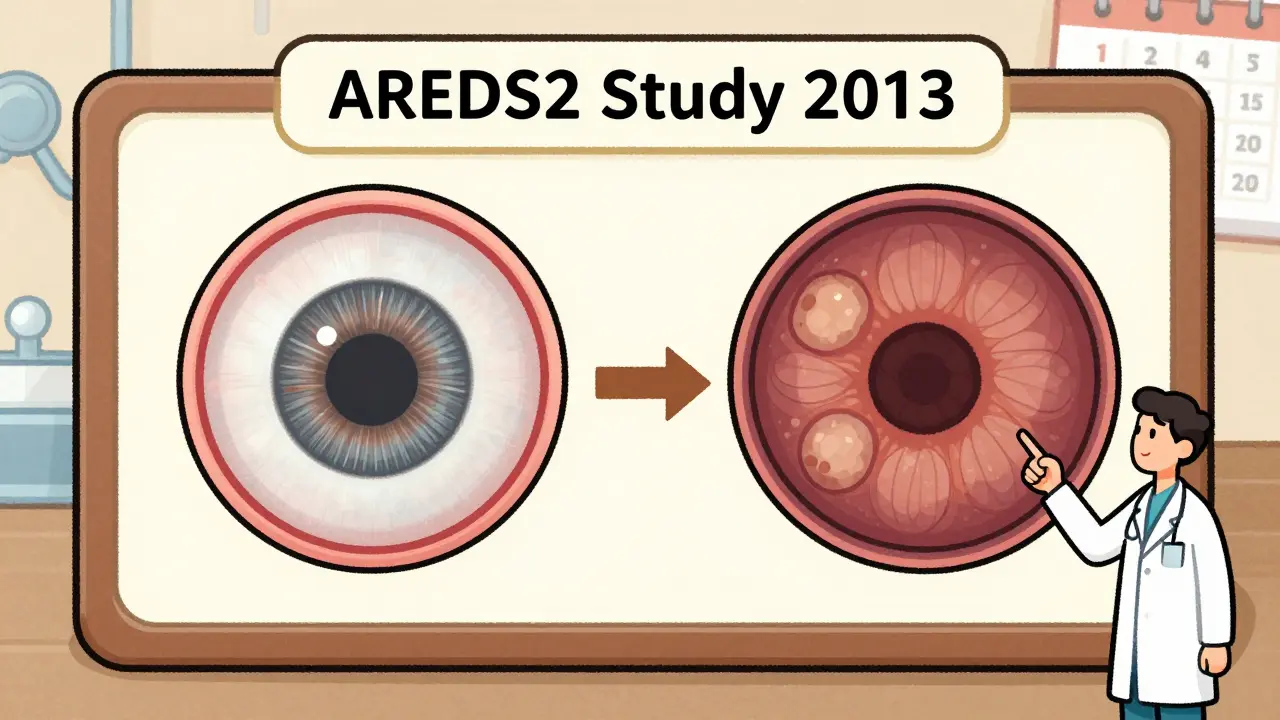
What About Late-Stage AMD? New Findings in 2024
For years, experts said AREDS2 didn’t help people with advanced geographic atrophy-the late, dry form of AMD where the macula has already started to die off. But a July 2024 study from the National Eye Institute changed that.
Researchers looked at retinal scans from 1,209 people in the original AREDS2 trial. They found that those taking the supplement had a 55% slower rate of geographic atrophy growth over three years-if the damaged area was outside the very center of the macula (the fovea).
This is huge. It means people with late-stage dry AMD might still benefit. Geraldine Hoad from the Macular Society called it “encouraging for people with GA.” The study didn’t say it restores vision. But slowing the spread of damage could mean staying independent longer-driving, reading, recognizing faces.
Still, this finding needs confirmation in a dedicated clinical trial. Right now, it’s strong observational data. But for the first time, there’s reason to believe AREDS2 might help even those with advanced disease.
What Doesn’t Work?
Many people assume if a little is good, more is better. That’s not true here.
Omega-3 fatty acids (fish oil) were tested in AREDS2. They provided no additional benefit. So don’t waste money on combo pills that include them.
B vitamins were also studied for prevention. They showed promise in early studies, but AREDS2 found no effect in slowing AMD progression.
Prevention? Nope. AREDS2 doesn’t prevent AMD from starting. It doesn’t help people with small drusen or no signs of the disease. If you’re healthy and take these vitamins hoping to “stay ahead,” you’re not protecting yourself-you’re just spending money.
Reversing damage? Absolutely not. Dr. Emily Chew, who led the 10-year study, is clear: “AREDS supplements cannot reverse vision damage that has already occurred.” They slow progression. They don’t fix what’s broken.
Are They Safe Long-Term?
Yes, but with caveats.
The 10-year follow-up found no major safety issues. People took these pills daily for over a decade without increased risk of serious side effects. Zinc can cause stomach upset in some. High doses may interfere with copper absorption, which is why copper is included.
But here’s the catch: high-dose zinc can interact with certain antibiotics and diuretics. If you’re on other medications, talk to your doctor. Also, avoid taking extra vitamin E or C supplements on top of AREDS2. You could hit toxic levels.
And if you’re a smoker? Never take a supplement with beta carotene. Ever. Stick to lutein and zeaxanthin only.

How to Take Them Right
Don’t just buy the cheapest bottle off Amazon. Look for brands that say “AREDS2 formula” on the label and list the exact dosages above. Some brands cut corners-using lower doses or wrong forms of nutrients.
Take them daily. Missing doses reduces effectiveness. Studies showed 90% of participants took them consistently during the trial. That’s what made the results so strong.
Always get your eyes checked annually. Your doctor needs to confirm your stage of AMD before prescribing these. If your condition changes, your treatment might need to change too.
What If You Can’t Swallow Pills?
Some brands offer chewable or liquid forms. But check the label. Many liquid versions don’t contain the full 80 mg of zinc. If you’re struggling with pills, talk to your eye doctor. They might know of a reputable brand with the right formulation.
And if you eat a lot of kale, spinach, broccoli, or eggs? You’re already getting lutein and zeaxanthin. But even the healthiest eaters can’t reach the 10 mg and 2 mg doses needed for therapeutic effect. Supplements are still necessary if you’re in the target group.
Final Reality Check
AREDS2 vitamins are not a miracle cure. They’re not a preventive. They’re not for everyone. But for the right person-someone with intermediate AMD or advanced AMD in one eye-they’re one of the few proven tools we have to protect vision.
Don’t take them because your friend does. Don’t take them because you’re scared of going blind. Take them only if your eye specialist confirms you’re in the right stage. And if you’re not? Save your money. Your eyes will thank you.


8 Comments
Ayush Pareek January 16, 2026
Been taking these for my intermediate AMD for two years now. My optometrist said my drusen haven’t grown since I started. Not magic, but it’s something. Don’t take them if you don’t need ‘em, but if your doc says yes, just do it.
Diane Hendriks January 16, 2026
Let me be perfectly clear: if you’re not diagnosed with intermediate or advanced AMD, you are wasting your money and potentially poisoning yourself with excessive zinc. The FDA doesn’t regulate supplements like pharmaceuticals, and yet people treat them like vitamins from God. This isn’t wellness culture-it’s evidence-based medicine. Stop the pseudoscience.
Annie Choi January 17, 2026
OMG I just found out my grandma’s been taking these for 5 years and her vision’s still sharp as a tack-she reads the newspaper without glasses! I’m getting my eyes checked this week and if I qualify, I’m buying the whole box. Lutein and zeaxanthin = nature’s armor 💪
Arjun Seth January 17, 2026
Everyone’s buying these like they’re holy water. You think a pill can stop aging? Pathetic. You think you can outsmart biology with a bottle from Amazon? The truth is, you’re just scared of going blind-and so you chase quick fixes. Real health is in diet, walking, not staring at screens. These vitamins? A scam for the gullible.
Dan Mack January 18, 2026
Wait… so the government funded this study… and now Big Pharma is pushing these pills? Who owns the National Eye Institute? Who profits? And why did they remove beta carotene right after the lung cancer link? Coincidence? I don’t think so. This smells like a controlled rollout to replace a dangerous ingredient with a more profitable one. Lutein? Patentable. Beta carotene? Not. Think deeper.
Amy Vickberg January 18, 2026
Arjun, I get your skepticism-but the data’s real. I work in ophthalmology. People with intermediate AMD who take this have measurable, statistically significant slower progression. It’s not a cure, but it’s one of the few tools we have that actually works. Don’t dismiss science because it’s inconvenient. And Annie, your grandma’s story is exactly why this matters.
Nishant Garg January 20, 2026
Back in Delhi, my uncle took these after his diagnosis-his doctor told him to avoid the cheap stuff. He switched from some $12 bottle on Flipkart to a brand that actually lists the exact dosages: 500mg C, 400 IU E, 10mg lutein, 2mg zeaxanthin, 80mg zinc, 2mg copper. He says his vision’s stable. I’ve seen people buy ‘AREDS2’ labeled bottles with half the zinc. That’s like calling water ‘Gatorade’ and expecting the electrolytes. Don’t be fooled by labels. Ask your doc for the exact formula. And yes, kale helps-but you’d need to eat two pounds a day to match the dose. Supplements aren’t evil. Ignorance is.
Nicholas Urmaza January 21, 2026
Take it daily. No exceptions. Miss a day and you’re not getting the full benefit. Consistency is everything. And if you’re on blood thinners or antibiotics, talk to your pharmacist. This isn’t a supplement you pop with your morning coffee. It’s a medical intervention. Treat it like one.