
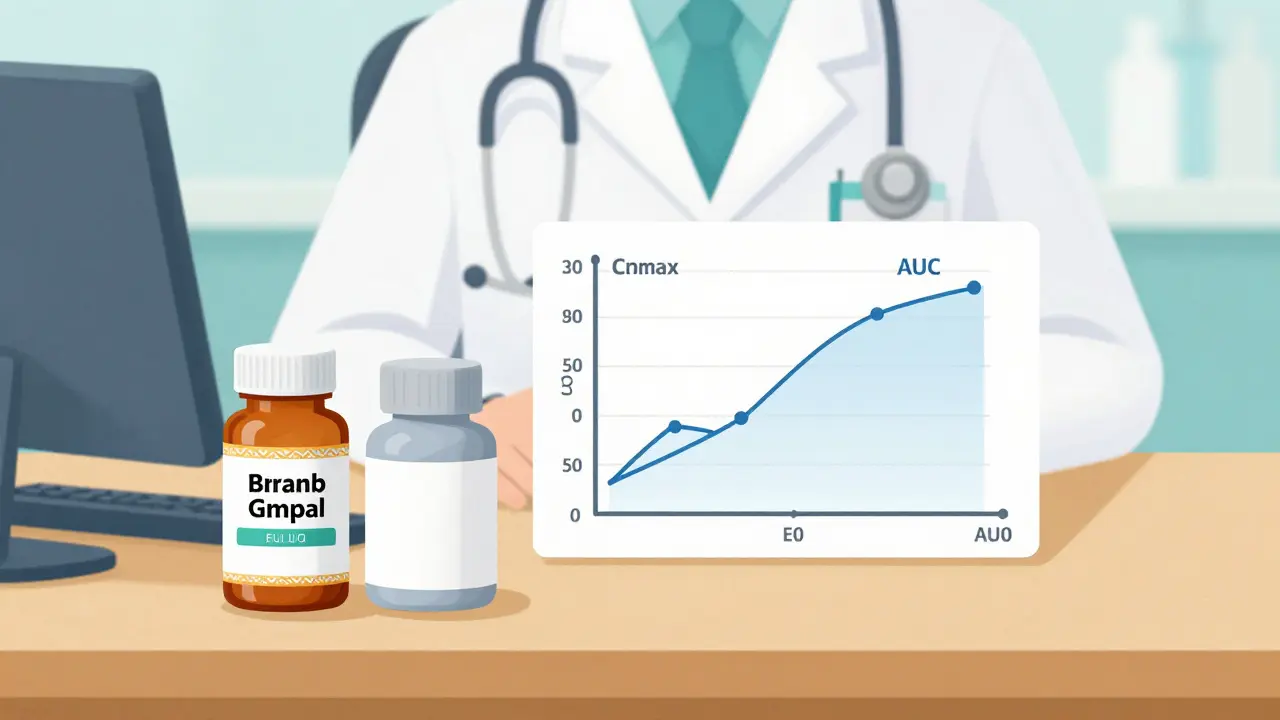
Switching a patient from a brand-name drug to a generic version often seems like a simple cost-saving move. But for healthcare providers, it can be a complex decision. While most transitions are seamless, there are specific clinical scenarios where a switch can lead to breakthrough symptoms or treatment failure. Understanding the gap between regulatory bioequivalence and real-world patient experience is the key to maintaining high standards of care while reducing costs.
The Standard of Equivalence
To understand why providers trust generics, we have to look at how they are approved. Generic medications is a category of pharmaceutical products that contain the same active ingredients as brand-name drugs but are sold at lower costs after patent expiration. For a generic to hit the market, the FDA is the U.S. government agency responsible for protecting public health by ensuring the safety and efficacy of medications requires proof of bioequivalence. This means the generic must deliver the same amount of active ingredient into the bloodstream within the same timeframe as the original.
Technically, this is measured through pharmacokinetic studies focusing on Cmax (the peak concentration of the drug) and AUC (the total drug exposure over time). The FDA allows a range of 80-125% bioequivalence. For most patients, this slight variance is clinically irrelevant. In fact, generics now make up about 90% of all prescriptions in the US, but they only account for 23% of total spending. That's a massive win for healthcare affordability.
When Substitution Works Seamlessly
For the vast majority of therapeutic areas, the switch is invisible. Providers frequently report zero clinical difference when substituting common medications like statins or ACE inhibitors. A Medicaid analysis showed that if we stopped requiring patient consent for substitutions of drugs like atorvastatin or clopidogrel, the system could have saved over $100 million in a single year. In these cases, the only real "risk" is the patient's psychological reaction to a different pill color or shape.
Even Authorized Generics is brand-name drugs sold without the brand name, often by the original innovator company perform similarly to regular generics. A study in JAMA Internal Medicine looked at cardiovascular and psychiatric drugs and found no significant difference in all-cause hospitalization or medication discontinuation rates between those using authorized generics and regular generics. Essentially, if the drug is a simple molecule and the patient is stable, the generic is almost always the right call.
| Category | Substitution Risk | Common Examples | Provider Approach |
|---|---|---|---|
| Standard Generics | Low | Statins, ACE Inhibitors | Automatic substitution |
| Narrow Therapeutic Index | High | Warfarin, Levothyroxine | Strict monitoring; avoid switches |
| Complex Generics | Moderate | Inhalers, Topical creams | Verify delivery mechanism |
| Antiepileptics | High | Lamotrigine, Phenytoin | "Dispense as Written" (DAW) |
The Danger Zone: Narrow Therapeutic Index Drugs
Not all drugs are created equal. Some medications have a "narrow therapeutic index," meaning the difference between a dose that works and a dose that is toxic (or ineffective) is very small. For these, a 10% difference in absorption can be the difference between a healthy patient and a medical emergency.
Providers are especially cautious with immunosuppressants for organ transplant recipients and anticoagulants like warfarin. A small shift in the plasma concentration can lead to organ rejection or internal bleeding. This is why you'll often see providers check the Orange Book is the FDA's official publication that lists all approved drug products and their therapeutic equivalence ratings . They look for an "AB" rating, which signifies that the product is therapeutically equivalent to the reference listed drug. If a drug is rated "BX," it means the FDA doesn't consider it interchangeable, and switching could be dangerous.
Case Study: The Epilepsy Challenge
Epilepsy provides a sobering example of where generic substitution can go wrong. The American College of Neurology warns against mandatory substitution of antiepileptic drugs (AEDs) without physician approval. There are documented cases where patients, previously stable on a brand-name version of lamotrigine, experienced breakthrough seizures after switching to a generic version.
In these case series, the seizures returned even though the generic was "bioequivalent" by FDA standards. Interestingly, most of these patients regained seizure control only after being switched back to the brand name. This suggests that for some patients, the inactive ingredients (excipients) or the specific release profile of the brand drug are critical to their stability. For these patients, providers use the "Dispense as Written" (DAW) instruction on prescriptions to block automatic pharmacy substitution.
The Regulatory Response to Failure
What happens when a generic fails in the real world? The FDA doesn't just ignore it. A notable example is the investigation into generics for Concerta. After receiving a high volume of "lack of effect" complaints, the FDA launched a multi-disciplinary review. They analyzed adverse events, lab data, and expert testimony. The result? The therapeutic equivalence ratings for two specific generic versions were downgraded from AB to BX. This means they were no longer considered interchangeable, protecting future patients from an ineffective version of the medication.
Bridging the Patient-Provider Gap
One of the biggest hurdles isn't the chemistry-it's the psychology. Many patients believe generics are "lower quality" simply because they are cheaper. However, data shows that when physicians actively recommend a generic, 66% of patients are willing to switch. This is significantly more than those who only receive a recommendation from a pharmacist (13.5%).
Interestingly, cost isn't always the driver. While lower out-of-pocket costs actually increase adherence by about 13%, some patients get confused when their pharmacy switches between different generic manufacturers. One month the pill is white and round; the next it's yellow and oval. Without a conversation with their provider, patients may think they've been given the wrong medication and stop taking it altogether.
Looking Ahead: AI and Biosimilars
The landscape is shifting toward Biosimilars is biologic medications that are highly similar to an approved biological product, though not exact copies . Because biologics are grown in living cells rather than chemically synthesized, they are much harder to copy. This requires a different regulatory approach than the traditional Hatch-Waxman framework used for small-molecule generics.
We are also seeing the rise of machine learning to predict which patients might react poorly to a generic switch. Recent studies have used Random Forest models to identify predictors for generic acceptance and efficacy. By combining these AI insights with real-world evidence from the FDA's Sentinel Initiative, providers will eventually be able to move from a "one size fits all" substitution model to a personalized approach.
What is the difference between a generic drug and an authorized generic?
A regular generic is made by a third-party company after a patent expires. An authorized generic is the exact same brand-name drug, but the original manufacturer sells it without the brand name, often to compete with other generic versions entering the market.
Why do some doctors insist on "Dispense as Written" (DAW)?
Providers use DAW for drugs with a narrow therapeutic index (like certain seizure or thyroid meds) where a small difference in absorption can cause a relapse or toxicity. They do this to prevent the pharmacy from automatically switching the patient to a generic that might not be as stable for that specific individual.
Does an "AB" rating in the Orange Book guarantee the drug is identical?
It guarantees bioequivalence within the 80-125% range of the brand name, meaning it delivers the active ingredient similarly. It does not mean the inactive ingredients (fillers, dyes) are identical, which is why a tiny fraction of patients may react differently to different generics.
Are generic medications generally less effective than brand names?
No. For the overwhelming majority of medications, generics provide the same clinical benefit. Large-scale studies on cardiovascular and psychiatric medications have shown no significant difference in outcomes between brand and generic users.
How can I tell if a generic switch is causing my symptoms to return?
Keep a log of any new or returning symptoms immediately after a pharmacy changes the manufacturer of your generic. If you notice a change in pill appearance followed by a dip in efficacy, contact your provider to discuss whether a specific brand or authorized generic is necessary.






12 Comments
Darius Prorok April 6, 2026
Everyone knows the FDA's 80-125% range is basically a huge loophole for pharma companies to save a buck while we deal with the side effects. It's common knowledge that the fillers in generics are often garbage compared to the brand name stuff.
Grace Lottering April 8, 2026
Big Pharma controls the Orange Book. They decide who gets an AB rating to keep us dependent on specific corporate labs. Wake up!
Christopher Cooper April 9, 2026
It is fascinating how the inactive ingredients can play such a pivotal role in patient stability, especially in neurology. I wonder if we will eventually see a standard where excipients are also regulated for bioequivalence to prevent those breakthrough seizures mentioned. This would be a huge step forward for patient safety and overall quality of life. It makes total sense that a patient's body might react differently to a dye or a filler even if the active molecule is identical. We should really be pushing for more transparency in how these generic formulas are constructed so providers can make more informed choices. It's about time we treat the whole pill as the medicine, not just the active ingredient. Let's keep advocating for better standards!
Jitesh Mohun April 10, 2026
stop trusting the system blindly if you want to stay healthy just look at the data yourself and dont let some pharmacy tech tell you it's the same thing when the pill color changed
Jay Vernon April 10, 2026
Totally agree with keeping a log of symptoms! 📝 It helps so much when talking to the doc 🩺✨
Windy Phillips April 11, 2026
Imagine actually thinking a 25% variance is "clinically irrelevant"... how quaint... Some of us actually care about precision in our healthcare... but I suppose that's too much to ask from the current system...
Alexander Idle April 11, 2026
This whole thing is just a nightmare. Imagine the absolute chaos of having a seizure because some corporate suit wanted to save two cents on a pill. Absolute tragedy. I can't even deal with the stress of thinking about it. Just a complete disaster for the patients involved.
shelley wales April 12, 2026
It's so important to feel supported during these medication changes. If anyone is feeling anxious about switching, just know that your provider is there to help you navigate this. You aren't alone in this process.
Nathan Kreider April 13, 2026
That's a really nice way to put it. We just need to be patient and work together with our doctors to find what works best for each person.
Rupert McKelvie April 15, 2026
The shift toward biosimilars sounds like a very positive development for the future of medicine. It will likely open up a lot of life-saving treatments to people who can't afford the brand names right now.
Sarabjeet Singh April 17, 2026
Good points here.
Ruth Swansburg April 19, 2026
We must advocate for better patient education. This is vital.