
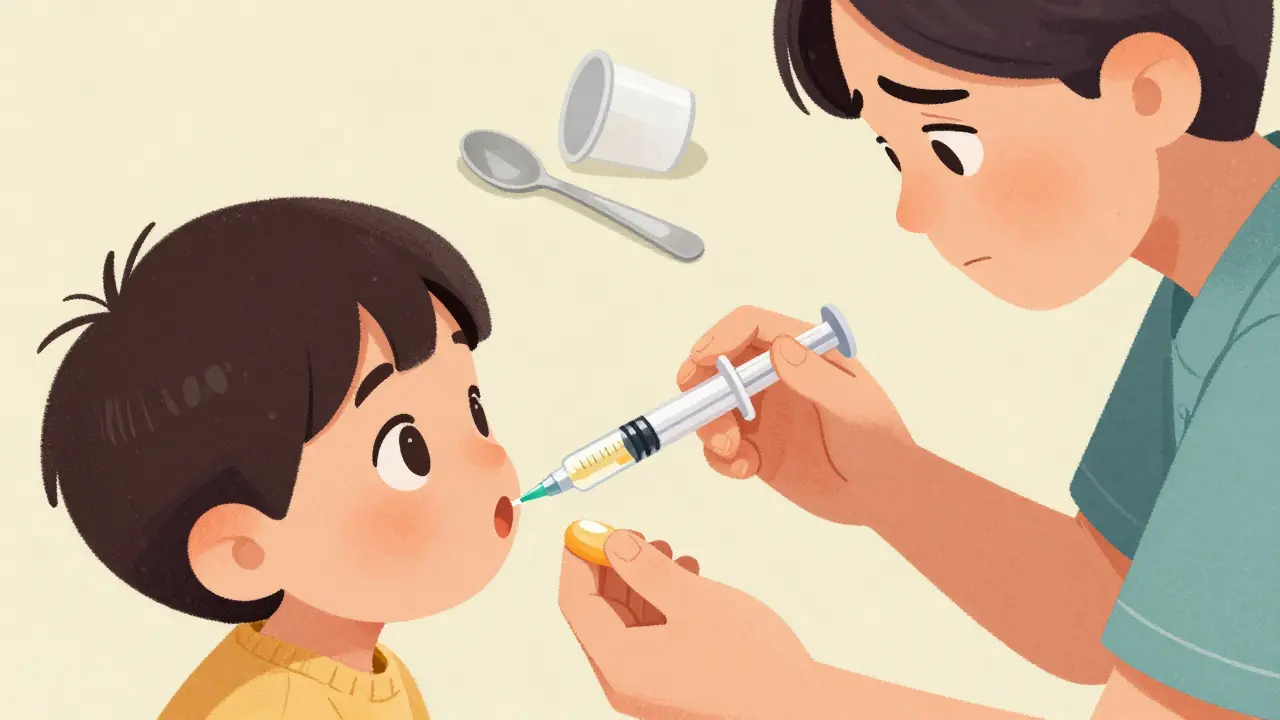
Getting the right dose of liquid medicine isn’t just important-it can be life or death. A 2023 study in the Journal of Pediatrics found that 80% of pediatric home medication errors involve wrong doses of liquid drugs. That’s not a small risk. It’s the leading cause of preventable harm in kids’ homes. And it’s not just parents making mistakes. Even in hospitals, nurses and pharmacists misread measurements, grab the wrong bottle, or assume a household spoon is fine. The truth? Most of these errors are avoidable. You don’t need fancy tech or a medical degree to stop them. You just need the right tools, clear habits, and a little awareness.
Stop Using Kitchen Spoons-Ever
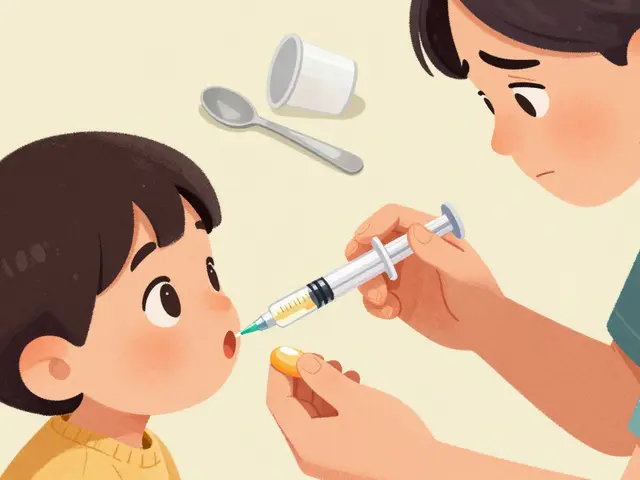
You’ve probably heard it before: “Just use a teaspoon.” But a kitchen teaspoon isn’t a teaspoon. It holds anywhere from 3 to 7 milliliters. A standard dosing teaspoon? Exactly 5 mL. That’s a 40% difference. And when you’re giving a child 10 mL of amoxicillin, using a kitchen spoon could mean giving them 14 mL instead. That’s not a mistake-it’s an overdose. A 2022 NIH study showed household spoons are only 62% accurate for measuring liquid meds. That means more than half the time, you’re giving the wrong amount.There’s no excuse anymore. Every time a liquid medication is prescribed for a child, an oral syringe should be included. Not a cup. Not a spoon. A syringe with clear mL markings. Oral syringes with 0.1 mL graduations for doses under 1 mL and 0.5 mL for doses between 1 and 5 mL cut error rates by 37% compared to dosing cups, according to a Yale study. And they’re cheap-under a dollar each. If your pharmacy doesn’t give you one, ask. If they say no, go elsewhere. Your child’s safety isn’t optional.
Milliliters Only-No Teaspoons, Tablespoons, or Drops
The biggest single fix? Eliminating non-metric units from prescriptions. The World Health Organization says this one change alone prevents 33% of all liquid medication errors. Why? Because “teaspoon” means different things to different people. A tablespoon? Even worse. Some people use a soup spoon. Others use a coffee spoon. The result? Chaos.Since 2015, the American Academy of Pediatrics has required all pediatric prescriptions to use only milliliters (mL). But many pharmacies still print “1 tsp” on labels because it’s easier. Don’t accept it. If you see “teaspoon” or “tbsp” on the label, call the pharmacy. Demand a corrected label with mL only. If they refuse, report it. The American Society of Health-System Pharmacists (ASHP) made this mandatory in 2023. You have a right to a label that says “5 mL,” not “1 tsp.”
Use Oral Syringes-Not Dosing Cups
Dosing cups look convenient. They’re easy to hold. But they’re terrible at accuracy. A 2021 study in Academic Emergency Medicine found that for doses under 5 mL, dosing cups had a 41.1% error rate. Oral syringes? Just 8.2%. That’s more than five times more accurate.Why? Cups have curved sides. You have to bend down to read the level. Your eye has to be perfectly level with the mark. If you’re tired, stressed, or in a dim room, you’ll misread it. Syringes? You hold them up. The plunger gives you a flat, clear line. You can see exactly where the liquid ends. And if you’re giving a tiny dose-like 0.5 mL-you can draw it up slowly and precisely. Dosing cups can’t do that.
Use the syringe that comes with the medicine. If you lose it, buy a new one. Most pharmacies sell them for under $1. Look for ones labeled “oral use only” and with clearly printed mL markings. Don’t reuse syringes meant for other purposes. Needle syringes are dangerous and inaccurate for oral use.
Check the Label Twice-Before and After
One of the most common errors? Grabbing the wrong bottle. Liquid medications often look alike. Amoxicillin and cefdinir? Both pink. Azithromycin and ibuprofen? Both sweet-smelling, both in similar plastic bottles. The Institute for Healthcare Improvement found that 49% of medication errors in hospitals involved look-alike packaging.Always check three things before giving any liquid medicine:
- Name-Is it the right drug? Not just the brand, but the generic too.
- Dose-Does it say 5 mL? Not 5 tsp? Not 10 mL?
- Frequency-Is it every 6 hours? Every 8? Once a day?
Do this even if you’ve given the same medicine before. Doses change. Weight changes. A 20-pound child last month might be 25 pounds now. That changes the dose. Always double-check the label against the prescription. If you’re unsure, call the pharmacy. Don’t guess.
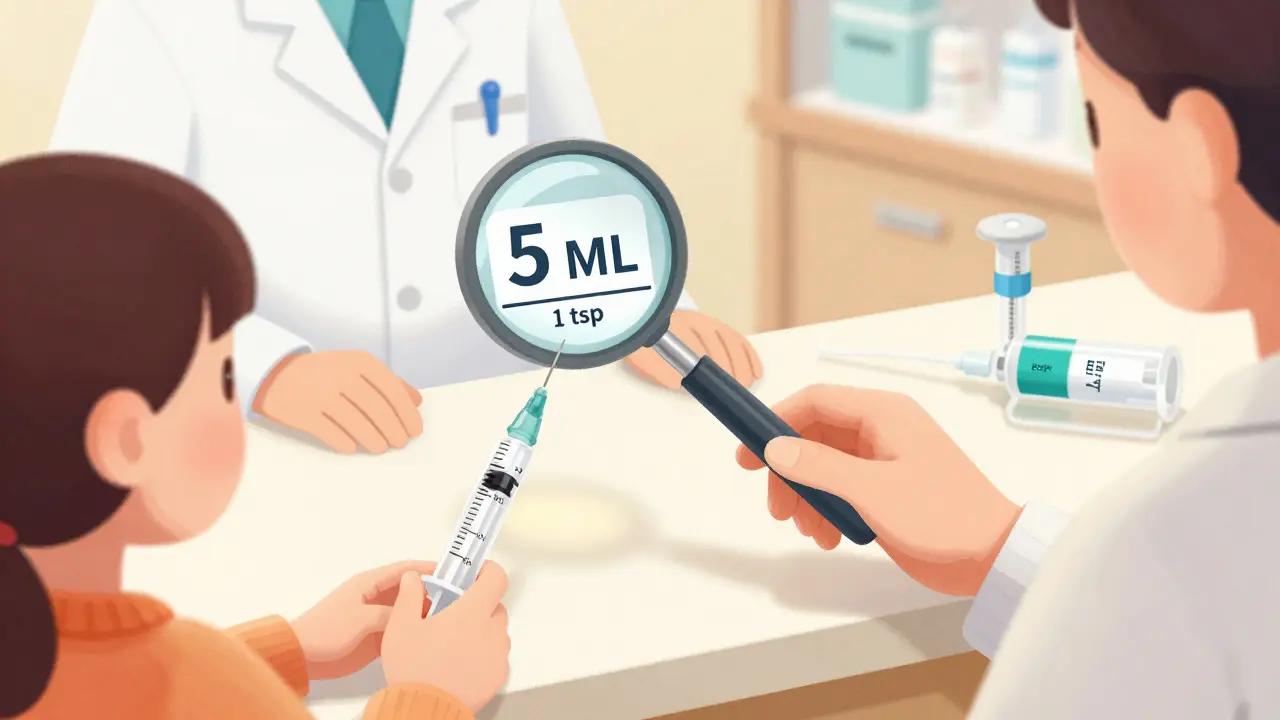
Ask for Pre-Measured Doses
If you’re giving medicine multiple times a day, ask your pharmacist if they can pre-measure each dose into a small, labeled cup or syringe. Many pharmacies now offer this service for free or for a small fee. In surveys, 94% of caregivers who received pre-measured doses said they felt more confident and made fewer mistakes.This is especially helpful for night doses, when you’re half-asleep. Instead of fumbling with a syringe in the dark, you just grab the pre-filled syringe and give it. No measuring. No math. No guesswork.
Some hospitals and clinics even use barcode systems that scan the medication and the child’s wristband before giving the dose. That’s not something you can do at home-but you can ask your doctor if your pharmacy offers pre-measured doses. It’s a simple fix with huge results.
Know the ENFit System-Even If You’re Not in a Hospital
ENFit is a connector standard designed to stop liquid medicine from being accidentally given through IV lines. Sounds far-fetched? It’s not. In 2022, a child in Ohio died after a feeding tube solution was given through an IV. That’s how wrong-route errors happen.Since 2016, hospitals have been required to use ENFit connectors for all enteral (tube-fed) liquids. These connectors are shaped differently from IV ones. They physically won’t fit. That’s why ENFit has reduced wrong-route errors by 98% in hospitals that use it.
While ENFit doesn’t affect oral liquid meds, it’s part of a bigger shift: the healthcare system is finally taking liquid medication safety seriously. If your child gets medicine through a feeding tube, make sure the syringe and tube are ENFit-compatible. If you’re unsure, ask the nurse or pharmacist. This isn’t just for hospitals-it’s for home care too.
Use Technology When You Can
Electronic health records (EHRs) with built-in dose calculators are a game-changer. If your child’s doctor uses one, they can type in the child’s weight and the system automatically suggests the right dose. A 2023 Cochrane Review found these systems reduce pediatric liquid errors by 58%.At home, you can use free apps like Medisafe or MyTherapy to set reminders and log doses. Some apps even let you scan the bottle’s barcode to confirm the dose. If you’re tech-savvy, try them. Even just setting a phone alarm for each dose cuts errors by 30%.
Look for apps that let you input weight and show you the correct mL based on the prescription. Don’t rely on memory. Don’t write it on a sticky note. Use a tool that does the math for you.

Teach Everyone Who Gives Medicine
Grandma? Babysitter? Older sibling? Anyone who gives the medicine needs to know how to measure it. Don’t assume they know. Show them. Let them practice with water first. Use a syringe. Show them how to read the mL line. Ask them to repeat the instructions back to you.One study found that when caregivers were given a 15-minute training session with a pharmacist, wrong-dose errors dropped by 52%. That’s not magic. That’s clarity. You don’t need to be a nurse to teach someone how to use a syringe. You just need to take five minutes.
What to Do If You Make a Mistake
If you realize you gave the wrong dose, don’t panic. Don’t wait. Call your pediatrician or pharmacist right away. Even if you think it’s “just a little too much,” get advice. Some meds are safe in small overdoses. Others can cause serious harm.Keep the medicine bottle and the measuring device you used. That helps the doctor figure out what happened. Write down:
- What medicine was given
- How much you thought you gave
- How much you actually gave
- When you gave it
- Any symptoms your child shows
Don’t feel guilty. Mistakes happen. What matters is what you do next. Getting help fast can prevent a bad outcome.
Bottom Line: Simple Steps, Big Results
Wrong-dose errors with liquid medications aren’t inevitable. They’re preventable. Here’s what you need to do:- Always use an oral syringe-never a spoon or cup
- Only measure in mL-no teaspoons or tablespoons
- Check the label every time-name, dose, frequency
- Ask for pre-measured doses if you give medicine often
- Teach everyone who gives medicine how to use a syringe
- Use apps or reminders to track doses
If you do these things, you’re doing more than 90% of families. You’re keeping your child safe. And you’re part of the solution to a problem that sends thousands of kids to the ER every year.
Medicine shouldn’t be a guessing game. With the right tools and habits, it doesn’t have to be.


13 Comments
Gregory Clayton January 9, 2026
OMG I can't believe people still use kitchen spoons. My cousin gave her kid 14mL of amoxicillin with a soup spoon and he ended up in the ER. Like... we live in 2024. There's a $0.99 syringe at every pharmacy. Stop being lazy. Your kid's life isn't a game.
Micheal Murdoch January 9, 2026
It’s wild how such a simple thing-measuring medicine-has become this complex safety issue. We’ve built rockets and AI, but we still can’t get a teaspoon right? The real problem isn’t the tools, it’s the assumption that everyone knows how to use them. We need to treat medication safety like fire safety: taught early, reinforced often, and never assumed. A syringe isn’t medical equipment-it’s parenting equipment. And if your pharmacy won’t give you one, you’re being failed by the system.
Matthew Maxwell January 10, 2026
It is utterly unacceptable that pharmacists still print 'tsp' on labels. This is not a matter of convenience-it is negligence. The American Academy of Pediatrics mandated mL-only labeling in 2015. The ASHP reinforced it in 2023. If you are still seeing non-metric units on your child's prescription, you are being deliberately misled. File a complaint with your state board of pharmacy. This is not a suggestion. It is a legal and ethical obligation.
Jeffrey Hu January 10, 2026
Yeah, syringes are better, but let’s be real-most parents don’t have time to fumble with a syringe at 3 a.m. with a screaming kid. Dosing cups are easier. And honestly? Most kids don’t die from a 1mL error. You’re acting like every mistake is a death sentence. Chill. Use a syringe if you want. But don’t shame people for using what works for them.
Catherine Scutt January 11, 2026
I used to use the dosing cup until my daughter choked on a sip. Now I use a syringe. No more cups. Ever. And I make sure my mom knows how to use it too. She’s not tech-savvy but she can pull a plunger.
Jacob Paterson January 12, 2026
Oh wow, another 'you're killing your kid' lecture. Let me guess-you also check the expiration date on your baby wipes and sterilize the sippy cup with UV light? Newsflash: kids have survived for centuries without oral syringes. Maybe the real problem is you’re too scared to parent. Relax. Your kid isn’t a lab rat.
Johanna Baxter January 13, 2026
I gave my son 10mL with a spoon once and he threw up for 3 hours… I cried for 2 days. I felt like the worst mom. Then I found out 80% of parents do this. I’m not alone. But I still feel guilty. I got the syringe now. I keep it next to his toothbrush. I’m not letting go.
Patty Walters January 14, 2026
pro tip: if you lose the syringe, go to a diabetes supply store-they sell those tiny insulin syringes for like $2. they’re perfect for 0.5ml doses. just make sure theyre not needle ones. i used to use the wrong ones and scared the hell out of my kid. now i label them 'baby med' with tape.
Phil Kemling January 15, 2026
It’s ironic that we’ve engineered precision into every aspect of modern life-phones, cars, even our coffee machines-but when it comes to our children’s medicine, we still trust guesswork. Why? Because we’ve normalized fear as routine. We don’t question the spoon because we’re too tired to care. But safety isn’t a luxury. It’s the baseline. The syringe isn’t the solution-it’s the minimum. What we really need is a culture that doesn’t wait for a tragedy to change its habits.
Jenci Spradlin January 16, 2026
pre-measured doses are a game changer. my pharmacist does it for free now. i just grab and go. no math, no stress. even my husband who hates anything medical can do it. he’s the one who forgets the syringe. but he never forgets the pre-filled one. lifesaver.
Maggie Noe January 17, 2026
ENFit for feeding tubes? YES. But what about the other 99% of meds? Why isn’t there a universal child-safe cap or color-coded syringes? 🤔 We fix the easy stuff. But the real problem? Systems that assume parents are doctors. We need better design, not just better habits. 💡❤️
Meghan Hammack January 18, 2026
My 5-year-old used to spit out medicine like it was poison. Then I started mixing it with applesauce in the syringe. No more fights. No more crying. Just a quick squirt and a hug. It works. Don’t overthink it. Just do it.
Ian Long January 18, 2026
I get that people are scared of making mistakes. But let’s not turn this into a moral panic. The real issue isn’t the spoon-it’s the lack of access. Not everyone can walk into a pharmacy and ask for a syringe. Some don’t have insurance. Some live in rural areas. Some are single parents working two jobs. We need policy changes-not just personal responsibility. A syringe shouldn’t be a privilege. It should be standard. Like seatbelts. Like smoke detectors.