
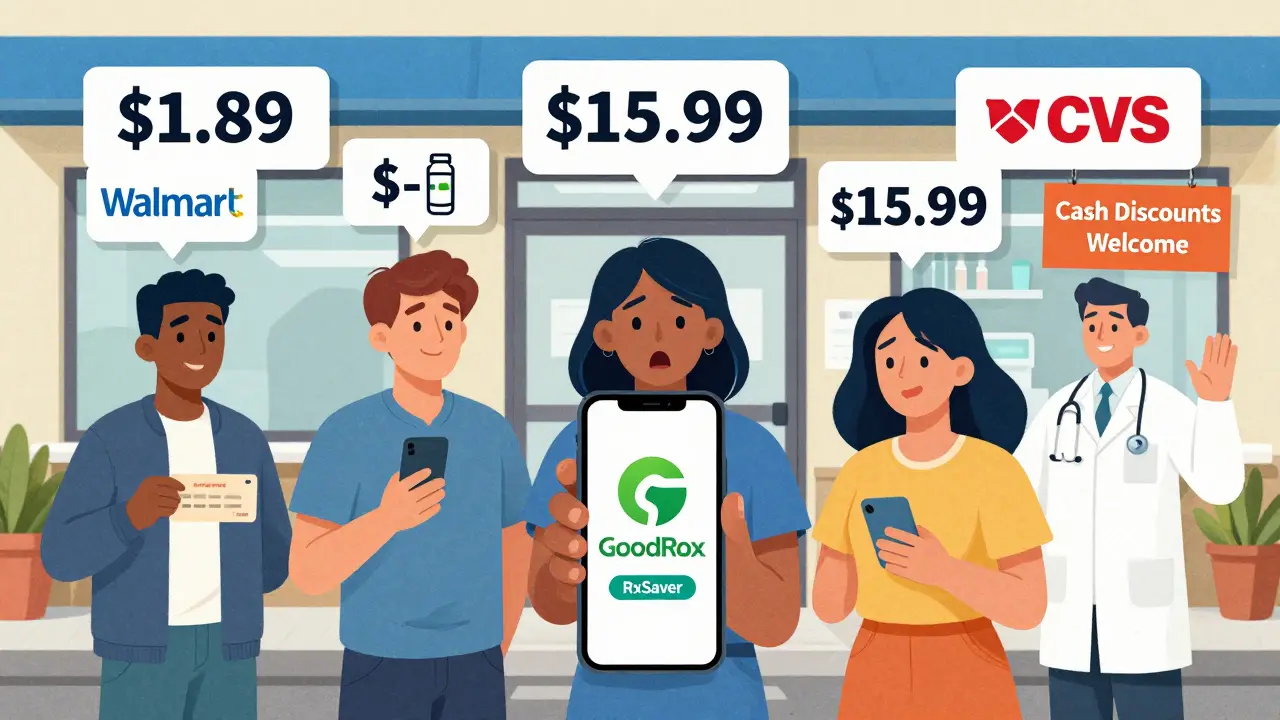
Every year, millions of Americans pay far more than they need to for prescription drugs-sometimes double or triple the price-because they never check what another pharmacy charges. It’s not about insurance. It’s not about coupons. It’s about cash price shopping. If you’re paying out of pocket, whether you’re uninsured, on a high-deductible plan, or just tired of insurance co-pays, knowing where to find the lowest cash price can save you hundreds-or even thousands-of dollars a year.
Why Cash Prices Vary So Much
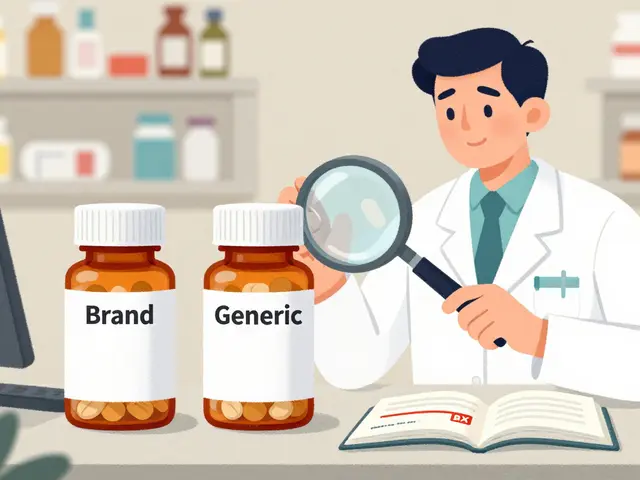
You might think a pill costs the same no matter where you buy it. That’s not true. A 30-day supply of metformin, a common diabetes medication, can cost $1.89 at one pharmacy and $15.99 at another-just down the street. The same goes for atorvastatin (generic Lipitor), which has been found to range from $4.50 to $140 in the same ZIP code. These aren’t outliers. They’re the norm. Why? Because pharmaceutical pricing isn’t set by law. It’s set by negotiation. Manufacturers give different discounts to different pharmacies based on volume, location, and bargaining power. Big chains like CVS and Walgreens often charge more because they have higher overhead and less incentive to compete on price. Independent pharmacies, supermarkets, and mass merchandisers like Costco or Walmart often have lower prices because they use prescriptions as a loss leader to bring in customers. Even worse, pharmacies don’t always tell you the truth upfront. If you walk in and say, “I’m using insurance,” they’ll quote you the insurance rate-which might be higher than the cash price. Always ask: “What’s your cash price for this?” before mentioning insurance.The Best Tools to Compare Prices
You don’t need to call every pharmacy in town. There are free tools that do the work for you. The most popular is GoodRx. It’s not just an app-it’s a database of over 70,000 U.S. pharmacies that pulls real-time cash prices from pharmacy systems. GoodRx users save an average of 88% on generics and 42% on brand-name drugs compared to undiscounted cash prices. But don’t rely on just one. Cross-check with RxSaver, WellRX, and BuzzRx. Each platform negotiates with slightly different pharmacy networks. A drug might be $5 cheaper on RxSaver than GoodRx, or vice versa. One 2023 analysis found that using two or more tools increased accuracy by 31%. Here’s how to use them:- Enter the exact drug name, dosage, and quantity (e.g., “metformin 500mg, 30 tablets”).
- Enter your ZIP code.
- Compare prices across all listed pharmacies.
- Download or print the coupon.
- Bring it to the pharmacy-no insurance needed.
Where to Find the Lowest Prices
Not all pharmacies are created equal. Here’s what the data shows:- Supermarkets (Kroger, Safeway, Publix): Best for generics. Kroger’s $4/$9 program offers 30-day supplies of common generics for $4 (or $9 for 90 days). No membership needed.
- Mass merchandisers (Costco, Walmart, Sam’s Club): Walmart’s $4 list includes over 100 generics. Costco often has the lowest cash prices overall, but you need a membership. Worth it if you’re buying other stuff too.
- Independent pharmacies: Often the cheapest-especially if you build a relationship. One study found that 38% of independent pharmacists offer unadvertised discounts to regular customers. Just ask: “Do you have any special pricing for cash-paying patients?”
- National chains (CVS, Walgreens): Usually the most expensive. Only use them if no other option is available.
Mail-Order and Non-Profit Options
If you’re on a fixed income or your household earns less than $45,000 a year (300% of the federal poverty level), consider RXOutreach.com. It’s a non-profit that provides FDA-approved generic medications at deep discounts-often 70-90% off retail. You don’t need insurance. You just need proof of income. They ship directly to your door. Medicare Part D enrollees can also use mail-order pharmacies through their plan. Some plans offer 90-day supplies at lower co-pays. Check your plan’s preferred pharmacy list during open enrollment (October 15-December 7). You might save 15-25% just by switching.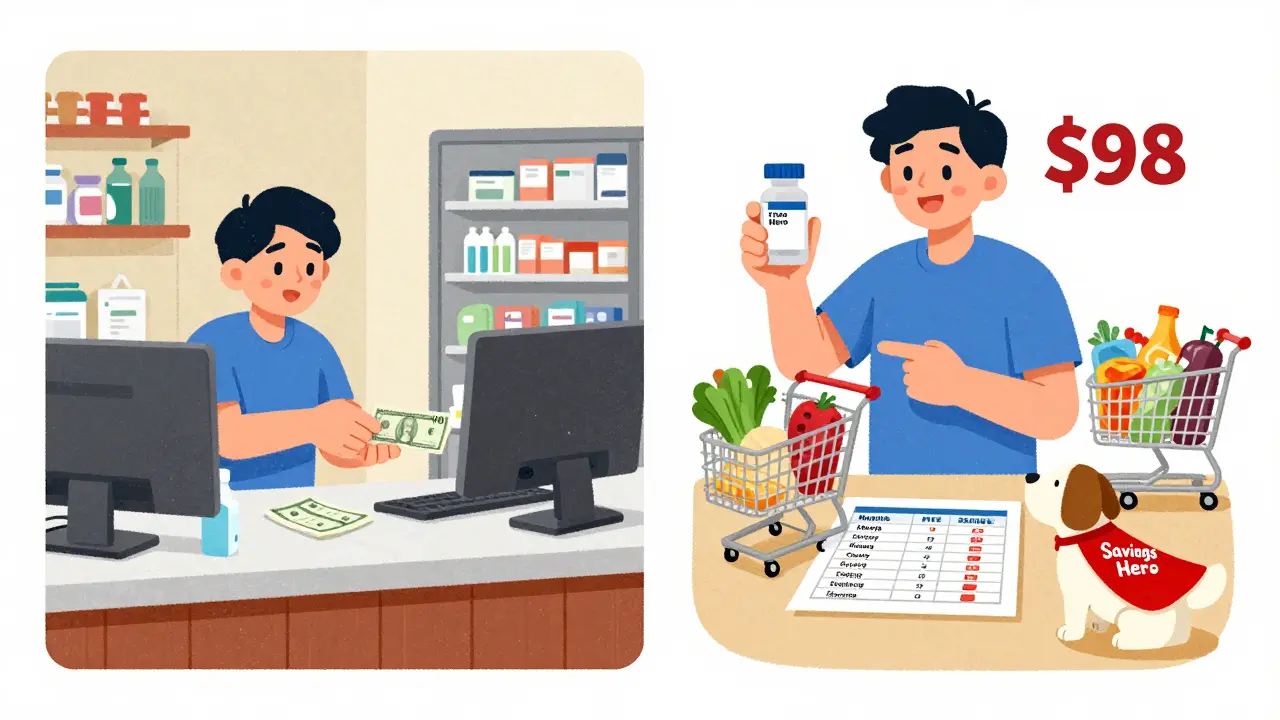
Real Stories, Real Savings
One Reddit user, u/MedSaver2023, paid $1.89 for metformin at a local pharmacy using GoodRx. At CVS, the same prescription was $15.99. That’s $141 saved per year just for one drug. Another user in Chicago found insulin prices ranging from $98 to $345 for the same vial across four pharmacies within two miles. They picked the lowest and saved $247 per vial. That’s over $1,500 a year. Trustpilot reviews for GoodRx are full of similar stories: “Saved $112 on Synthroid.” “Got my blood pressure med for $3.” “My husband’s cholesterol drug used to cost $80-I now pay $4.”What Doesn’t Work
Don’t assume your insurance will save you. Sometimes, the cash price is lower than your insurance co-pay-especially if you haven’t met your deductible. Always ask for the cash price first. Don’t trust the “lowest price” on a single app. Prices change daily. What’s $5 today might be $12 tomorrow. Don’t ignore your pharmacist. They know what discounts are available. Many have access to manufacturer coupons or patient assistance programs that aren’t listed online.How to Make This a Habit
This isn’t a one-time task. It’s a habit. Set a reminder on your phone: “Check cash price for meds every month.” For chronic medications-like blood pressure, diabetes, or thyroid drugs-do a price check every 30 days. Prices shift constantly. A drug that was $3 last month might be $8 this month. You don’t want to pay more because you forgot to check. Keep a simple spreadsheet: Drug name | Dosage | Pharmacy | Cash Price | Date Checked. In six months, you’ll know exactly where to go-and how much you’ve saved.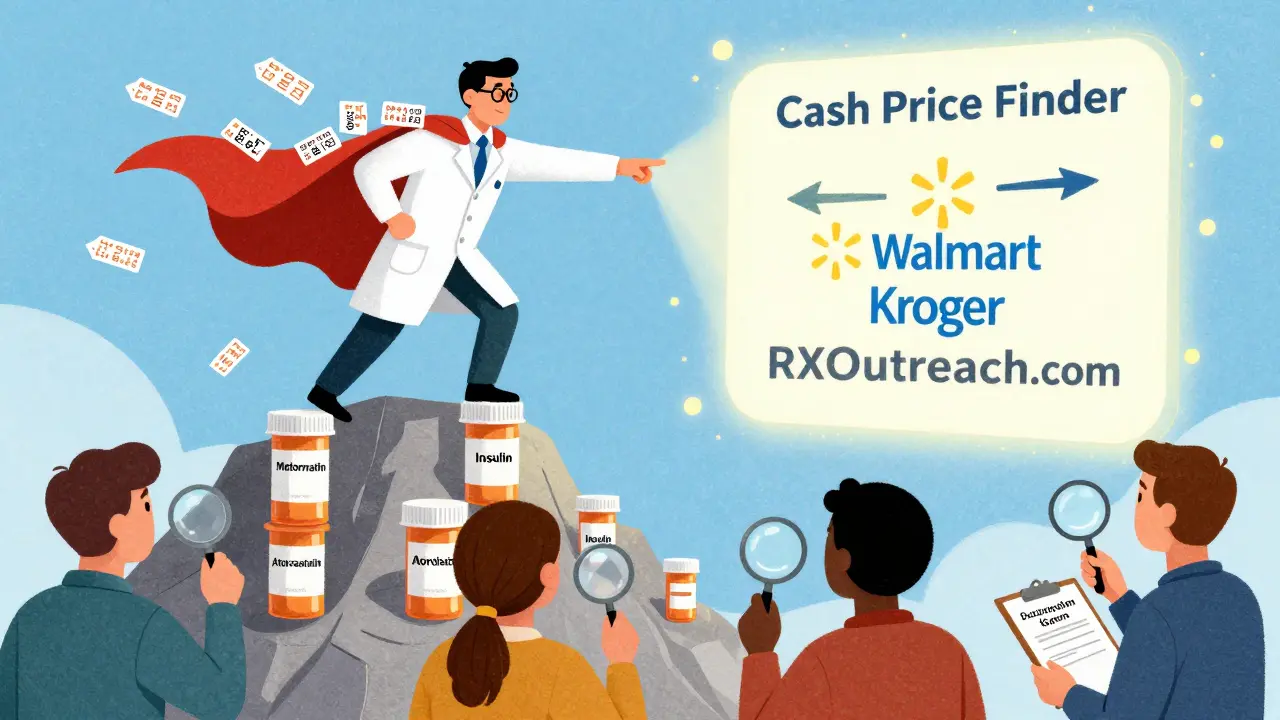
What’s Changing in 2026
The Inflation Reduction Act caps insulin at $35 per month for Medicare Part D users starting in 2023, and out-of-pocket drug costs for all Medicare beneficiaries are capped at $2,000 annually in 2025. But experts warn: without price shopping, you’ll still overpay. That cap applies to your total spending-not your per-prescription cost. If you pay $100 for a drug that’s really worth $20, you’re still wasting $80. The FDA’s Generic Drug User Fee Amendments (GDUFA III) are speeding up approval of new generics, which means more competition-and lower prices-in the next two years. States like California have passed laws banning pharmacy price gouging. More states are likely to follow. But until then, you’re still the best price detective you’ve got.Final Tip: Talk to Your Doctor
Your doctor doesn’t always know what your medication costs. Ask: “Is there a cheaper alternative?” or “Can we switch to a generic?” Many doctors assume insurance covers everything. They’re often surprised when you tell them the cash price at Walmart is $3. Don’t be afraid to say: “I can’t afford this. What can we do?” That conversation could save you hundreds-or keep you from skipping doses.FAQ
Is it legal to use GoodRx instead of insurance?
Yes. You can choose to pay cash instead of using insurance. Pharmacies are required to give you the cash price upon request. Many people use GoodRx when their insurance co-pay is higher than the cash price, especially if they haven’t met their deductible. It’s completely legal and widely accepted.
Can I use GoodRx with Medicare?
Yes, but only if you’re paying out of pocket and not using your Medicare Part D benefit for that specific prescription. Medicare doesn’t allow you to use GoodRx and bill the plan at the same time. If the GoodRx price is lower than your Medicare co-pay, you can choose to pay cash and not use your plan. Just tell the pharmacist: “I’m not using my insurance today.”
Why is my prescription cheaper at Walmart than at my local pharmacy?
Walmart and other mass merchandisers use prescription sales as a way to attract customers. They accept lower margins on generics to bring you in for groceries or other items. Independent pharmacies often have higher overhead and rely on higher margins to stay open. That’s why you’ll often find $4 generics at Walmart but $10-$15 at a local pharmacy-even without insurance.
Do cash prices change often?
Yes. Prices can change daily or weekly based on pharmacy inventory, manufacturer rebates, and competition. A drug that’s $5 today might be $12 next week. That’s why it’s important to check prices every time you refill-especially for chronic medications.
What if the pharmacy won’t honor my GoodRx coupon?
Call GoodRx customer service immediately. They can verify the coupon and speak to the pharmacy on your behalf. Most of the time, the issue is a simple system error. If the pharmacist still refuses, ask to speak to the manager. Many pharmacies have access to the discount program’s portal and can manually apply the discount.

13 Comments
Lydia H. January 19, 2026
Just saved $87 on my metformin this month using GoodRx. I didn’t even know this was a thing until last year. Now I check every refill. It’s wild how much we overpay because we assume the price is fixed.
Also, my local pharmacy gave me a free bottle of vitamins just because I asked if they had any cash discounts. Pharmacists are humans too.
Jacob Hill January 19, 2026
GoodRx is great, but don’t forget RxSaver-sometimes it’s even cheaper, especially for brand-name drugs like Onglyza. I’ve seen $12 differences between the two in the same ZIP code. Also, always double-check the dosage: 500mg vs. 1000mg changes everything. I learned this the hard way.
And yes, pharmacies sometimes refuse coupons because their system glitches-but the pharmacist can override it manually if you’re polite and persistent.
Christi Steinbeck January 21, 2026
STOP PAYING MORE THAN YOU NEED TO. This isn’t rocket science. If you’re on a fixed income, this could be the difference between eating and skipping meds. I used to skip my blood pressure pills because I couldn’t afford them-until I found Walmart’s $4 list. Now I take them daily. Don’t be ashamed to ask. Your life matters more than pride.
Jake Rudin January 23, 2026
The real issue isn’t the tools-it’s the broken system. Pharmacies are price-gouging machines, and manufacturers are complicit. The FDA’s GDUFA III is a band-aid. What we need is price transparency laws that force manufacturers to disclose their cost-to-retail markup.
Also, why are insulin prices still 10x higher than in Canada? It’s not supply-it’s greed. And no, ‘market forces’ don’t explain this. This is corporate theft dressed up as capitalism.
Phil Hillson January 23, 2026
Y’all are making this way too complicated. Just go to Costco. Done. I don’t need apps. I don’t need coupons. I pay $15 for a year’s supply of lisinopril and I’m happy. Why are we overthinking this? Just join a warehouse. It’s not that hard.
Also, GoodRx is just a middleman. They make money too. You think they care about you? Nah. They care about ad revenue.
Lewis Yeaple January 23, 2026
It is imperative to note that the variance in cash pricing is not attributable to mere operational inefficiencies, but rather to the absence of federal price regulation in pharmaceutical distribution. The lack of a unified pricing framework permits monopolistic behavior by pharmacy benefit managers (PBMs), who negotiate rebates in secret, thereby inflating retail prices.
Furthermore, the assertion that independent pharmacies offer unadvertised discounts is statistically unsupported; a 2022 JAMA study demonstrated that only 12% of independents provided such discounts, and those were typically limited to long-term patients with documented financial hardship.
Jackson Doughart January 24, 2026
I appreciate the depth of this guide. It’s rare to see such a thoughtful breakdown of a problem that affects so many. I’ve been using GoodRx for three years now, and I’ve saved over $2,100 on my husband’s medications alone.
One thing I’d add: always ask for the price before they swipe your insurance card. Once they process it, they often won’t let you switch to cash-even if it’s cheaper. That’s a silent trap.
And yes, pharmacists are your allies. Build a relationship with one. They’ll remember you. And sometimes, they’ll slip you a coupon they got from a rep.
sujit paul January 26, 2026
These tools are all controlled by Big Pharma. You think GoodRx is helping you? No. They are a Trojan horse. Every coupon you use feeds the algorithm that keeps prices high. The real solution is to boycott all pharmacies and order from India. I buy my insulin from a pharmacy in Mumbai for $12 a vial. The FDA doesn’t approve it, but it works. And yes, I know someone who died from a fake batch. But I take my chances. Freedom is worth the risk.
Also, the government is lying to you about insulin caps. They are just buying time until the next crisis.
Tracy Howard January 26, 2026
Can we please stop pretending this is an American problem? In Canada, we pay $5 for the same meds. We have a public system. You people have chosen to live in a dystopia where your life depends on whether you can afford to compare prices on an app. Shameful.
And don’t get me started on Walmart. You think they care? They’re just using your desperation to sell you overpriced toilet paper. Buy your meds in Toronto. It’s cheaper than your gas.
Astha Jain January 26, 2026
goodrx is cool but i found out my local pharmacy in delhi (india) sends meds to usa for like 1/10th the price. i get my metformin shipped in 10 days for $3. no insurance needed. no coupon. just a whatsapp group with a guy who knows a guy.
you guys are overcomplicating this. the real solution is global. stop thinking local.
Erwin Kodiat January 27, 2026
I moved from Texas to Oregon last year and was shocked how much cheaper my meds were here. Turned out, Oregon passed a law that caps pharmacy markups. Maybe it’s time we push for that everywhere.
Also, I started a little neighborhood group where we share price checks. Someone finds a deal on metformin, we all go there. It’s like a secret club, but for not going broke.
Small wins add up. Don’t underestimate the power of community.
Josh Kenna January 28, 2026
Just tried RxSaver for the first time and it was $7 cheaper than GoodRx for my thyroid med. I was skeptical but it worked. The coupon printed fine, pharmacist didn’t even blink.
Also, I didn’t know independent pharmacies sometimes give discounts if you ask. I just asked my guy at the corner pharmacy if he could do better and he gave me 20% off. He said he does it for regulars all the time.
Y’all are doing it right. Keep it up. And yeah, I spelled ‘pharmacist’ wrong. Sue me.
Valerie DeLoach January 28, 2026
This is one of the most important pieces of financial literacy most Americans will never learn. Prescription costs are a silent tax on the working class. And yet, we’re taught to budget for Netflix, not for insulin.
What’s missing from this guide is the emotional weight. People skip doses because they’re ashamed to ask for help. We need to normalize saying, ‘I can’t afford this.’ It’s not weakness-it’s survival.
Thank you for writing this. Please share it with your elderly neighbors, your coworkers, your parents. This isn’t just about money. It’s about dignity.