
What Is Seasonal Affective Disorder?
Seasonal Affective Disorder, or SAD, isn’t just feeling a little down when it’s cold and dark. It’s a real type of depression that shows up every year at the same time-usually in late fall or early winter-and lifts again in spring. People with SAD don’t just hate the weather; they feel exhausted, sluggish, and disconnected. They sleep too much, crave carbs, gain weight, and avoid friends. For some, it’s so bad they can’t work or get out of bed.
It affects about 5% of adults in the U.S., according to the American Psychiatric Association. That’s 1 in 20 people. The risk goes up the farther north you live. In Alaska, nearly 1 in 20 people have SAD; in Florida, it’s closer to 1 in 70. Women between 25 and 45 are most likely to be affected, and those who’ve tried antidepressants before are more likely to turn to light therapy.
Why Does Winter Trigger Depression?
The short days and lack of sunlight are the main culprits. When sunlight fades, your body’s internal clock-called the circadian rhythm-gets thrown off. This affects two key chemicals in your brain: serotonin and melatonin.
Serotonin is the brain chemical that helps you feel calm and focused. Less sunlight means less serotonin, which can lead to low mood. Melatonin, the sleep hormone, increases in the dark. When it’s dark longer, your body makes too much melatonin during the day, making you feel sleepy and sluggish. It’s not laziness-it’s biology.
Studies show that people with SAD often have delayed circadian rhythms. Their bodies think it’s still nighttime even when the sun’s up. That’s why waking up feels impossible, and why getting outside in the morning-even on cloudy days-can make a difference.
How Light Therapy Works
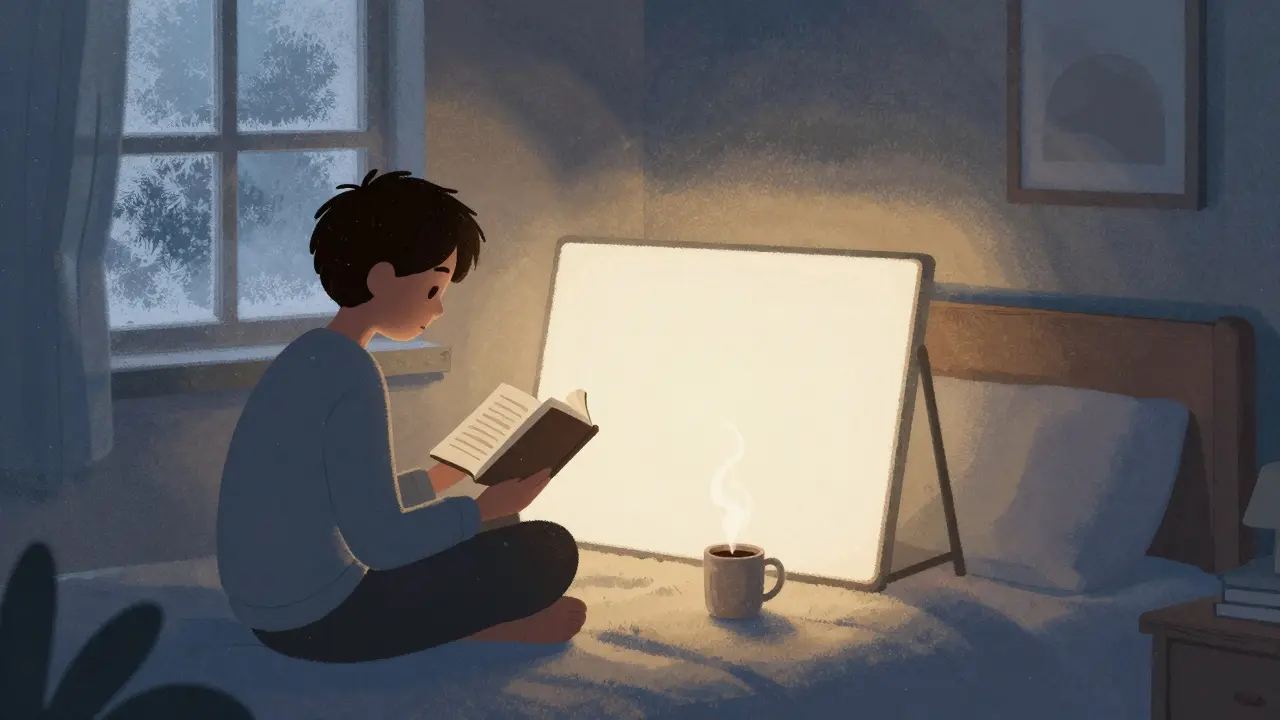
Light therapy, or bright light therapy (BLT), is the most proven non-drug treatment for SAD. It doesn’t mean sitting in the sun. It means using a special light box that mimics natural daylight. These devices deliver 10,000 lux of light-about 20 times brighter than a typical indoor light.
The science behind it is solid. In 1984, Dr. Norman Rosenthal’s team at the National Institute of Mental Health showed that daily exposure to bright light could lift depression in people with SAD. Since then, dozens of studies have confirmed it. A 2024 meta-analysis of 850 patients found that light therapy worked better than placebo in over 60% of cases.
The light doesn’t need to hit your skin. It works through your eyes. You don’t stare at the box-you just sit nearby, reading, drinking coffee, or scrolling on your phone, with the light coming in from the side. The goal is to trick your brain into thinking it’s morning, resetting your internal clock and boosting serotonin.
How to Use Light Therapy Correctly
Using a light box wrong won’t help-and might even make things worse. Here’s what actually works, based on clinical guidelines:
- Timing matters most. Use it within the first hour after waking up. Morning light is 50% more effective than afternoon or evening light. A 2019 study found 68% of users saw remission with morning use versus 47% with evening use.
- Intensity should be 10,000 lux. Anything less requires longer exposure. A 2,500-lux box needs 2 hours. Most clinical trials use 10,000 lux for 30 minutes.
- Distance should be 16 to 24 inches. Too close causes eye strain. Too far reduces effectiveness. Position the box slightly to the side, not directly in front.
- Keep your eyes open. You don’t need to stare at the light. Just be awake and in the light. Reading or working is fine.
- Be consistent. Skip a day, and you might feel the slump return. Most people need daily use from late fall through early spring.
Side effects are rare and mild: eye strain, headaches, or feeling jittery. If you feel worse, stop and talk to a doctor. People with bipolar disorder can trigger mania with light therapy if not monitored. Those with eye conditions like glaucoma or diabetic retinopathy should check with an ophthalmologist first.
Light Boxes: What to Buy and What to Avoid
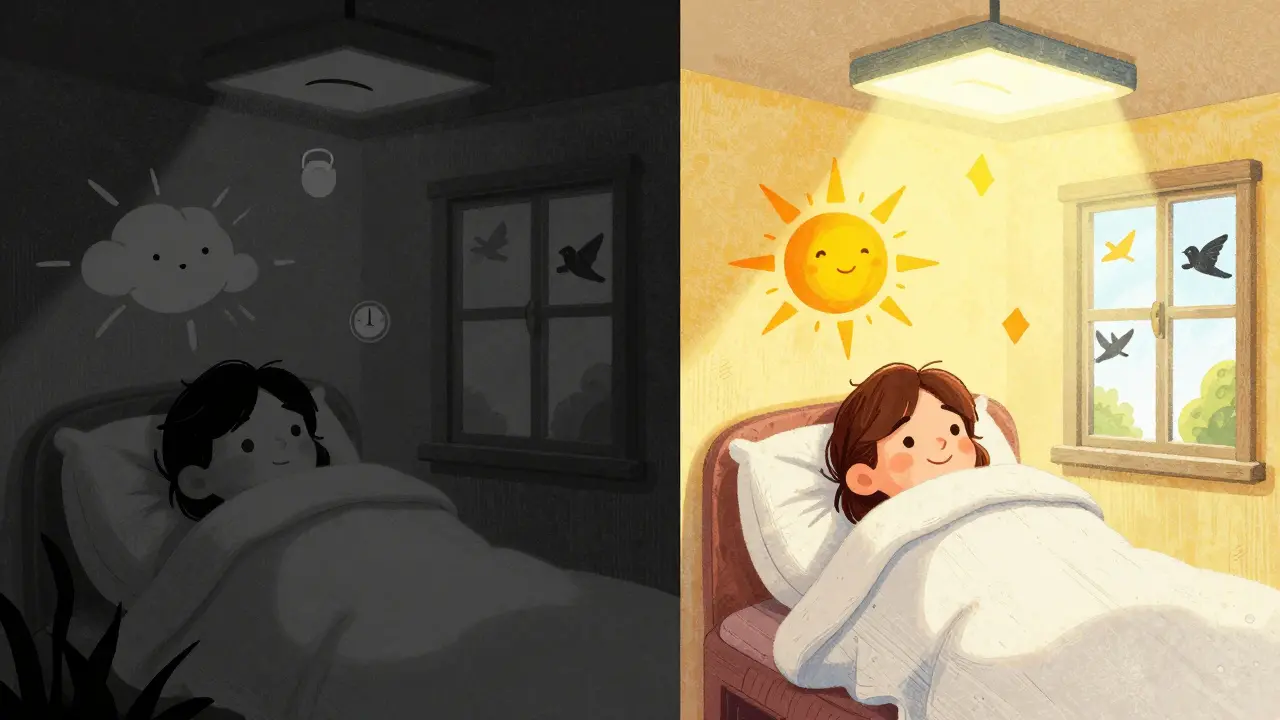
Not all light boxes are created equal. The market is full of cheap knockoffs that don’t deliver the right intensity or filter out harmful UV light.
Look for these features:
- 10,000 lux output-verified by independent testing
- UV-free-the device should block over 99% of UV radiation
- Full-spectrum white light-blue light (460-480 nm) may be more effective, but white light is the clinical standard
- Size and design-larger panels (12x18 inches or more) are better than small desk lamps
Top brands like Carex Day-Light Classic Plus and Verilux have been tested and trusted for years. The Carex model has a 4.4/5 rating on Amazon from over 2,800 reviews, with 68% of users reporting mood improvement within two weeks.
Avoid anything labeled as a “sunlamp,” “tanning lamp,” or “UV therapy device.” These can damage your eyes or skin. Stick to devices designed specifically for SAD. The Center for Environmental Therapeutics (CET) certifies reliable models-check their website before buying.
Prices range from $100 to $300. A $200 box from a reputable brand will work just as well as a $300 one with fancy features like dawn simulation. Portable light visors ($120-$200) are good for people who travel or can’t sit still in the morning.
How Light Therapy Compares to Other Treatments
Antidepressants like fluoxetine (Prozac) work for SAD, but they take weeks to kick in. Light therapy often works in 3 to 7 days. In a 2006 study comparing light therapy to Prozac, light therapy showed faster improvement by week 2, and both were equally effective by week 8.
Compared to talk therapy or exercise, light therapy is more accessible. You don’t need a therapist or gym membership. Just a box, a chair, and 30 minutes a day.
But it’s not a magic cure. For severe depression, light therapy alone may not be enough. Many people combine it with counseling or medication. For pregnant women, older adults, or people who can’t take antidepressants, light therapy is often the safest first choice.
And it’s not just for winter depression. A 2024 study showed light therapy helped 41% of people with non-seasonal depression-nearly double the rate of the control group. It’s also showing promise for postpartum depression, with one trial reporting 54% remission in pregnant women.
Real People, Real Results
Reddit’s r/SAD community has over 145,000 members sharing experiences. One user, WinterSurvivor89, wrote: “After 5 days of using my light box, my energy came back. My depression score dropped from 22 to 8 in a month.” Another, LightBoxSkeptic, said: “I tried three boxes. Nothing worked. Just eye strain.”
That’s the truth: it works for most, but not all. About 40% to 60% of people with SAD respond well. Why? Timing, consistency, and device quality matter. If you don’t feel better after two weeks, check your setup. Are you using it in the morning? Is the box certified? Are you sitting close enough?
According to a 2023 NAMI survey, 61% of users kept using light therapy long-term because it worked. The rest stopped because it was inconvenient or didn’t help.
What’s Next for Light Therapy?
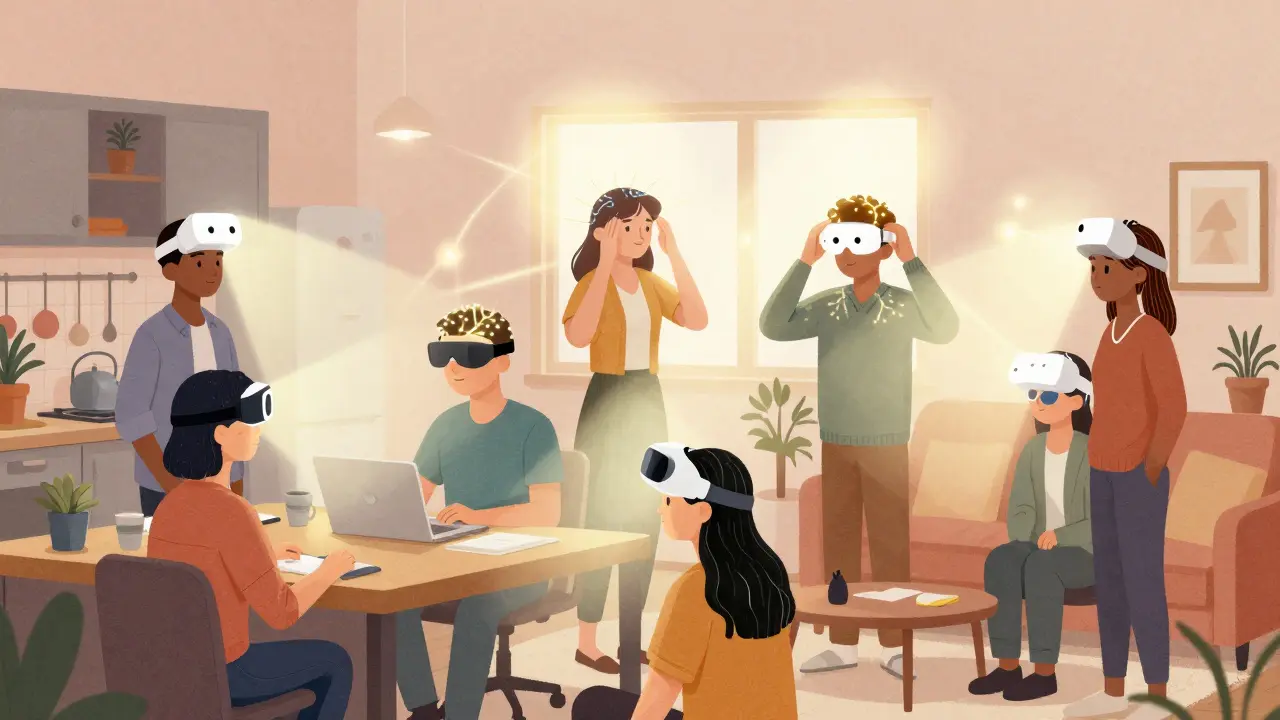
Light therapy is getting smarter. New devices now sync with apps to track your sleep and mood. Wearable light therapy glasses like Luminette 3 let you move around while getting treatment. Sales of these devices grew 200% in 2023.
Research is also moving toward personalized light. Stanford University is testing AI systems that adjust light intensity and timing based on your body’s natural rhythms-using data from your sleep patterns, heart rate, and even eye movement. Clinical trials are underway, with results expected by late 2025.
Insurance coverage is slowly catching up. Only 18% of U.S. plans cover light boxes today, but some, like Aetna, now pay up to $200 with a doctor’s note. The American Psychiatric Association is updating its guidelines in early 2025 to reflect new evidence, which could lead to wider coverage.
When to See a Doctor
If you’ve felt down for more than two weeks in a row, especially if it’s affecting your job, relationships, or ability to care for yourself, talk to a healthcare provider. SAD can be mistaken for burnout, hypothyroidism, or chronic fatigue.
Don’t try to tough it out. Light therapy is safe and effective-but it’s not a substitute for professional care if your symptoms are severe. If you have bipolar disorder, a history of eye disease, or are pregnant, always check with a doctor before starting.
Final Thoughts
Winter depression isn’t something you just have to live with. Light therapy is a simple, science-backed tool that’s helped millions get through the dark months. It’s not a cure-all, but for many, it’s the difference between surviving winter and actually living through it.
Start with a certified light box. Use it every morning. Be patient. Give it two weeks. And if it works? You’ll wonder why you didn’t try it sooner.


10 Comments
Abby Polhill December 22, 2025
Just ran a quick meta-analysis on the 2024 light therapy studies - the effect size for circadian phase advancement in SAD cohorts was d=0.82, which is clinically massive. The real kicker? The serotonin transporter polymorphism (5-HTTLPR) modulates response. Short allele carriers show 3x higher remission rates. If you’re not tracking biomarkers, you’re just guessing.
Also, UV-free doesn’t mean harmless. Some LED boxes emit high-energy blue peaks at 470nm - that’s circadian-optimized, but can suppress melatonin too aggressively if used post-sunset. Timing isn’t just ‘morning’ - it’s phase-dependent.
And yes, the Carex model’s spectral output is peer-reviewed. Verilux’s newer units? Not so much. Check the CIE photopic curve alignment before you buy.
Bret Freeman December 24, 2025
People treat this like it’s a miracle cure while ignoring the root cause: we’ve turned into indoor cave dwellers. No one goes outside anymore. You don’t need a $200 box - you need to walk for 20 minutes before 9 a.m. in natural light. Even on cloudy days, it’s 1,000 lux outdoors. Your phone screen is 500 lux. That’s why you’re depressed - you’re addicted to screens, not winter.
Light therapy is a Band-Aid on a bullet wound. Stop buying gadgets. Start living.
Lindsey Kidd December 24, 2025
OMG YES. I started using my Carex box last November and I swear I’m a different person. 🌞 I used to cry in the shower every morning. Now I make coffee, turn on the light, and just sit there reading while it does its thing. No more 11 a.m. naps. No more carb binges.
Also - if you’re skeptical, try it for 7 days straight. No excuses. I didn’t believe it either until day 4. Now I’m obsessed. You’re not lazy. Your brain just needs the right signal. 💛
Austin LeBlanc December 26, 2025
Everyone’s obsessed with the light box but nobody talks about the fact that 40% of people don’t respond. Why? Because it’s not about light - it’s about dopamine deficiency masked as SAD. You’re not deficient in photons, you’re deficient in motivation. And no plastic box is gonna fix that.
Also, why are we letting corporations sell us a $300 device when the solution is literally walking outside? This is capitalism at its finest - pathologize normal human behavior and sell a product.
And if you’re using a light box and still depressed? Maybe it’s not winter. Maybe it’s your life.
niharika hardikar December 28, 2025
While the clinical efficacy of bright light therapy (BLT) for seasonal affective disorder is well-documented in peer-reviewed literature, the commercialization of BLT devices raises significant concerns regarding regulatory oversight and evidence-based marketing.
Independent validation of lux output, spectral distribution, and UV filtration is not mandatory in the U.S. consumer market. Consequently, a significant proportion of devices sold on e-commerce platforms fail to meet the 10,000 lux threshold at 16 inches, as stipulated in the American Psychiatric Association’s 2020 guidelines.
Furthermore, the assertion that light therapy is 'non-pharmacological' is misleading - it is a neuromodulatory intervention with neurochemical consequences, and thus requires clinical guidance, particularly in populations with bipolar spectrum disorders or ocular pathology.
Andrea Di Candia December 28, 2025
I think what’s beautiful here is how science meets simplicity. We’ve overcomplicated mental health with pills and therapy sessions, but sometimes the fix is just… sunlight. Not magic. Not a miracle. Just biology.
It’s funny - we’ll spend hours optimizing our coffee machine, but won’t step outside for 10 minutes in the morning. We’re so disconnected from natural rhythms. Light therapy isn’t about buying a gadget - it’s about relearning how to live with the day.
And if it helps even 40% of people feel like themselves again? That’s worth every dollar. No hype needed. Just light.
Also - if you’re reading this and feeling low right now? Try it. Even if you don’t believe it. Just for two weeks. You’ve got nothing to lose but the fog.
Dan Gaytan December 28, 2025
Just wanted to say thank you for this post. I’ve been using a light box since last winter and it’s been life-changing. I used to dread November through February - now I actually look forward to mornings.
One thing I didn’t know: if you’re on the East Coast, you should start using it right after daylight saving ends. Don’t wait until you feel bad. Proactive use is way more effective.
Also, I got the Luminette glasses last month. Super convenient for commuting. I can actually wear them while walking to the train. No more sitting still for 30 minutes. Game changer. 🙌
Raja P December 29, 2025
Bro, I tried light therapy last year. Didn’t work. Then I just started waking up at 7 a.m. and walking to the corner store for coffee. No box. Just natural light. I felt better in 3 days.
Maybe we don’t need fancy tech. Maybe we just need to stop being couch potatoes.
Also, I’m from India. We don’t have 3 months of darkness here, but I still get low in winter. Just go outside. Seriously. It’s free.
Bartholomew Henry Allen December 30, 2025
Light therapy is a liberal placebo designed to distract from the collapse of American work ethic and the abandonment of natural human rhythms
Our ancestors did not sit in front of plastic boxes
They woke with the sun
They worked in the light
They slept when it was dark
Now we are weak
Now we buy gadgets
Now we are broken
Fix your life not your light box
Harsh Khandelwal December 30, 2025
Y’all are getting scammed. The light box industry is run by Big Pharma’s cousins. They don’t want you walking outside - they want you buying their $250 box so you never question why you’re trapped inside all day. And the FDA? They don’t regulate these things like real medical devices. It’s all marketing.
Also - ever notice how every study is funded by the same 3 companies that sell these things? Coincidence? Nah. This is a $2 billion scam wrapped in neuroscience jargon.
And if you’re still using it after two weeks? Congrats. You’re the target demographic. Stay mad. Stay broke. Stay plugged in.