
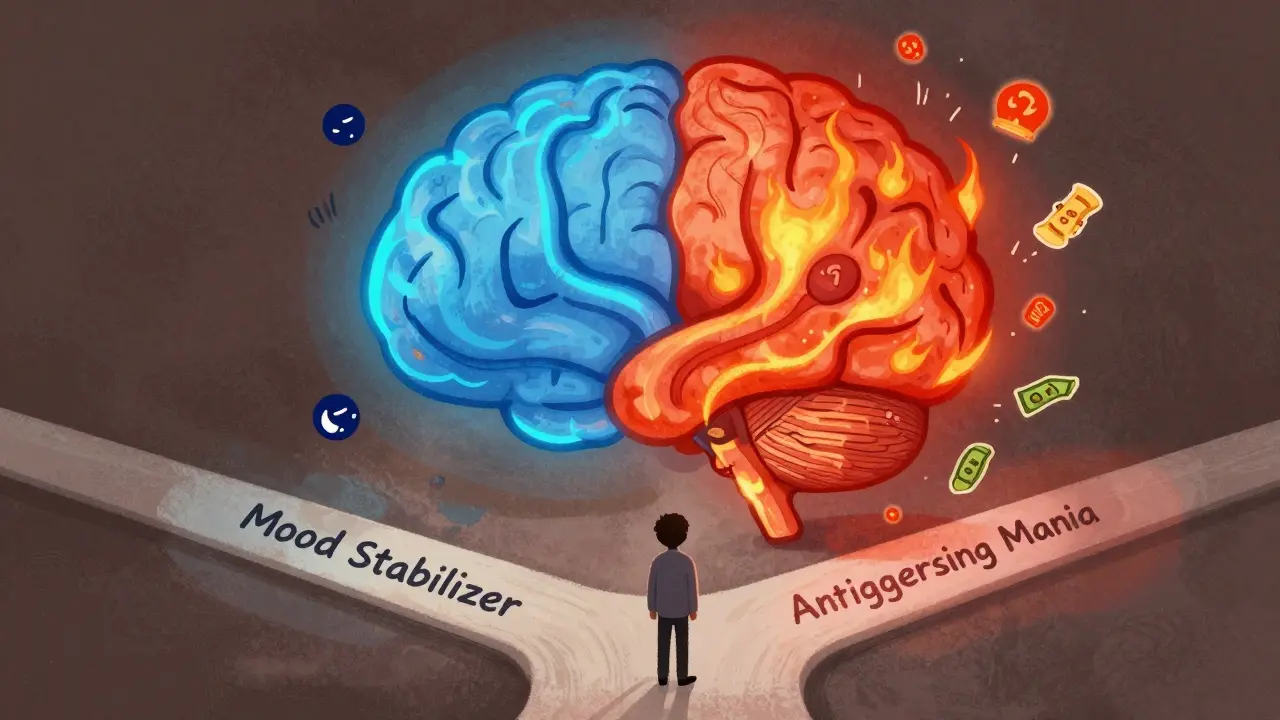
Bipolar Treatment Risk Calculator
Treatment Options
Key Findings from the Article:
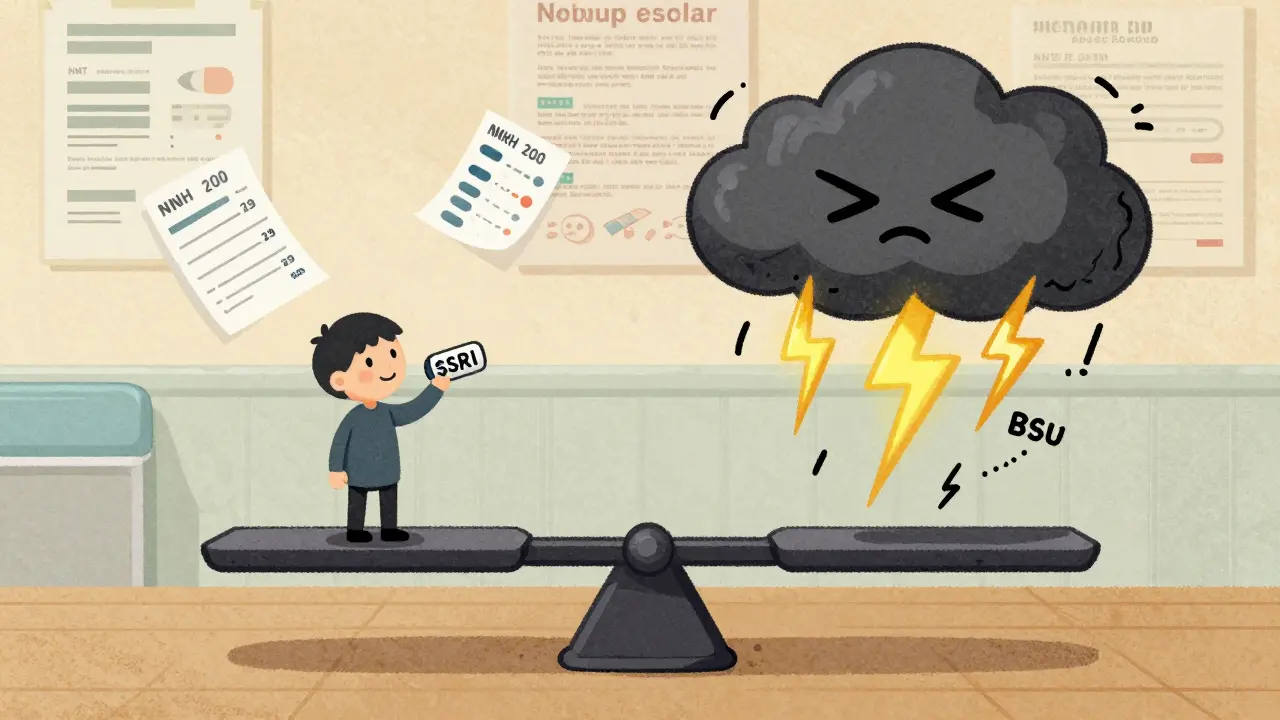
- Antidepressants have a number needed to treat (NNT) of 29.4
- Antidepressants have a number needed to harm (NNH) of 200
- Quetiapine has 50-60% response rate with less than 5% switch risk
- Lurasidone has 50% response rate with 2.5% switch risk
- Cariprazine has 48% response rate with 4.5% switch risk
Risk-Benefit Analysis
Antidepressants
Benefit: 3.4 patients experience improvement
Risk: 0.5 patients experience mood switch
For every 29.4 patients treated, 1 feels better.
For every 200 patients treated, 1 experiences a mood switch.
Compared to Quetiapine:
- 22 fewer patients improved
- 4.5 more patients experienced mood switches
When someone with bipolar disorder feels deep depression, it’s tempting to reach for an antidepressant. After all, these drugs work for unipolar depression. But in bipolar disorder, the same medication can do more harm than good. Instead of lifting the mood, antidepressants can trigger mania, rapid cycling, or mixed states - episodes where depression and mania crash together. This isn’t rare. It’s a well-documented danger that many doctors still overlook.
Why Antidepressants Can Backfire in Bipolar Disorder
Antidepressants like SSRIs (sertraline, fluoxetine) or SNRIs (venlafaxine) are designed to boost serotonin or norepinephrine. In unipolar depression, that helps. In bipolar disorder, that same chemical push can destabilize an already fragile mood system. The brain’s mood circuits in bipolar patients are wired differently. Adding an antidepressant without a mood stabilizer is like stepping on the gas in a car with no brakes.
Studies show about 12% of people with bipolar disorder who take antidepressants experience a switch into mania or hypomania - even if they’ve never had one before. In retrospective studies, that number jumps to 31%. The risk isn’t the same for everyone. People with Bipolar I, a history of previous switches, or rapid cycling (four or more mood episodes a year) are at the highest risk. Those with mixed features - feeling depressed but also agitated, irritable, or racing thoughts - are especially vulnerable. Up to 20% of bipolar depressions include these mixed symptoms, and antidepressants make them worse.
How Big Is the Risk? Numbers That Matter
Let’s put the numbers in plain terms. For every 29 people with bipolar depression treated with an antidepressant, about one will feel significantly better. That’s a number needed to treat (NNT) of 29.4. But for every 200 people treated, one will have a mood switch - that’s the number needed to harm (NNH). Compare that to FDA-approved treatments for bipolar depression: quetiapine (Seroquel) has a 50-60% response rate with less than 5% switch risk. Lurasidone (Latuda) works for half of users with just 2.5% risk of mania. Cariprazine (Vraylar) gives a 48% response rate with 4.5% switch risk.
That’s not even close. Antidepressants offer slim benefits at a high cost. And the harm doesn’t stop at mania. Long-term use increases the chance of rapid cycling by over twice. People who stay on antidepressants for more than 24 weeks are 37% more likely to have another depressive or manic episode, according to the STEP-BD study. The drug isn’t just triggering one episode - it’s making the whole illness worse over time.
What Types of Antidepressants Are Riskiest?
Not all antidepressants are equal. Tricyclics (like amitriptyline) carry the highest risk - up to 25% chance of triggering mania. SNRIs like venlafaxine are next, with 15-20% risk. SSRIs like fluoxetine or sertraline are lower, around 8-10%, but still dangerous in the wrong patient. Bupropion (Wellbutrin) is sometimes seen as safer because it doesn’t affect serotonin as much. But even bupropion has caused switches in people with a history of rapid cycling.
The real issue isn’t the drug class - it’s the context. Taking an antidepressant alone? High risk. Taking it with a mood stabilizer like lithium or valproate? Lower, but still present. Taking it with an atypical antipsychotic like quetiapine? Much safer. But even then, guidelines say: only if everything else has failed.
When Might Antidepressants Be Okay?
There are rare cases where antidepressants might be considered. The International Society for Bipolar Disorders (ISBD) says: only for severe, treatment-resistant depression - after trying at least two FDA-approved options like quetiapine, lurasidone, or the olanzapine-fluoxetine combo (Symbyax). And even then, only as a short-term bridge - no longer than 8 to 12 weeks.
Some experts believe SSRIs might be tolerable in Bipolar II patients with pure depression, no prior switches, and no mixed features. But this is controversial. Dr. Nassir Ghaemi at Tufts Medical Center treats only 19% of his bipolar patients with antidepressants at all. He says if you’re not sure it’s bipolar, you’re probably wrong. Up to 40% of people initially diagnosed with unipolar depression actually have bipolar disorder - and antidepressants can reveal it by triggering their first manic episode.
What Should Be Used Instead?
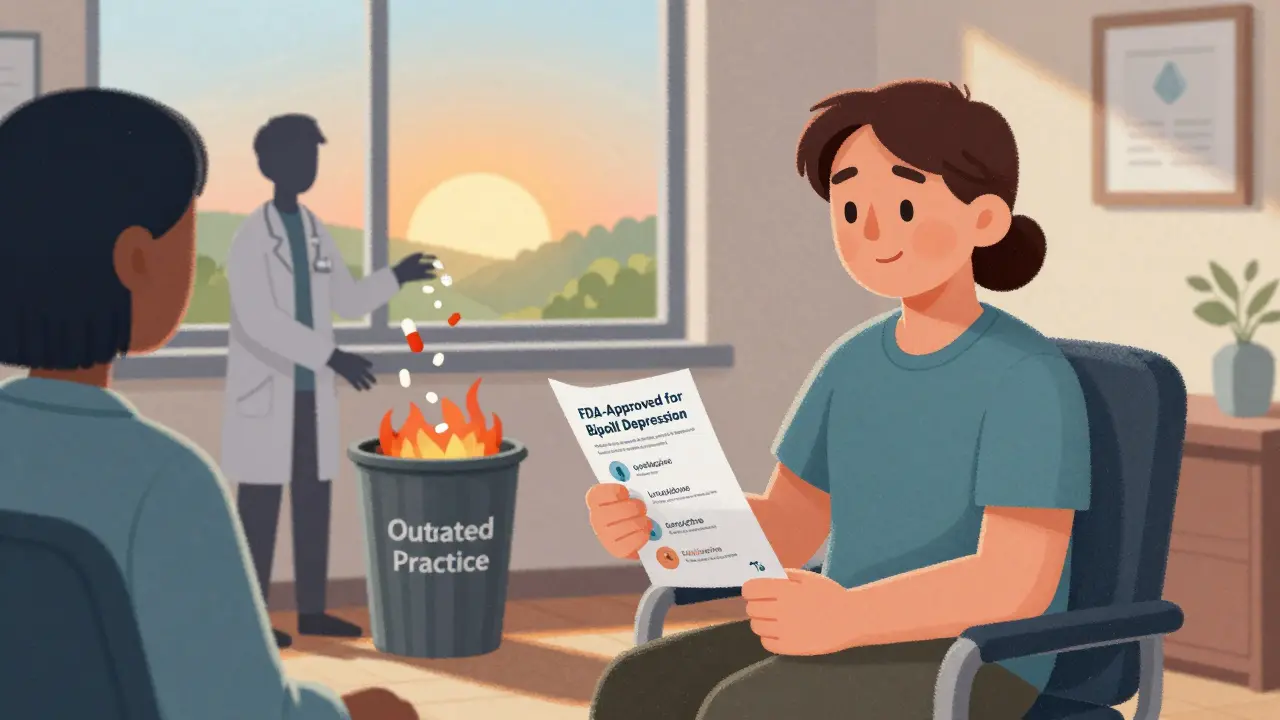
Four medications are FDA-approved specifically for bipolar depression:
- Quetiapine (Seroquel) - Works for 50-60% of patients, switch risk under 5%
- Lurasidone (Latuda) - 50% response rate, only 2.5% switch risk
- Cariprazine (Vraylar) - 48% response rate, 4.5% switch risk
- Olanzapine-fluoxetine combo (Symbyax) - Approved for bipolar depression, but fluoxetine here is paired with an antipsychotic - not used alone
These drugs don’t just treat depression - they stabilize the whole mood cycle. Lithium and valproate are also first-line for long-term prevention. Newer options like esketamine nasal spray (Spravato) are showing promise in trials, with 52% response in bipolar depression and just 3.1% switch risk.
What Happens If You Don’t Stop?
Too often, antidepressants are kept too long. In community clinics, 65% of patients stay on them beyond 12 weeks. Some stay on them for years. That’s not just ineffective - it’s harmful. Long-term use increases episode frequency. It makes mood stabilizers less effective. It can turn a stable person into a chronic cycler.
And when mania starts, it’s not always obvious. A patient might feel more energetic, sleep less, spend more money, or become unusually irritable. They might think it’s improvement. Clinicians miss it too - 25% of cases continue the antidepressant even as hypomania develops. That’s when hospitalization becomes likely.
How to Monitor for Danger Signs
If an antidepressant is used at all, monitoring is non-negotiable. Weekly check-ins for the first month are standard. Watch for:
- Sleeping less than 4 hours a night without feeling tired
- Increased talkativeness or racing thoughts
- Impulsive spending, risky behavior, or grandiose ideas
- Unusual irritability or anger
- Feeling "too good" or "on top of the world"
Any of these mean stop the drug immediately. No waiting. No "let’s try a lower dose." The risk is too high.
Why Do Doctors Still Prescribe Them?
It’s not because they’re unaware. It’s because it’s hard to change. Many doctors were trained to treat depression the same way, regardless of diagnosis. Patients ask for antidepressants. They’ve seen them work for friends or family with unipolar depression. Insurance often covers them more easily than newer antipsychotics. And in rural areas or under-resourced clinics, specialists who know bipolar disorder are scarce.
Only 30% of community psychiatrists follow the ISBD guidelines. In academic centers, it’s 65%. That gap means thousands of people are being exposed to unnecessary risk.
What Patients Should Know
If you have bipolar disorder and your doctor suggests an antidepressant, ask:
- Have I been properly diagnosed with bipolar disorder - not just depression?
- Have I tried FDA-approved treatments first?
- Am I on a mood stabilizer or antipsychotic right now?
- What’s the plan if I start feeling "too energetic" or irritable?
- How long will I be on this drug - and what happens if it doesn’t work?
Don’t be afraid to get a second opinion. If your doctor dismisses your concerns about mood swings, find someone who specializes in bipolar disorder. The stakes are too high to guess.
The Bottom Line
Antidepressants have a place in treating unipolar depression. But in bipolar disorder, they’re a gamble with high odds of losing. The benefits are small. The risks are real - and often permanent. Mood stabilizers and approved antipsychotics work better, safer, and longer. If you’re being prescribed an antidepressant for bipolar depression, ask why. And if the answer is "it’s what usually works," walk away. The science has moved on. Your treatment should too.




15 Comments
Blair Kelly January 30, 2026
Antidepressants for bipolar? That’s like handing a heroin addict a syringe and saying ‘just don’t OD.’ The data doesn’t lie - 1 in 20 people switch into mania. And no, ‘it worked for my cousin’ doesn’t override a 31% retrospective switch rate. This isn’t debate territory. It’s medical malpractice waiting to happen.
Doctors who still prescribe SSRIs without mood stabilizers should be required to retake psych 101. Or at least read the STEP-BD study. Again. And again. Until it sinks in.
I’ve seen it firsthand. A guy on sertraline for ‘depression’ - turned into a sleep-deprived, credit-card-maxing, yelling-at-his-pet-dog maniac in three weeks. No one connected the dots until he got hospitalized. That’s not a side effect. That’s a fucking trigger.
And don’t get me started on how insurance pushes the cheapest drug instead of the safest one. Symbyax? Too expensive. Wellbutrin? ‘Oh, it’s non-serotonergic!’ Yeah, until it isn’t. Bupropion isn’t magic. It’s just the less obvious path to disaster.
The fact that 65% of patients stay on these drugs past 12 weeks? That’s not negligence. That’s systemic failure. We treat bipolar like it’s a bad mood. It’s a neurological minefield. And antidepressants are the match.
Stop romanticizing ‘quick fixes.’ There are no quick fixes here. Only better, evidence-based, FDA-approved alternatives that don’t turn your brain into a fireworks show.
And if your doctor says ‘it’s what usually works’ - walk out. Find someone who actually knows what they’re doing. Your stability depends on it.
Rohit Kumar February 1, 2026
The brain is not a simple chemical balance. Bipolar disorder is not depression with extra steps. It is a dysregulation of rhythm - circadian, neurochemical, emotional. Antidepressants impose a linear fix on a nonlinear system. The result is not healing - it is destabilization.
In Indian psychiatry, we see this too. Families bring patients who were ‘cured’ by fluoxetine - only to return months later in full hypomania, confused, blaming themselves. The doctor said it was ‘improvement.’ The patient believed it. The system failed.
Western medicine loves its pills. But pills do not understand culture, trauma, sleep cycles, or spiritual distress. They only react to neurotransmitter levels. And when you force a serotonin boost on a brain already dancing on the edge of collapse - you don’t lift it. You throw it off the cliff.
Lithium has been used for over 70 years. It is ancient. It is imperfect. But it is *stable*. Why do we chase the new when the old works? Because profit has a louder voice than science.
Let us not mistake pharmaceutical innovation for medical wisdom. Sometimes, the most advanced treatment is the most forgotten one.
kate jones February 1, 2026
Let’s be precise: the NNT of 29.4 for antidepressants in bipolar depression is statistically negligible when weighed against an NNH of 200. That’s a risk-benefit ratio that would never pass regulatory review for any other chronic condition.
Moreover, the STEP-BD data is unequivocal - long-term antidepressant use increases episode recurrence by 37%. This isn’t anecdotal. It’s prospective, multicenter, longitudinal. And yet, 70% of community providers still default to SSRIs.
Even more concerning: mixed features are present in up to 20% of bipolar depressive episodes, and antidepressants exacerbate agitation, irritability, and racing thoughts - symptoms already present. Giving an SSRI to someone with mixed depression is like pouring gasoline on a smoldering fire.
Guidelines from ISBD, APA, and CANMAT are aligned: mood stabilizers and atypical antipsychotics are first-line. Antidepressants are third-line - if at all. The disconnect between evidence and practice is not just alarming - it’s indefensible.
And yes, quetiapine, lurasidone, cariprazine - they’re expensive. But so are hospitalizations, lost jobs, suicide attempts, and fractured relationships. The real cost isn’t the pill. It’s the life you ruin by choosing convenience over competence.
Natasha Plebani February 2, 2026
What’s fascinating is how we anthropomorphize neurotransmitters. Serotonin isn’t a ‘happy chemical.’ It’s a modulator. And in bipolar disorder, modulation isn’t the goal - regulation is.
The brain doesn’t need more serotonin. It needs stability. Antidepressants don’t stabilize. They stimulate. And stimulation in a dysregulated circuit is not therapy - it’s provocation.
Consider the neuroanatomy: the prefrontal cortex, amygdala, and hypothalamic-pituitary-adrenal axis are already hyperconnected in bipolar disorder. SSRIs amplify that connectivity. You’re not fixing the signal. You’re amplifying the noise.
And then there’s the placebo effect. Many patients report ‘improvement’ on antidepressants because they believe they should feel better. But that’s not remission. That’s expectation. And expectation doesn’t prevent mania.
The real tragedy? We’ve known this since the 1980s. The data is old. The guidelines are clear. The failure is institutional. Not scientific.
We’re not failing patients because we don’t know better. We’re failing them because we’re too tired to change.
And that’s not incompetence. That’s moral exhaustion.
Kelly Weinhold February 2, 2026
I just want to say - if you’re reading this and you’re on an antidepressant for bipolar, please don’t panic. You’re not alone. I was too. I was on sertraline for two years thinking it was helping. Then I started sleeping 3 hours a night, buying a motorcycle I didn’t need, and yelling at my mom for ‘not understanding me.’ I thought I was ‘finally happy.’
Turns out, I was hypomanic. And my doctor didn’t catch it because I told him I was ‘feeling better.’
Switching to lurasidone and lithium changed my life. Not because it was magic - because it was steady. No highs, no lows, just… me.
If you’re scared to talk to your doctor - I get it. I was too. But your mental health isn’t a last resort. It’s your priority. Ask for alternatives. Ask for data. Ask for time.
You deserve stability. Not a chemical rollercoaster.
And if your doctor rolls their eyes? Find a new one. Seriously. There are so many good ones out there. You just have to keep looking.
Kimberly Reker February 4, 2026
So many people don’t realize that bipolar isn’t just ‘mood swings.’ It’s a chronic illness with biological underpinnings - and antidepressants are like putting a Band-Aid on a broken leg.
I’ve been in recovery for 12 years. I was misdiagnosed as unipolar for five. Took fluoxetine. Had three full manic episodes. Lost my apartment. My job. My dog.
Once I got on the right meds - cariprazine and lamotrigine - everything stabilized. Not perfectly. But enough to live.
Don’t let fear of ‘not feeling normal’ keep you from the right treatment. The goal isn’t to feel euphoric. It’s to feel *present*.
If your doctor won’t listen, go to a bipolar specialty clinic. They exist. And they’re lifesavers.
You’re not broken. You’re just on the wrong medication.
Eliana Botelho February 4, 2026
Wait - so you’re saying antidepressants are dangerous for bipolar people? Wow. Shocking. I thought they were just like vitamins for sadness.
Oh wait - I’m being sarcastic. But seriously, why is this even a debate? Because someone made a profit off prescribing SSRIs for 30 years? Because doctors are lazy? Because patients don’t know any better?
Let’s not pretend this is a scientific controversy. It’s a financial one.
And now we’re supposed to be impressed that ‘new’ drugs like cariprazine exist? They’re just repackaged antipsychotics with bigger price tags.
Meanwhile, lithium costs $10 a month and has been proven to reduce suicide risk by 80%. But nope - let’s keep selling $500 pills that make people go crazy.
Oh, and don’t get me started on how Symbyax is just Prozac + Zyprexa. So why not just prescribe both separately? Oh right - because the combo is patented. And profit > patient.
Let’s not pretend this is about science. It’s about money. And the people paying are the ones with bipolar.
Rob Webber February 5, 2026
They’re not ‘risking’ mania. They’re *causing* it. And then they wonder why bipolar patients have higher suicide rates.
I’ve been in psych wards three times because some idiot doctor thought ‘SSRI for depression’ was a universal prescription.
My first switch? Took me 17 days to realize I was manic. I thought I was ‘finally functioning.’ I maxed out three credit cards. Quit my job. Told my boss I was ‘the chosen one.’
And the doctor? Said ‘you’re responding well.’
That’s not treatment. That’s torture with a prescription pad.
Stop calling it ‘off-label.’ It’s off-the-wall. And it’s killing people.
If you’re on an antidepressant for bipolar - stop. Now. Call your doctor. If they don’t listen - find someone who does. Your life isn’t a clinical trial.
calanha nevin February 5, 2026
Antidepressant-induced mood switching is a well-documented phenomenon with robust empirical support. The risk is not theoretical. It is quantifiable. It is preventable.
Current clinical guidelines, including those from the American Psychiatric Association, explicitly recommend against the use of antidepressants as monotherapy in bipolar disorder.
When used adjunctively, they must be paired with a mood stabilizer or atypical antipsychotic, and only after failure of first-line agents.
The prevalence of misdiagnosis remains a critical barrier. Up to 40% of individuals initially diagnosed with major depressive disorder meet criteria for bipolar disorder upon longitudinal assessment.
Therefore, diagnostic clarity must precede pharmacological intervention. The consequences of mismanagement are severe, persistent, and often irreversible.
Professional accountability and adherence to evidence-based protocols are non-negotiable.
Patients deserve better than outdated paradigms.
Lisa McCluskey February 6, 2026
I used to think antidepressants were harmless. I was wrong.
My sister took fluoxetine for two years. She went from quiet and sad to loud and reckless. Bought a car she couldn’t afford. Stopped sleeping. Said she didn’t need anyone anymore.
We didn’t know it was mania. Thought she was ‘finding herself.’
She ended up in the hospital. Diagnosed with Bipolar I. Took lithium. Got stable.
Now she says the worst part wasn’t the mania. It was the guilt. She felt like she betrayed everyone. Like she chose to be crazy.
Don’t let anyone tell you it’s ‘just depression.’ Bipolar is different. And antidepressants can make it worse.
Ask questions. Push back. You’re not being difficult. You’re being smart.
owori patrick February 7, 2026
In Nigeria, many people still believe depression is a spiritual problem. But when they come to the clinic and are given antidepressants, we see the same thing - sudden energy, sleeplessness, reckless spending.
We call it ‘spiritual awakening’ at first. Then we realize - it’s hypomania.
Our challenge isn’t just lack of meds. It’s lack of training. Many doctors here were taught depression = SSRIs. Period.
But we are learning. We are listening. We are starting to say: bipolar is not depression.
And we are grateful for posts like this. They help us educate our communities.
Thank you for the clarity. We need more of this.
Claire Wiltshire February 7, 2026
It is important to emphasize that the use of antidepressants in bipolar depression remains controversial and is not recommended as first-line therapy by any major international clinical guideline.
When indicated, their use should be temporary, closely monitored, and always in combination with a mood-stabilizing agent.
The data from the STEP-BD trial, along with numerous meta-analyses, consistently demonstrate that antidepressants increase the risk of mood destabilization and rapid cycling over time.
Conversely, FDA-approved agents such as quetiapine, lurasidone, and cariprazine offer superior efficacy with significantly lower rates of manic conversion.
Therefore, clinicians are ethically obligated to prioritize evidence-based, guideline-concordant treatment over convenience, familiarity, or cost.
Patients deserve treatment grounded in science - not tradition.
Darren Gormley February 8, 2026
So antidepressants cause mania? 😳
Wow. Groundbreaking. Next you’ll tell me water is wet.
But here’s the real issue - why are we still having this conversation in 2025? Because Big Pharma still makes billions off SSRIs?
Also, why is everyone acting like quetiapine is some miracle drug? It’s an antipsychotic. You gain weight. You get sleepy. You feel like a zombie. But hey - at least you won’t go bankrupt during a manic episode.
And don’t get me started on lithium. It’s ancient. It’s toxic. You need blood tests. It’s a pain.
So we’re supposed to trade one set of side effects for another? Great. So what’s the real solution? Therapy? Sleep hygiene? Light therapy? Nah. Let’s just keep pushing pills.
Also, I just saw a TikTok that said ‘bipolar is just trauma.’ So… are antidepressants bad because they’re ineffective? Or because they’re ‘trauma-informed’? I’m confused now.
Anyway, I’m not a doctor. But I play one on Reddit. And I say - stop overmedicating. And stop pretending we have all the answers.
❤️ #MentalHealthMatters
Mike Rose February 8, 2026
idk man i think antidepressants are fine. my cousin took them and she was fine. maybe its just for some people. doctors dont know everything. maybe its all just in your head. like why do we even need all these fancy pills. just go for a walk or something. i think people make too big a deal outta this.
also i heard lithium makes you tired. who wants that?
Blair Kelly February 9, 2026
Mike Rose just proved my entire point.
This isn’t a debate. It’s a public health crisis wrapped in ignorance.
You think it’s ‘just for some people’? No. It’s for *everyone* with bipolar. The risk isn’t individual. It’s biological. And your cousin’s anecdote? That’s not data. That’s luck.
And ‘just go for a walk’? Wow. You’re a real clinician.
Meanwhile, people are losing jobs, relationships, custody of their kids - because someone thought ‘SSRI for depression’ was a universal fix.
Thanks for being the poster child for why this system is broken.