
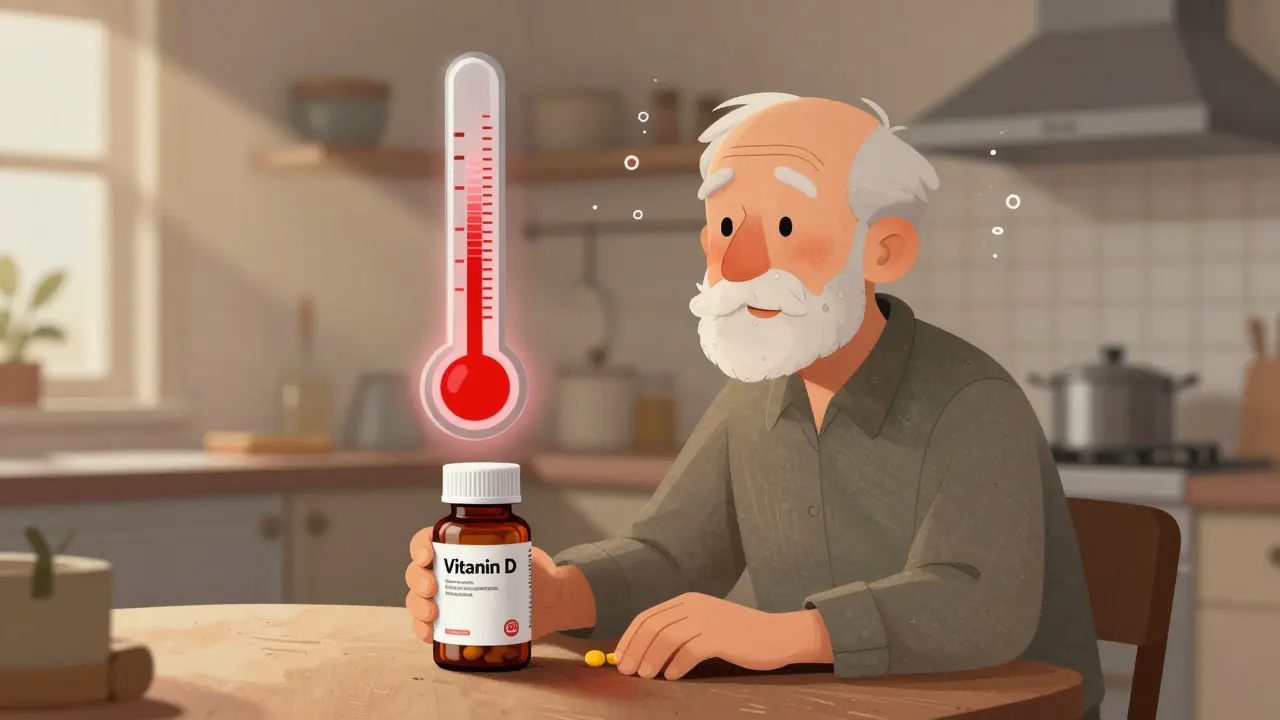
Hypercalcemia Risk Calculator
Vitamin D & Thiazide Interaction Risk
Enter your vitamin D dosage and thiazide type to check your hypercalcemia risk level. Based on Mayo Clinic studies showing 8-12% risk with >4,000 IU vitamin D.
Your Risk Assessment
Combining vitamin D supplements with thiazide diuretics might seem like a simple way to manage both bone health and high blood pressure - but it can quietly push your calcium levels into dangerous territory. This isn’t a rare edge case. It’s happening in clinics, pharmacies, and homes across the U.S. and U.K. every day. And most people don’t even realize they’re at risk.
How Thiazide Diuretics Change Your Body’s Calcium Balance
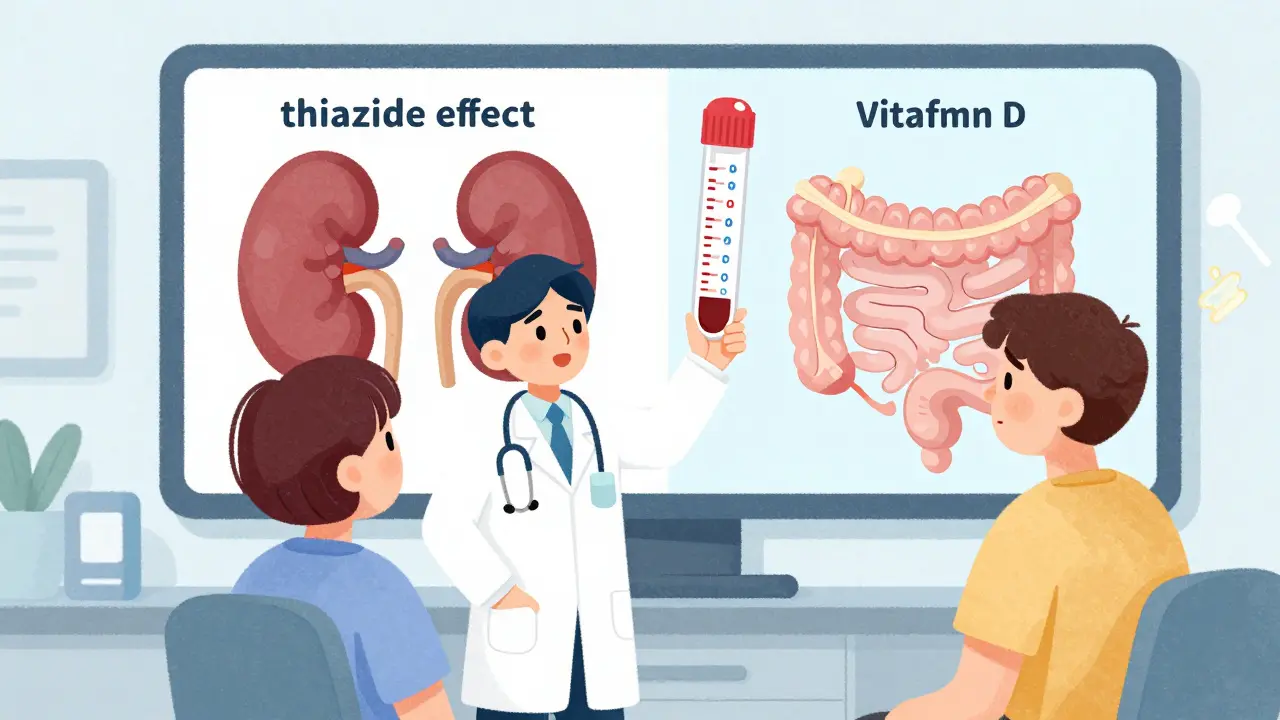
Thiazide diuretics - like hydrochlorothiazide (HCTZ) and chlorthalidone - are common blood pressure pills. They work by blocking sodium and chloride reabsorption in the kidneys, which helps lower blood pressure. But here’s the twist: while they make you pee out more sodium, they also make your kidneys hold onto more calcium. That’s not a side effect - it’s part of how they work.
Studies show thiazides reduce urinary calcium loss by 30-40%. That sounds good, right? Less calcium in your urine means less bone loss. But when you add vitamin D into the mix, that’s where things go sideways.
How Vitamin D Boosts Calcium - Too Much
Vitamin D isn’t just a supplement for bones. Its active form, calcitriol, turns on genes in your gut that let your body absorb way more calcium from food. At high doses (5,000 IU or more), this can increase intestinal calcium absorption by up to 80%. That’s powerful. And when your kidneys are already holding onto calcium because of a thiazide, that extra calcium doesn’t just disappear - it builds up in your blood.
This isn’t theory. A 2021 study from the Mayo Clinic found that people taking more than 4,000 IU of vitamin D daily while on a thiazide had an 8-12% chance of developing hypercalcemia. That’s more than four times higher than people on thiazides alone.
The Numbers Don’t Lie
Let’s put this in real terms. In 2022, over 53 million thiazide prescriptions were filled in the U.S. - mostly hydrochlorothiazide. Meanwhile, nearly half of American adults take vitamin D supplements. That’s millions of people potentially stacking these two.
The American Heart Association found that 15% of emergency room visits for drug-induced hypercalcemia involved this exact combo. And it’s not just about numbers - it’s about symptoms. Fatigue. Nausea. Constipation. Confusion. Frequent urination. These are the quiet signs that your calcium is too high. Many patients brush them off as "just getting older" or "side effects of meds." But they’re red flags.
One nurse practitioner on Reddit shared that in just six months, she had three patients with calcium levels over 11 mg/dL - all from taking 5,000 IU of vitamin D3 with HCTZ. All three ended up hospitalized.
Who’s Most at Risk?
It’s not just anyone. The highest risk group? Older adults. Over 80% of people over 65 take at least one of these drugs. Many take vitamin D because they’ve been told it’s essential for bone health. But they’re not told about the interaction.
A 2022 survey by the National Council on Aging found that 61% of seniors on thiazides had no idea they needed to monitor their calcium levels. That’s a massive gap in patient education.
People with kidney issues, parathyroid disorders, or those already starting with elevated calcium levels (above 10.2 mg/dL) are especially vulnerable. The American Geriatrics Society explicitly lists this combo as "potentially inappropriate" for older adults with baseline hypercalcemia.
What About Other Diuretics?
Not all water pills are the same. Loop diuretics - like furosemide - do the opposite. They make you pee out more calcium. So if you’re on furosemide for heart failure or fluid retention, vitamin D is much less risky.
Potassium-sparing diuretics like spironolactone don’t affect calcium excretion either. That makes them a safer alternative if you need to keep taking vitamin D. But thiazides are still preferred for high blood pressure because they control pressure better over 24 hours. So switching isn’t always easy.
How Much Vitamin D Is Safe?
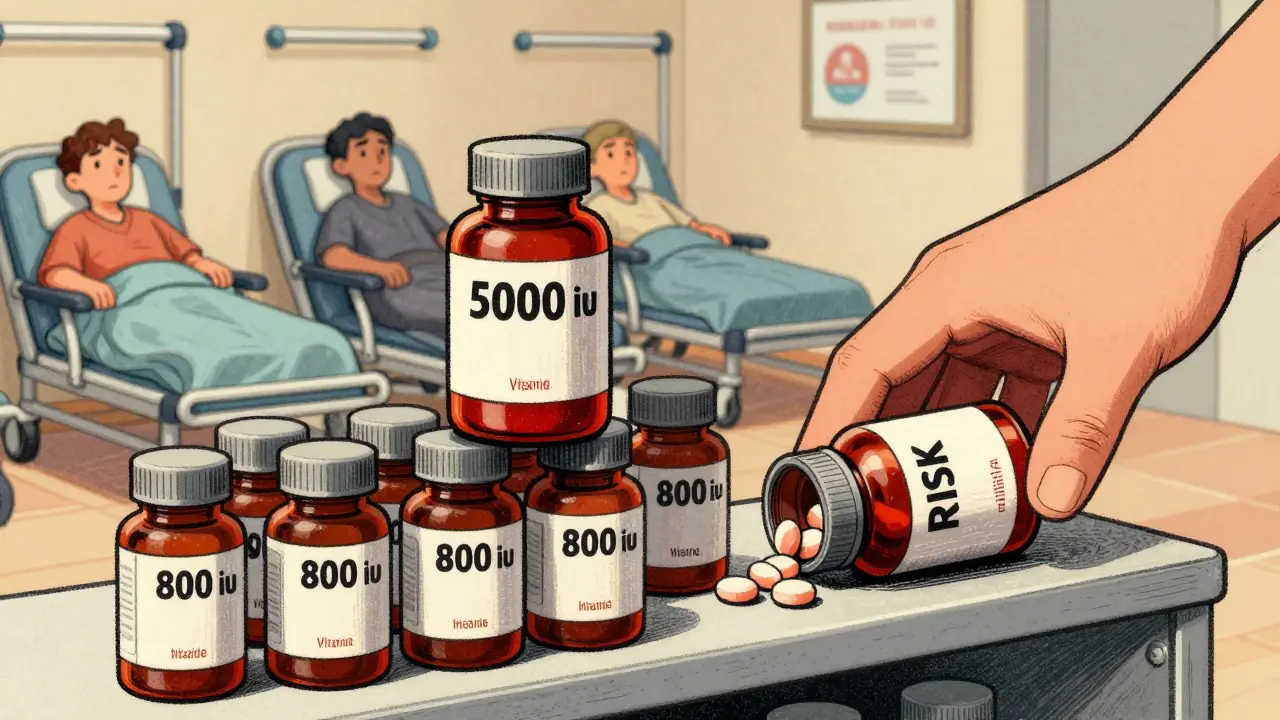
The Endocrine Society recommends 600-800 IU daily for most adults. That’s enough to support bone health without pushing calcium too high. But many people take 1,000, 2,000, or even 5,000 IU - often because they think "more is better."
The European Society of Cardiology advises keeping vitamin D under 2,000 IU/day if you’re on a thiazide. But even that might be too high for some. A 2022 study showed that patients taking just 800-1,000 IU daily maintained normal calcium levels while still improving bone density by 1.8% per year.
Bottom line: If you’re on a thiazide, stick to the lower end. Avoid anything over 1,000 IU unless your doctor specifically tells you otherwise.
What Should You Do?
If you’re taking both a thiazide and vitamin D, here’s what to do now:
- Get your serum calcium tested. This isn’t a routine blood panel. Ask for a corrected calcium level - it adjusts for albumin levels and gives a clearer picture.
- Test before you start. If you’re about to begin vitamin D, get your calcium checked first. If it’s already above 10.2 mg/dL, pause the supplement until you talk to your doctor.
- Monitor every 3-6 months. Don’t wait a year. The American Society of Nephrology recommends testing every 3-6 months if you’re on this combo. Annual checks aren’t enough.
- Check your dose. Are you taking more than 1,000 IU daily? Talk to your provider about lowering it. Many OTC supplements are 2,000-5,000 IU - that’s not needed for most people.
- Ask about alternatives. Could you switch to a different blood pressure med? Spironolactone or a calcium channel blocker might be safer with vitamin D.
Doctors Are Catching On - But Slowly
A 2023 survey showed 78% of internists know about this interaction. But only 42% know how often to monitor calcium. That’s a problem.
Some health systems are stepping up. Kaiser Permanente now triggers EHR alerts when a patient on a thiazide tries to order vitamin D over 2,000 IU. Since 2020, this has cut dangerous combinations by 63%.
Pharmacist-led interventions have also made a big difference. In one study, patients who got regular follow-ups from pharmacists saw hypercalcemia rates drop from 11.3% to just 2.7%.
What’s Next?
New research is emerging. In 2023, the FDA approved a genetic test called CalcCheck that looks at variants in the calcium-sensing receptor gene. This can predict who’s most likely to develop hypercalcemia from this combo. It’s not widely available yet - but it’s coming.
Also, newer diuretics like metolazone may have less calcium-sparing effect than traditional thiazides. That could mean safer options in the future.
For now, the message is clear: vitamin D and thiazides can work together - but only if you’re watching your calcium levels closely. Don’t assume it’s safe because you feel fine. Hypercalcemia doesn’t always cause obvious symptoms - until it does.
Final Takeaway
You don’t need to stop vitamin D. You don’t need to stop your blood pressure pill. But you do need to be smart about it. Get tested. Lower your dose if you’re taking more than 1,000 IU. Talk to your doctor. This isn’t about fear - it’s about control. With the right checks in place, you can protect your bones and your heart - without risking your health.



9 Comments
Steven Pam February 22, 2026
I’ve been on HCTZ for years and started vitamin D because my doctor said it was "good for everything." Didn’t think twice until my mom had a scary ER trip last year. Now I’m down to 800 IU and get checked every 4 months. Seriously, if you’re taking more than 1k with a thiazide, you’re playing Russian roulette with your kidneys.
Stop assuming supplements are harmless. They’re drugs with side effects.
Timothy Haroutunian February 24, 2026
Look, I get it. The article is thorough. But let’s be real-this isn’t exactly groundbreaking. Every pharmacist in a CVS has known this for a decade. The real issue isn’t the combo-it’s that doctors still treat vitamin D like a vitamin instead of a hormone with pharmacokinetics. I’ve seen patients on 5,000 IU daily with HCTZ and zero monitoring. That’s malpractice waiting to happen. And don’t even get me started on how OTC supplements are unregulated. You can buy 10,000 IU capsules next to gummy vitamins. This isn’t a medical issue. It’s a regulatory failure.
Erin Pinheiro February 26, 2026
i was just told by my dr to take 5000iu of d3 bc i have low levels... now im reading this and im like oh sh*t. my bp med is hctz too. i just took my last pill yesterday. should i stop? i dont even know what my calcium level is. why dont they tell you this stuff before you start??
Michael FItzpatrick February 26, 2026
This is why we need better patient education-not more warnings on labels. The problem isn’t the science; it’s the communication gap. Think about it: millions of people take vitamin D because they’re told it’s "essential"-like oxygen. But no one says, "This is a steroid analog that can trigger hypercalcemia when paired with certain diuretics." We treat supplements like candy. And then we act shocked when people get sick. We need mandatory counseling for high-dose vitamin D prescriptions, especially when paired with thiazides. Pharmacists should be required to flag it. Not optional. Mandatory. And insurance should cover the labs. This isn’t a niche concern-it’s a public health blind spot.
Brandice Valentino February 27, 2026
I mean, I’m not surprised. I took 2000 IU for "bone health" while on HCTZ for 8 months. My doctor didn’t even blink. I only found out because I read a random Reddit thread while waiting for my refill. Honestly? If you’re taking more than 1000 IU without a blood test, you’re just doing it for the vibes. And no, your "I feel better" isn’t evidence. It’s placebo. You’re not a wellness influencer. You’re a patient. Get tested.
Larry Zerpa February 28, 2026
Let’s not pretend this is some hidden danger. The Mayo Clinic study? Yeah, it’s real. But the sample size? Tiny. And they didn’t control for dietary calcium intake. You think your 800 IU supplement is the culprit? What about your cheese, your yogurt, your fortified orange juice? The real risk factor isn’t vitamin D-it’s the American diet. And let’s be honest: this whole narrative is being pushed by people who hate thiazides because they’re cheap. If this combo were so dangerous, why aren’t we seeing ER spikes? Why are hospitalization rates still below 0.5%? This feels like fearmongering dressed up as science.
Nandini Wagh March 2, 2026
I live in India. We don’t even have thiazides as first-line here. But I read this and thought-this is exactly why I stopped my 2000 IU D3 last year. My dad had a stroke from hypercalcemia. He was on HCTZ and didn’t know. I didn’t know. No one told us. So now I test my calcium every 6 months. And I tell everyone I know. This isn’t about fear. It’s about not being the next statistic.
tia novialiswati March 2, 2026
You're not alone! 💪 I was taking 5000 IU too until I found this post. Got my calcium checked last week-10.8 mg/dL. Scary! Switched to 800 IU and my doc said "good call." I feel way less tired now too. Seriously, if you're on a thiazide, don't guess-get tested. You got this! 🙌
Lillian Knezek March 3, 2026
This is all a Big Pharma scam. They want you to take more tests, more meds, more supplements. The real cause of hypercalcemia? Fluoride in the water. And glyphosate. They don’t want you to know that. The FDA approved CalcCheck? That’s just to sell genetic tests. I’ve been taking 10,000 IU for 5 years with HCTZ. I’m fine. Why? Because I don’t trust the system. 💊🩸