

QT Prolongation Risk Calculator
Patient Information
Medication Information
Your QT Prolongation Risk Assessment
Enter your information to see your risk assessment.
Recommended Actions
Recommended actions will appear here based on your risk assessment.
When you’re managing a serious mental health condition like schizophrenia, the last thing you want to worry about is your heart. But for many people taking antipsychotics, that’s exactly what doctors are asking them to do: monitor their heart rhythm. Why? Because some of these life-saving psychiatric drugs can stretch out the QT interval on an ECG - a change that, in rare but dangerous cases, can trigger a fatal heart rhythm called torsade de pointes.
What Exactly Is QT Prolongation?
The QT interval on an electrocardiogram (ECG) measures how long it takes your heart’s ventricles to recharge between beats. If that interval gets too long - known as QT prolongation - your heart can slip into an irregular, chaotic rhythm. The corrected QT interval, or QTc, adjusts for heart rate. A QTc over 500 milliseconds is considered clinically dangerous. If it jumps more than 60 ms from your baseline, or hits 550 ms or higher, it’s a red flag that needs immediate action. This isn’t theoretical. In the UK, heart rhythm specialists see this regularly. A 2023 study of 1,200 psychiatric inpatients found nearly 1 in 5 developed a QTc over 500 ms while on antipsychotics. Most of those cases involved taking more than one drug that affects the heart. That’s the real danger: combinations.Which Antipsychotics Carry the Highest Risk?
Not all antipsychotics are created equal when it comes to heart risk. The differences are stark. Thioridazine - once a common treatment - was pulled from the U.S. market in 2005 because it prolonged the QT interval by up to 35 milliseconds. It’s a classic example of a drug that saved lives from psychosis but cost lives through cardiac arrest. Haloperidol, still widely used, especially in hospitals, adds about 4-6 ms to the QTc. That might sound small, but in someone with low potassium, kidney problems, or on other heart-affecting meds, that tiny push can be enough to tip them into danger. Ziprasidone has a mixed reputation. Pharmacovigilance data shows it’s linked to a reporting odds ratio of 4.9 for QT prolongation - meaning it’s flagged more often than most. But a major 2023 ICU study found no significant QT increase in critically ill patients compared to placebo. Why the contradiction? Context matters. In a healthy person, ziprasidone may be fine. In someone on diuretics, with low magnesium, and already on a beta-blocker? That’s a recipe for trouble. At the bottom of the risk ladder? Lurasidone. Studies show it barely moves the needle - just 1-2 ms on average. It’s now a go-to option for patients with heart conditions or those on multiple cardiac medications. The CredibleMeds classification breaks it down clearly:- High risk: Thioridazine, haloperidol, ziprasidone
- Moderate risk: Quetiapine, risperidone, iloperidone
- Low risk: Lurasidone, aripiprazole, brexpiprazole, paliperidone
Cardiac Medications That Make Things Worse
Antipsychotics don’t act alone. Many heart drugs also prolong the QT interval - and when they’re taken together, the effect multiplies. Common offenders include:- Antiarrhythmics like amiodarone and sotalol
- Antibiotics like moxifloxacin and erythromycin
- Antifungals like fluconazole and ketoconazole
- Some antidepressants, especially citalopram and escitalopram
- Diuretics that cause low potassium or magnesium

Who’s Most at Risk?
Some people are just more vulnerable. Risk factors aren’t just about the drugs - they’re about the person.- Age over 65: Odds of QT prolongation increase by 2.3 times.
- Female sex: Women have a 1.7 times higher risk than men.
- Low potassium (hypokalemia): Found in 28% of cases with QTc > 500 ms.
- Low magnesium: Under 1.8 mg/dL significantly increases vulnerability.
- Heart disease: History of heart failure, prior arrhythmias, or prolonged QTc baseline.
- Genetic factors: Some people carry silent mutations that make them extra-sensitive to QT-prolonging drugs.
What Should Doctors Do?
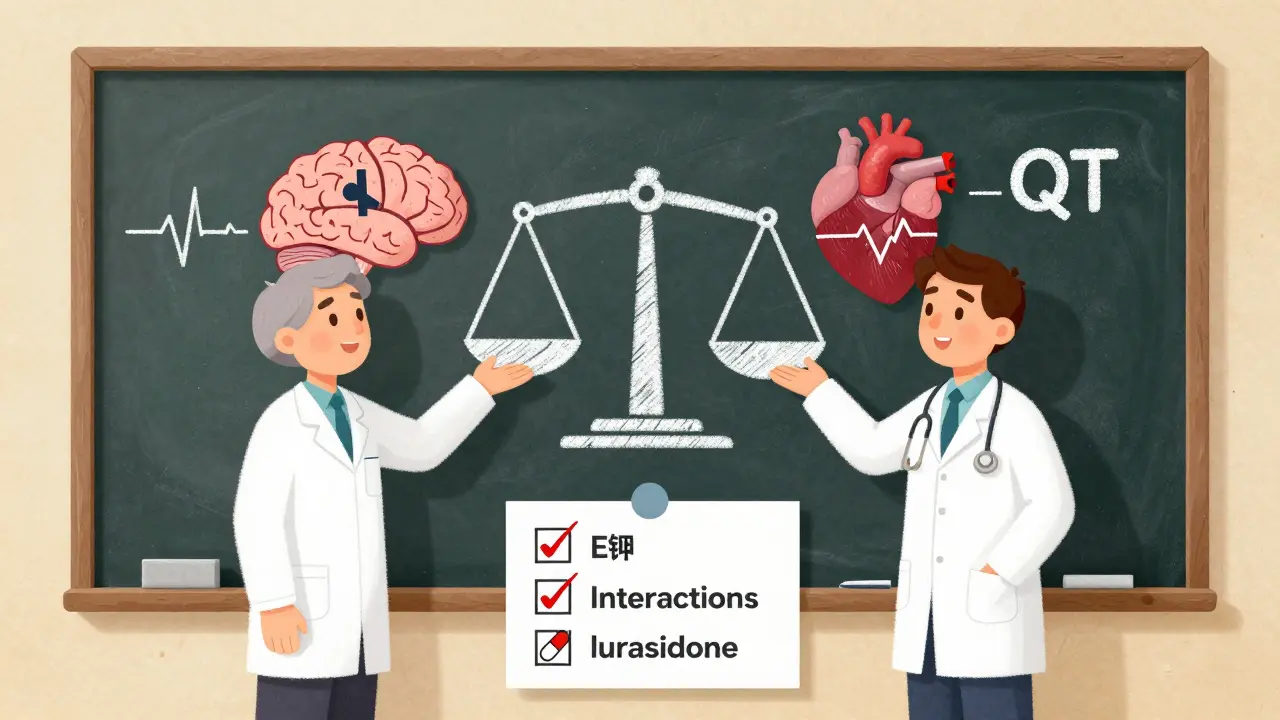
The British Heart Rhythm Society and other guidelines give clear steps:- Get a baseline ECG before starting any high- or moderate-risk antipsychotic.
- Repeat the ECG one week after reaching a steady dose. That’s when levels peak and effects are clearest.
- Check electrolytes. Potassium should be above 4.0 mmol/L. Magnesium above 1.8 mg/dL.
- Review all other medications. Use tools like CredibleMeds or a drug interaction checker. If you’re adding a new drug, ask: does this add to the QT burden?
- Monitor high-risk patients closely. Inpatients on haloperidol or ziprasidone should have continuous cardiac monitoring for the first 24-48 hours.
- Consider switching. If QTc rises above 500 ms, or increases by more than 60 ms from baseline, switch to a lower-risk agent like lurasidone or aripiprazole.
What About the Benefits?
It’s easy to focus on the risks - and yes, they’re real. But ignoring antipsychotics is far more dangerous. People with schizophrenia have a 5% lifetime risk of suicide. They’re 12% more likely to die from accidents. Studies show that those who take antipsychotics have 40% lower overall mortality than those who don’t. The risk isn’t in taking the drug - it’s in not taking it when you need it. The mortality curve is U-shaped: people on no medication and those on the highest doses have the worst outcomes. The sweet spot? Low to medium doses, carefully monitored. As one expert put it: “Assume all antipsychotics carry an increased risk of sudden cardiac death - but also assume that not treating psychosis carries a greater risk.”What Can Patients Do?
You don’t need to be a doctor to protect yourself.- Know your meds. Ask your pharmacist or doctor: “Does this drug affect my heart rhythm?”
- Keep track of your ECG results. Ask for a copy. Know your QTc number.
- Report symptoms: dizziness, fainting, palpitations, or sudden shortness of breath. Don’t wait.
- Don’t skip blood tests. Potassium and magnesium matter. If you’re on diuretics, ask if you need supplements.
- Bring all your meds - including over-the-counter and herbal - to every appointment.
The Future Is Monitoring - Not Avoidance
The FDA now requires all new antipsychotics to pass a “thorough QT study” before approval. That’s good. It means safer drugs are coming. Lurasidone’s sales grew 14% in 2022 as doctors shifted toward lower-risk options. Haloperidol sales dropped. By 2026, ECG monitoring for antipsychotic users is expected to rise by 22%. Telemedicine ECGs are making it easier to check heart rhythms without hospital visits. Integrated care models - where psychiatrists and cardiologists talk - are becoming standard. This isn’t about fear. It’s about smart management. Antipsychotics are essential. But they’re not harmless. With the right checks - baseline ECGs, electrolyte balance, drug reviews, and patient awareness - the risks can be managed without giving up the benefits. The goal isn’t to stop treatment. It’s to make it safer. Because for many, the alternative - untreated psychosis - is far worse than a monitored heart.Can antipsychotics cause sudden cardiac death?
Yes, in rare cases. Antipsychotics can prolong the QT interval, which may lead to torsade de pointes, a life-threatening arrhythmia. The risk is highest with certain drugs like thioridazine and haloperidol, especially when combined with other QT-prolonging medications or in patients with low potassium, heart disease, or older age. However, the overall risk remains low with proper monitoring.
Which antipsychotic has the lowest QT prolongation risk?
Lurasidone has the lowest risk of QT prolongation among commonly used antipsychotics. Studies show it causes minimal QTc changes - often less than 2 milliseconds - making it a preferred choice for patients with heart conditions or those on multiple cardiac medications. Aripiprazole and brexpiprazole are also low-risk options.
Do I need an ECG before starting an antipsychotic?
Yes, if you’re starting a high- or moderate-risk antipsychotic like haloperidol, ziprasidone, or risperidone. A baseline ECG is recommended by the British Heart Rhythm Society and other guidelines. A repeat ECG should be done one week after reaching a stable dose. Even for lower-risk drugs, an ECG is advised if you have heart disease, electrolyte imbalances, or are on other QT-prolonging meds.
Can I still take antipsychotics if I have a heart condition?
Yes, but you need careful management. Many people with heart disease take antipsychotics safely. The key is choosing low-risk agents like lurasidone or aripiprazole, avoiding drug combinations that prolong QT, checking electrolytes regularly, and monitoring ECGs. Avoiding antipsychotics entirely increases the risk of suicide and accidental death in schizophrenia - so the goal is safe use, not avoidance.
How do I know if my QT interval is too long?
Your doctor will measure your corrected QT interval (QTc) from an ECG. A QTc over 500 ms is considered dangerous. An increase of more than 60 ms from your baseline also requires attention. Men should aim for QTc under 450 ms; women under 470 ms. If your QTc is borderline, your doctor may check your potassium, magnesium, and review all your medications.
Are there alternatives to antipsychotics if I’m at high risk for QT prolongation?
There are no direct alternatives that work the same way for psychosis, but some antipsychotics are much safer. Switching from haloperidol or ziprasidone to lurasidone, aripiprazole, or paliperidone can reduce cardiac risk significantly. Non-pharmacological approaches like cognitive behavioral therapy (CBT) can help with some symptoms but cannot replace antipsychotics for severe psychosis. The decision should be made with your psychiatrist and cardiologist together.





12 Comments
John Chapman January 1, 2026
This is such a wake-up call 🚨 I had no idea my grandma’s haloperidol could be ticking like a bomb with her diuretics. Why isn’t this standard info on every script label??
anggit marga January 3, 2026
Americans always act like their meds are sacred while we in Nigeria just take what works and pray to the ancestors. QT prolongation? We got worse problems like no insulin or clean water
Urvi Patel January 4, 2026
Lurasidone is the only rational choice period full stop if you're not a medical school dropout who thinks 'low risk' means 'no risk' 🤦♀️
Joy Nickles January 5, 2026
I’m a nurse and I’ve seen this happen… like, a 73-year-old woman on risperidone + citalopram + furosemide… and her QTc was 560… and the psych team was like ‘oh she’s just anxious’… and then she coded… I mean… how??
Emma Hooper January 7, 2026
You know what’s wild? People will fight tooth and nail to keep their antipsychotic because it keeps the voices quiet… but the second you say ‘you need an ECG’ they ghost you like you asked them to donate a kidney. Priorities, people.
Martin Viau January 8, 2026
The CredibleMeds classification is a decent heuristic but it ignores pharmacokinetic interactions in polypharmacy. The real issue isn’t the drug-it’s the lack of pharmacogenomic screening. We’re treating psychosis like it’s 1998.
Kayla Kliphardt January 10, 2026
I’ve been on lurasidone for 3 years. My QTc is always 412. I get bloodwork every 3 months. I keep my potassium up. I don’t take NSAIDs or cold meds without checking. It’s not hard. It’s just… not talked about.
Marilyn Ferrera January 11, 2026
Baseline ECGs aren’t optional. They’re the bare minimum. If your doctor won’t order one, find a new one. Your heart doesn’t negotiate.
Branden Temew January 13, 2026
So… we’re saying the solution to psychiatric medication risks is… more paperwork? And more doctors talking? Groundbreaking. Next you’ll tell me we should brush our teeth after eating sugar.
Brandon Boyd January 13, 2026
Listen. I get it. It’s scary. But you know what’s scarier? Waking up one day and realizing you could’ve been here-if you’d just asked one question. Don’t be the person who says ‘I didn’t know.’ You know now. Go talk to your doc. Today.
Robb Rice January 15, 2026
I’m a patient with schizophrenia. I take aripiprazole. My ECGs are normal. My potassium is 4.2. I don’t take ibuprofen. I don’t use St. John’s Wort. I don’t skip labs. I’m alive because I treated this like a partnership-not a gamble.
Harriet Hollingsworth January 16, 2026
If you’re not getting an ECG before starting ANY antipsychotic, you’re not a doctor-you’re a roulette dealer. And your patients are the chips.