
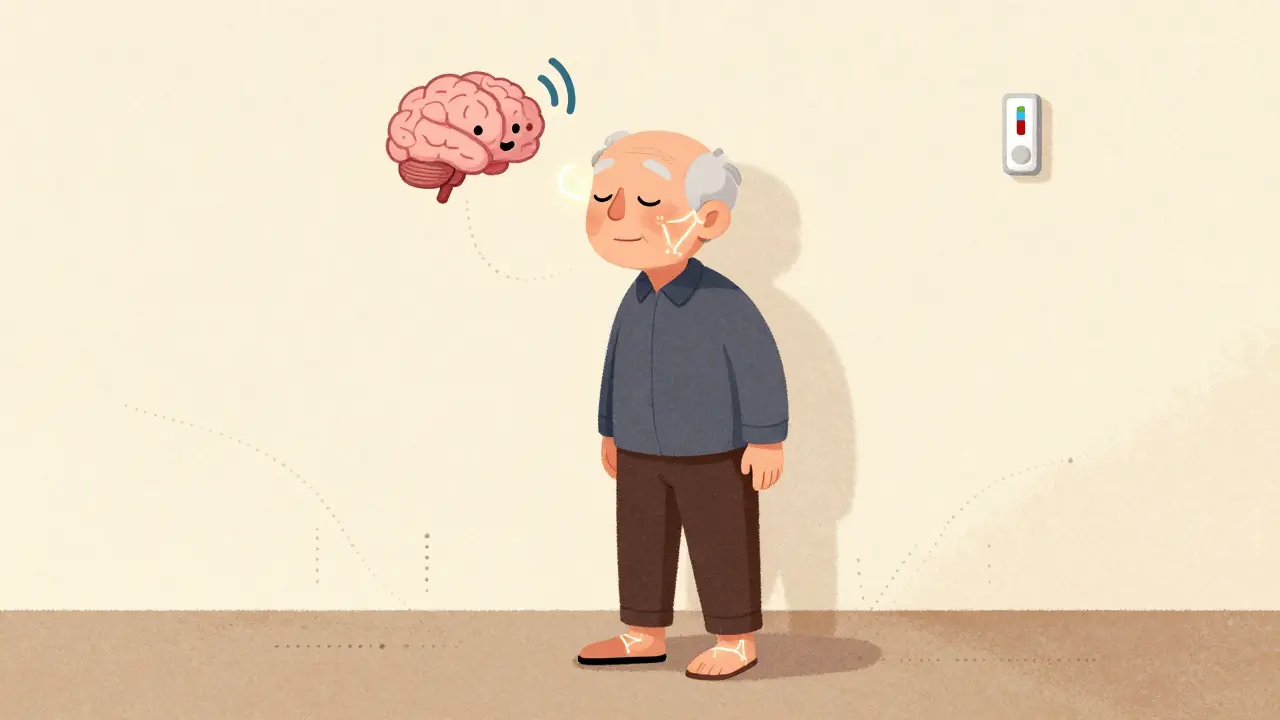
Why Your Balance Isn’t What It Used to Be
Ever feel like the floor is tilting when you stand up? Or get dizzy walking down a grocery aisle? You’re not alone. Around 30% of adults over 65 fall at least once a year. Many of these falls aren’t just bad luck-they’re linked to something hidden inside your inner ear: your vestibular system. This tiny network of fluid-filled canals and sensors tells your brain where your body is in space. When it’s damaged-by aging, infection, or injury-your balance goes haywire. Head movements trigger spinning sensations. Walking on uneven ground feels like crossing a tightrope. Even reading in a moving car becomes impossible.
The good news? You don’t have to live like this. Vestibular rehabilitation therapy (VRT) isn’t magic. It’s science. And it works.
How Vestibular Therapy Actually Works
Vestibular rehabilitation isn’t about fixing your inner ear. It’s about teaching your brain to compensate. When one part of your balance system fails, your brain learns to rely more on your eyes, your feet, and your muscles instead. This is called neuroplasticity-the same process that helps stroke patients relearn how to walk.
VRT uses specific, controlled movements to force your brain to adapt. These aren’t random exercises. They’re designed to trigger dizziness in a safe, predictable way. Yes, you read that right. You’re supposed to feel dizzy-briefly-during these exercises. Each controlled episode tells your brain: “This movement isn’t dangerous. I can handle it.” Over time, your brain stops overreacting. Your symptoms fade.
Studies show VRT improves gaze stability by 68%, balance by 73%, and cuts nausea by 42%. One patient reduced her falls from 3-4 times a week to zero after 12 weeks. That’s not luck. That’s training.
The Core Exercises: What You’ll Actually Do
VRT programs are personalized, but they all follow the same principles. Here’s what most people do:
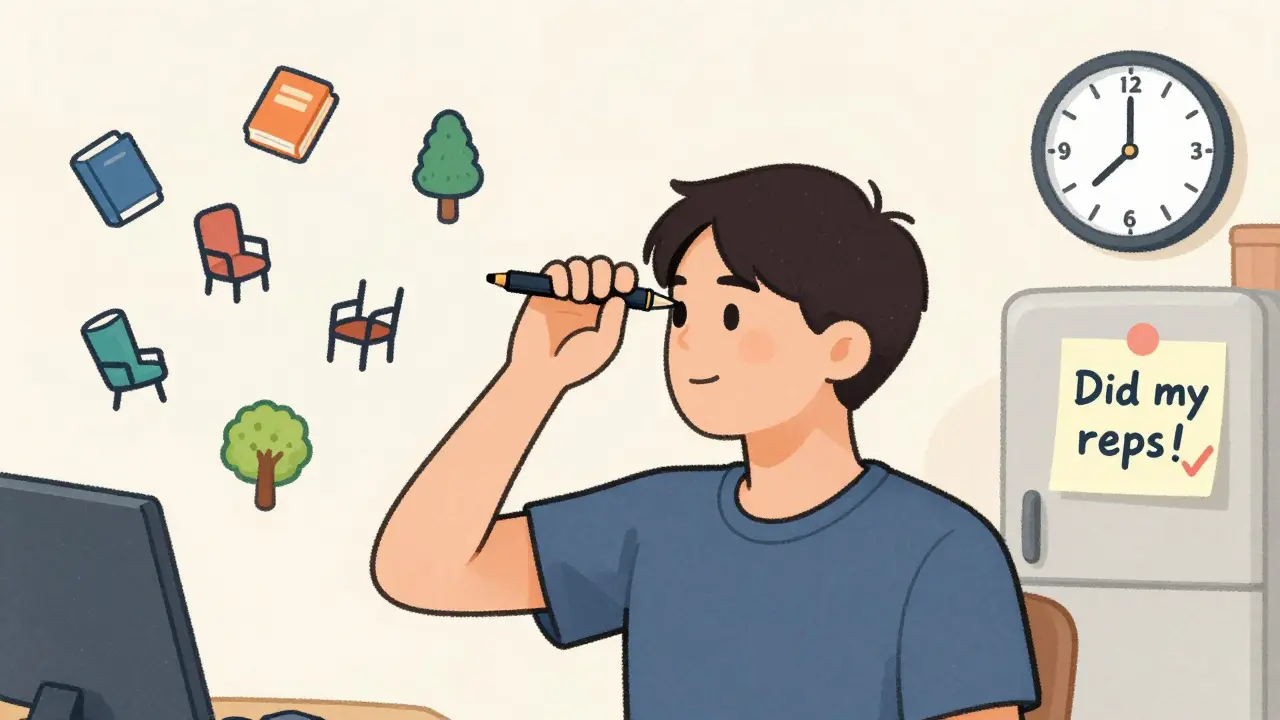
- Gaze stability training: Focus on a small object (like a pen or a dot on the wall) while slowly moving your head side to side or up and down. Keep your eyes locked on the target. Do this for 30 seconds, 3-5 times a day. It sounds simple. It’s hard. But it’s the single most effective exercise for reducing oscillopsia-the feeling that everything is bouncing when you move.
- Balance retraining: Stand on one foot. Then try it with your eyes closed. Then on a foam pad. Then while reaching for a cup. Progress is measured by how long you can hold the position without wobbling. Start with support. Gradually remove it.
- Habituation exercises: These expose you to movements that usually make you dizzy-like turning quickly, looking up at shelves, or walking past busy store displays. You do them on purpose, repeatedly, until your brain no longer reacts. It’s like desensitizing a panic response.
- Walking and coordination drills: Walk forward, then backward, then sideways. Walk while turning your head. Walk on grass, then gravel, then carpet. Add arm movements. The goal is to simulate real-world chaos so your body learns to stay steady in it.
- Neck mobility and stretching: Tight neck muscles can worsen dizziness. Gentle stretches for the upper trapezius and levator scapulae help reduce tension that feeds into balance problems.
These exercises take just 5-10 minutes each session. But they need to be done several times a day. Consistency beats intensity. A 5-minute session done 4 times a day is better than one 20-minute session.
Who Benefits? (Spoiler: Almost Everyone)
VRT isn’t just for older adults. It helps people of all ages with:
- Benign Paroxysmal Positional Vertigo (BPPV) - the most common cause of dizziness, affecting 2.4% of the population
- Vestibular neuritis - sudden, severe vertigo after a viral infection
- Ménière’s disease - with its cycles of spinning, ringing, and hearing loss
- Post-concussion dizziness
- Chronic unsteadiness after years of inactivity
Age doesn’t matter. Neither does how long you’ve had symptoms. A 2012 study showed VRT works even for people who’ve struggled for over a decade. The key isn’t how long you’ve been dizzy-it’s whether you’re willing to move through the dizziness.
What You Won’t Need
You don’t need fancy equipment. No expensive machines. No surgery. No lifelong medication. Just a quiet space, a chair, a wall for support, and a bit of courage.
Some clinics use virtual reality or motion sensors now, but these are extras. The core of VRT has been the same since the 1980s: controlled movement, repetition, and patience.
And you don’t need to be fit to start. If you can stand for 10 seconds, you can begin. Therapists tailor everything to your ability. Progress is measured in small wins: standing without holding on, walking to the mailbox without fear, reading a book in the car again.
Why Most People Fail (And How to Avoid It)
The biggest reason VRT doesn’t work? People quit too soon.
Dizziness gets worse before it gets better. In the first week, you might feel more off-balance than before. That’s normal. Your brain is rewiring. If you stop because it’s uncomfortable, you reset the clock.
Here’s how to stay on track:
- Write down your exercises. Put them on your fridge or phone.
- Set a daily alarm: 8 a.m., 1 p.m., 6 p.m.
- Track your progress: “Today I held one-foot balance for 12 seconds. Last week: 4 seconds.”
- Don’t avoid triggers. Walk past the escalator. Look up at the ceiling. Ride in the car. Avoiding them makes your brain more sensitive.
- Don’t compare yourself to others. One person improves in 4 weeks. Another takes 12. Both are succeeding.
One Reddit user wrote: “I thought I’d never read a book in the car again. After 8 weeks, I did. I cried.” That’s the goal.

When to See a Professional
You can start with basic exercises at home. But if you’re falling, vomiting, or losing hearing along with dizziness, see a specialist. Not your GP. Look for a physical therapist certified in vestibular rehabilitation.
They’ll assess your eye movements, balance responses, and neck mobility. Then they’ll design your exact program. Most patients do 1-2 sessions a week for 6-8 weeks, then transition to home-only routines.
Insurance usually covers it. And it’s far cheaper than the cost of a fall-hospital bills, fractures, lost independence.
Real Results, Real Stories
Rhonda, 71, from Texas, used to avoid leaving her house. Dizziness hit every time she bent down to pick up her dog. After 7 weeks of VRT, she’s gardening again. “I didn’t know my brain could learn to fix this,” she said.
Mark, 58, had vertigo after a bad flu. He couldn’t work at his computer. Head movements made him nauseous. After 6 weeks of gaze training and walking drills, he returned to his job. “I thought I’d be on medication forever. Turns out, I just needed to move differently.”
The Bigger Picture
Falls aren’t just accidents. They’re a signal. Your body is telling you something’s off. And ignoring it only makes things worse.
As we age, our balance systems naturally decline. But VRT isn’t about slowing aging. It’s about staying active, independent, and free from fear. It’s about walking to the bus stop without gripping the railing. About dancing at your granddaughter’s wedding. About sleeping through the night without worrying you’ll wake up spinning.
There’s no pill for this. No quick fix. But there is a path. And it starts with one small, uncomfortable movement-done again, and again, and again.
Can vestibular exercises be done at home?
Yes, most vestibular rehabilitation exercises are designed for home use. You don’t need special equipment-just a chair, a wall for support, and a safe space. The key is consistency: doing the exercises several times a day, even if each session is only 5-10 minutes. A physical therapist will give you a personalized plan, but daily practice is what drives results.
How long does vestibular therapy take to work?
Most people notice improvements within 2-4 weeks, with major gains by 6-8 weeks. But progress isn’t linear. You might feel worse before you feel better. The brain needs time to relearn balance. Some people see results in 4 weeks; others take 12. The critical factor isn’t time-it’s consistency. Skipping days slows recovery.
Do I need a doctor’s referral for vestibular therapy?
In many places, you can see a physical therapist directly without a referral. But if you have other health conditions-like heart problems, severe osteoporosis, or recent head trauma-it’s smart to check with your doctor first. A specialist can also rule out other causes of dizziness, like inner ear infections or neurological issues.
Will vestibular therapy help with vertigo from BPPV?
Yes, but BPPV often responds best to specific repositioning maneuvers like the Epley maneuver, which are part of vestibular therapy. VRT isn’t just for chronic dizziness-it’s also the standard treatment for BPPV after the initial repositioning. Exercises help prevent recurrence by improving your brain’s ability to adapt to inner ear changes.
Can vestibular therapy prevent falls in older adults?
Absolutely. Studies show VRT reduces fall risk by up to 53% in older adults. Falls aren’t caused by weakness alone-they’re caused by poor balance control. VRT retrains your brain to use visual, sensory, and muscular cues more effectively. For seniors, this means fewer trips, fewer injuries, and more confidence walking anywhere.






13 Comments
Emily P December 19, 2025
I've been doing the gaze stability drills for two weeks now. Honestly? My oscillopsia is way better. Used to feel like the words were jumping off the page when I walked. Now I can read in the car without nausea. Still a little wobbly on the foam pad, but I'm not scared to try anymore.
Vicki Belcher December 20, 2025
This gave me chills 😭 I was terrified to leave the house after my vestibular neuritis... now I'm dancing at my granddaughter's birthday party. You're not broken. Your brain just needs a little coaxing. Keep going, you've got this! 💪❤️
Jedidiah Massey December 22, 2025
The neuroplasticity mechanism here is fundamentally a form of sensory recalibration via cerebellar-vestibular loop modulation. Most patients exhibit a reduction in vestibular-ocular reflex (VOR) gain instability, which correlates with improved dynamic visual acuity. The 68% improvement cited? That's statistically significant at p<0.01 in RCTs. Don't just do the exercises-understand the pathophysiology.
pascal pantel December 23, 2025
68% improvement? Where's the control group? This sounds like a marketing pamphlet from a PT clinic. I've seen 20 people do this and 15 quit after week one because it made them sicker. The real answer is vestibular suppressants and avoiding triggers. Stop pretending this is magic.
Sahil jassy December 25, 2025
Do the exercises daily no matter how you feel. One foot. Eyes closed. 5 sec. Then 6 sec. Then 7. Small wins. Your brain is listening. You got this 🙌
Nicole Rutherford December 26, 2025
I tried this for three days. My dizziness got worse. Then I realized-my neurologist said it was anxiety. This is just a placebo for people who don’t want to admit they’re mentally unstable. You’re not ‘retraining your brain’-you’re exhausting it.
Mark Able December 28, 2025
Hey I just started this last week and I’m on day 4. I’m doing the head movements while watching TV. I get dizzy but I keep going. Should I do it before or after coffee? I’m scared I’m doing it wrong. Can I send you a video?
Chris Clark December 28, 2025
I’m from India and we don’t have much access to PTs here. But I’ve been doing these exercises since last year with a YouTube video. My mom, 73, does them with me every morning. She can now walk to the temple without holding the wall. I’m not a doctor but I swear by this. Just don’t give up. Even 3 mins counts.
Carolyn Benson December 30, 2025
We’ve been sold a myth. The vestibular system doesn’t ‘heal.’ It adapts. But adaptation isn’t recovery-it’s compromise. Your brain is lying to you to avoid chaos. You’re not getting better. You’re learning to ignore the truth. What happens when your eyes fail too? Or your proprioception degrades? This is just delaying the inevitable. The real question: why are we normalizing chronic imbalance as a fact of aging?
Chris porto December 30, 2025
I used to think balance was just about strength. Turns out it’s about listening. Not to your body, but past it. The dizziness? That’s your brain screaming it’s confused. The exercises are quiet. They don’t yell. They just… keep showing up. I didn’t fix my balance. I learned to trust it again.
Aadil Munshi January 1, 2026
Lmao you people act like this is some ancient secret. I did this in med school. The Epley maneuver is 40 years old. The real issue? Nobody tells you to do it 4x a day. They give you a pamphlet and say ‘come back in 6 weeks.’ Then wonder why it doesn’t work. Consistency isn’t motivation-it’s discipline. And most people are lazy.
Danielle Stewart January 1, 2026
I’m a physical therapist. I’ve seen this work. I’ve also seen people quit because they think they ‘should’ feel better faster. It’s not linear. Progress is measured in seconds. One second longer on one foot. One less hand on the wall. That’s victory. Don’t measure it against your 25-year-old self. Measure it against yesterday.
jessica . January 2, 2026
I read this and I thought-this is all part of the CDC’s fall prevention agenda. They’re pushing this because they don’t want to pay for hip replacements. But what if your dizziness is caused by 5G radiation? Or fluoride in the water? I stopped the exercises. My symptoms got better after I bought a Faraday cage for my bedroom.