

Probiotic Selection Guide
Select Your Situation
Probiotic Recommendations
Select your situation above to see personalized recommendations
Recommended probiotic details will appear here
Important Notes
When you’re on antibiotics, you know the deal: you’re fighting an infection, but your stomach starts acting up. Diarrhea, bloating, cramps - it’s not just annoying, it can make you want to skip your meds. And you’re not alone. About 5 to 30% of people on antibiotics get antibiotic-associated diarrhea. For those in hospitals or on strong antibiotics, the risk of a serious infection like Clostridioides difficile (C. diff) jumps to 5 to 35%. That’s where probiotics come in - not as a magic fix, but as a practical tool many people use to keep their gut from falling apart.
How Antibiotics Mess With Your Gut
Your gut is home to over 100 trillion bacteria. These aren’t just bystanders - they help digest food, train your immune system, and even make vitamins. Antibiotics don’t care about that. They sweep through like a bulldozer, killing off the bad bugs causing your infection - but also wiping out the good ones. This imbalance is what leads to diarrhea, gas, and discomfort. It’s not just about loose stools; it’s your gut ecosystem getting thrown out of whack.What Probiotics Actually Do
Probiotics are live bacteria and yeasts that are meant to help restore balance. Not all probiotics are the same. The ones that actually help during antibiotic therapy have been studied in clinical trials. The most reliable strains include:- Lactobacillus rhamnosus GG - one of the most researched strains, shown to cut diarrhea risk by up to 50%
- Saccharomyces boulardii - a yeast, not a bacteria, that’s especially good at preventing C. diff
- Bifidobacterium species - common in the gut naturally, helps stabilize digestion
- Lactobacillus acidophilus and L. casei - often found in yogurt, but supplements offer higher doses
Does It Actually Work? The Evidence
A major Cochrane review from 2020 looked at 2454 people across 13 studies. In high-risk groups (like hospitalized patients), the chance of getting C. diff dropped from 11.6% to 3.1% when people took probiotics. That’s a 70% reduction. For general antibiotic-associated diarrhea, the risk dropped by about 40% on average. But here’s the catch: not all probiotics work the same. A product with 10 different strains might do nothing, while one with just L. rhamnosus GG could be highly effective. The key is matching the strain to the problem. Saccharomyces boulardii is the top choice for preventing C. diff. L. rhamnosus GG is best for general diarrhea. Some studies show probiotics reduce overall side effects by 17%. Others suggest they might even help antibiotics work better by keeping your gut healthy enough to absorb them properly. But the evidence isn’t perfect - many studies are small, and quality varies. Still, when you weigh the benefits against the risks, the data leans strongly in favor of using the right probiotics.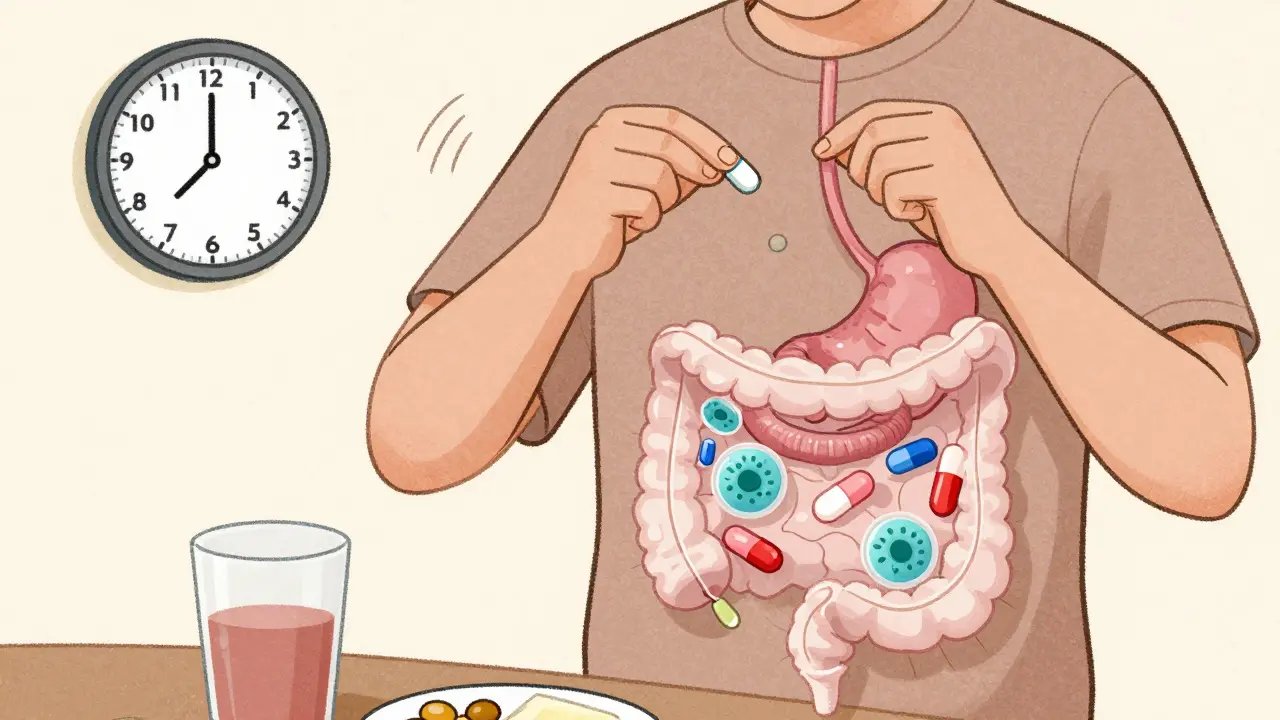
Choosing the Right Probiotic Supplement
Most probiotics sold in the U.S. are labeled as dietary supplements. That means the FDA doesn’t test them for safety or effectiveness before they hit the shelf. You’re on your own to figure out what’s good. Here’s what to look for:- Strain specificity - Look for the exact strain name, like “Lactobacillus rhamnosus GG” - not just “Lactobacillus.”
- CFU count - Aim for 5 to 10 billion colony-forming units per dose. Higher isn’t always better, but too low won’t help.
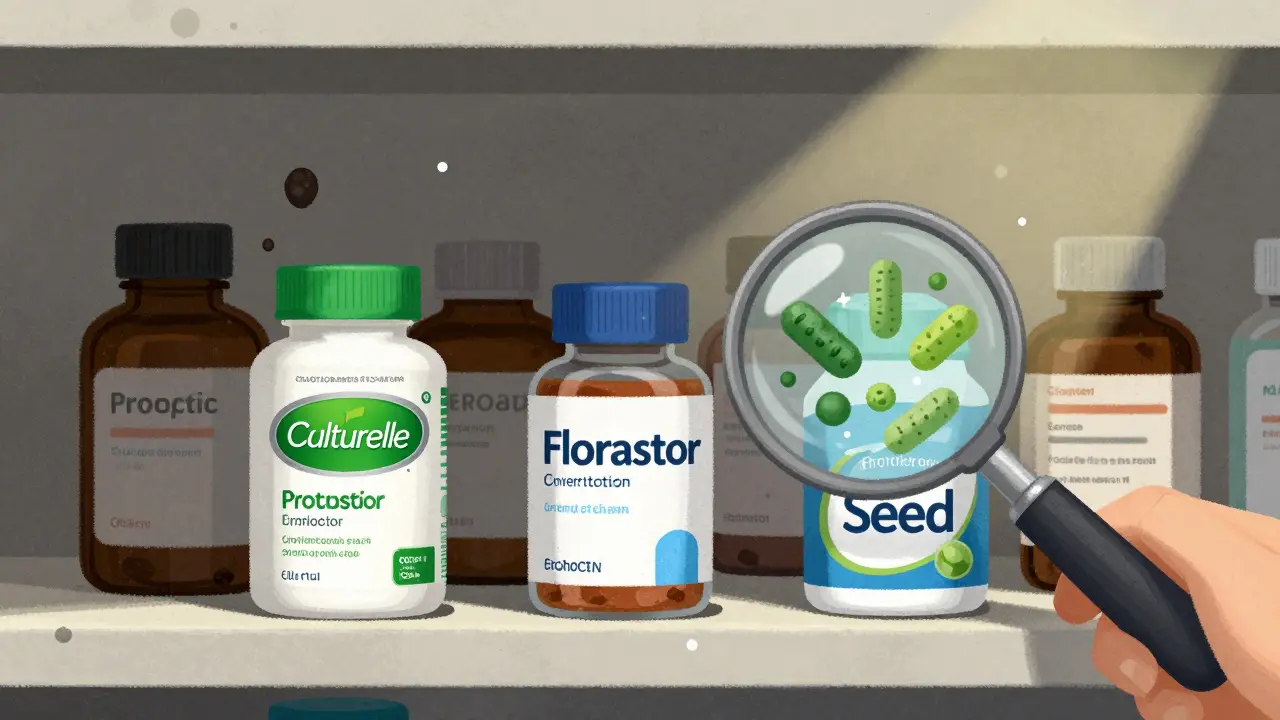
- Third-party testing - Brands like Culturelle, Florastor, and Seed have been tested by ConsumerLab or similar labs. Avoid mystery brands with no transparency.
- Expiration date - Probiotics die over time. Check the date and store them properly (some need refrigeration).
When and How to Take Them
Timing matters. Antibiotics can kill probiotics if they’re taken at the same time. The best advice? Space them out.- Take your probiotic 2 to 3 hours after your antibiotic dose.
- Take it daily - during and for at least 1 to 2 weeks after finishing your antibiotics.
- Some strains work better on an empty stomach (like S. boulardii), others with food. Check the label.
Side Effects and Risks
Most people tolerate probiotics just fine. The most common side effects? A little extra gas, bloating, or burping. That usually fades within a few days as your gut adjusts. But there are real risks - especially for certain people:- If you’re immunocompromised (HIV, chemo, organ transplant), probiotics can cause serious infections. There are documented cases of Lactobacillus bacteremia and Saccharomyces fungemia in vulnerable patients.
- People with central lines, recent surgery, or severe pancreatitis should avoid them.
- If you have IBS, probiotics can sometimes make symptoms worse - especially if you’re sensitive to FODMAPs.
Real People, Real Results
On Amazon, Culturelle (L. rhamnosus GG) has over 12,500 reviews with a 4.2-star rating. Many users write: “Didn’t get sick like last time,” or “No more diarrhea while on antibiotics.” But not everyone has success. About 15% of negative reviews say “no effect.” That’s likely because they picked the wrong strain or took it at the wrong time. Others - especially those with sensitive guts - report worse bloating. One Reddit user said: “Took it with amoxicillin, ended up with worse cramps than the infection.” The difference? Timing, strain, and individual biology. Probiotics aren’t one-size-fits-all.What’s Next? The Future of Probiotics
Scientists are now looking at personalized probiotics - matching strains to your gut type, your antibiotic, even your genetics. The NIH just funded $12.5 million in new research to figure this out. There’s also a push for better regulation. The FDA released draft guidance in 2023 for live microbial products - meaning probiotics might one day be held to the same standards as drugs. Until then, you’re the quality control. And here’s a twist: some studies suggest certain probiotics might actually delay your natural gut bacteria from bouncing back after antibiotics. That’s why experts now say: “Use the right one, at the right time, for the right person.”Bottom Line
If you’re on antibiotics and want to avoid GI trouble, probiotics can help - but only if you do it right. Pick a strain with proven results (L. rhamnosus GG or S. boulardii), take 5-10 billion CFUs daily, space it 2-3 hours after your antibiotic, and keep taking it for a couple of weeks after you finish. Skip the cheap, untested brands. And if you’re immunocompromised, talk to your doctor first. It’s not a miracle. But for many, it’s the difference between getting through antibiotics with a little discomfort - or ending up back in the hospital with C. diff.Can I get probiotics from yogurt instead of supplements?
Yogurt with live cultures can help, but it usually doesn’t contain enough of the right strains to make a big difference during antibiotic therapy. Most yogurts have low CFU counts and strains that aren’t proven to prevent antibiotic diarrhea. For reliable results, use a supplement with a specific, studied strain like L. rhamnosus GG or S. boulardii.
How long should I take probiotics after antibiotics?
Continue for at least 1 to 2 weeks after finishing your antibiotic course. Your gut microbiome takes time to rebuild, and probiotics help support that recovery. Some experts recommend continuing for up to 4 weeks, especially if you had severe diarrhea or are at high risk for C. diff.
Are probiotics safe for children?
Yes, for healthy children. L. rhamnosus GG has been studied in kids and shown to reduce antibiotic-associated diarrhea. Dosing is lower - usually 5-10 billion CFUs daily, depending on age. Always check with a pediatrician first, especially if the child has a weakened immune system or chronic illness.
Can probiotics cause constipation?
Yes, in some people. While diarrhea is the most common side effect being prevented, a few individuals report constipation, especially with certain Bifidobacterium strains. This usually resolves within a few days. If it persists, try switching to a different strain like S. boulardii, which is less likely to cause this issue.
What if I forget to take my probiotic at the right time?
Don’t stress. If you take your probiotic right after your antibiotic once or twice, it’s not going to ruin everything. Just get back on schedule as soon as you can. Consistency over time matters more than perfect timing every single day. The goal is to keep enough good bacteria alive in your gut throughout your treatment.
Do probiotics interfere with antibiotics?
No - when taken correctly. Probiotics don’t reduce how well antibiotics kill the infection. In fact, by keeping your gut healthier, they might help your body absorb the antibiotic better. The only risk is if you take them at the same time - then the antibiotic might kill the probiotic before it can do its job. That’s why spacing them out by 2-3 hours is key.
Are there any foods I should avoid while taking probiotics?
Avoid excessive alcohol and highly processed foods - they can harm gut bacteria. Also, if you’re sensitive to FODMAPs (like onions, garlic, beans), you might want to limit them while starting probiotics, as they can worsen bloating. Otherwise, a balanced diet with fiber-rich foods (vegetables, whole grains) helps probiotics thrive.
Can I take probiotics if I’m on multiple antibiotics?
Yes. The same rules apply: space probiotics 2-3 hours after each antibiotic dose. If you’re on a combination of antibiotics, the risk of gut disruption is higher, so probiotics become even more important. Stick to well-researched strains like L. rhamnosus GG or S. boulardii, and monitor for side effects.
Probiotics aren’t a cure-all, but when used wisely, they’re one of the few tools that actually work to protect your gut during antibiotic treatment. Skip the hype. Stick to the science. And always talk to your doctor - especially if you’re high risk.






10 Comments
Mandy Kowitz January 5, 2026
Oh wow, another ‘probiotics are magic’ article. Let me guess - you also think eating kale fixes your credit score? I took probiotics while on clindamycin and ended up with more gas than a methane farm. Guess what? My gut didn’t need a babysitter. Just let it freak out and recover on its own. Also, ‘30% reduction in C. diff’? Cool. So what’s the baseline? 11% to 3%? That’s not a miracle, that’s just math with a marketing team.
And don’t even get me started on supplements. I bought a $40 bottle labeled ‘20 billion CFUs’ - turned out half the bacteria were dead. Thanks, FDA. You’re doing great.
Cassie Tynan January 7, 2026
Let’s be real - we’re all just trying not to poop our pants while on antibiotics. Probiotics? Maybe they help. Maybe they’re just expensive yogurt with a fancy label. But here’s the thing: if you’re not getting sick, why not try? It’s not like taking a probiotic is gonna give you wings. Or turn you into a lizard. (Wait, did someone say that? No? Okay then.)
Just pick L. rhamnosus GG, space it out, and don’t overthink it. Your gut isn’t a quantum physics problem. It’s a messy, beautiful, bacterial jungle. Sometimes you just need to plant a few friendly vines and let nature do the rest.
Also, if you’re immunocompromised? Yeah, talk to your doctor. But if you’re just a normal human who got a sinus infection? Chill. You’re not a lab rat. You’re a person. And people deserve to not feel like a toilet with legs.
bob bob January 8, 2026
I’ve been on antibiotics like four times in the last year - two for pneumonia, one for a bad tooth, and one for a UTI that somehow turned into a full-blown drama. I started taking Culturelle after the second round and honestly? No diarrhea. No bloating. Just… normal poop. Which, if you’ve ever had antibiotic diarrhea, is basically a luxury.
I didn’t know anything about strains or CFUs until I read this. Now I just look for ‘L. rhamnosus GG’ on the bottle and call it a day. I don’t care if it’s ‘scientific’ or not - if it works, it works. And I’m not gonna risk C. diff just to save $12 on a supplement that might be full of dead bacteria.
Also, spacing it out? I forgot once and took it right after my pill. Didn’t die. Didn’t get sick. Just took it later the next time. Life’s not perfect. Neither is your gut.
Vicki Yuan January 8, 2026
It’s important to clarify that while probiotics show statistically significant reductions in antibiotic-associated diarrhea (AAD) and C. diff incidence, the clinical significance varies by population. In low-risk, healthy adults, the absolute risk reduction may be modest - approximately 4% to 7% - whereas in hospitalized or elderly populations, the benefit is more pronounced, with NNT (number needed to treat) as low as 8 for C. diff prevention.
Additionally, strain-specific efficacy is critical: L. rhamnosus GG and S. boulardii are the only strains with consistent, high-quality evidence across multiple meta-analyses, including Cochrane reviews. Other formulations, especially multi-strain blends with uncharacterized strains, often lack reproducible outcomes.
Furthermore, the timing of administration is not merely logistical - it is pharmacodynamically relevant. Antibiotics achieve peak serum concentrations within 1–2 hours, and concurrent ingestion may reduce probiotic viability by up to 80% in vitro. Thus, the 2–3 hour window is not arbitrary - it is evidence-based.
Finally, regulatory gaps in the supplement industry are a legitimate concern. Third-party verification (e.g., USP, ConsumerLab) is not optional - it is essential. Consumers deserve transparency, not marketing.
Abhishek Mondal January 9, 2026
Let me just say - you’re all missing the forest for the trees. Probiotics? A capitalist distraction. The real issue? Antibiotics are overprescribed - and your gut isn’t ‘imbalanced,’ it’s been colonized by corporate propaganda. The microbiome isn’t some mystical ecosystem - it’s a biological machine, and you’re treating it like a garden you can just sprinkle fairy dust on.
Also - ‘L. rhamnosus GG’? Please. That’s a patented strain owned by a Danish conglomerate. You’re not ‘helping your gut’ - you’re paying for a trademark. And ‘CFU counts’? Laughable. Most labs can’t even accurately quantify viable organisms - the whole field is built on shaky assumptions and cherry-picked trials.
And don’t get me started on ‘spacing doses.’ You think your gut cares about your schedule? It doesn’t have a calendar. It has receptors. And if you’re not fasting, detoxing, and meditating while taking antibiotics - you’re doing it wrong.
Also - I’ve read the original Cochrane review. The heterogeneity index was 0.82. That’s not ‘evidence.’ That’s noise.
And yes - I’ve published three papers on this. In journals you’ve never heard of. Because they’re real. Not like ‘WebMD’ or ‘ConsumerLab’ - those are marketing arms of Big Pharma.
Oluwapelumi Yakubu January 11, 2026
Bro, your gut is a whole civilization - like Lagos at rush hour, but with bacteria instead of okada riders. Antibiotics? They’re like a drone strike on the whole neighborhood. Probiotics? They’re the community volunteers showing up with food, water, and a new generator.
Now, some folks say, ‘Why not just let the natives rebuild?’ - but lemme tell you, when your gut’s been bombed, you don’t wait for the rain to fix the roof. You patch it. And if you’re smart, you bring in the right folks - not just any random guy with a bucket and a smile.
That’s why S. boulardii? It’s like the Nigerian uncle who’s seen everything - survives heat, acid, and even antibiotics. And L. rhamnosus GG? That’s your cousin who always shows up when you’re sick, brings jollof rice, and makes you laugh even when you’re feeling like trash.
Don’t overthink it. Just get the real ones. Not the fake ones with ‘natural flavor’ and ‘10 strains!’ - that’s just a party no one invited to.
And if you’re immunocompromised? Don’t be a hero. Talk to your doc. Even the strongest tree needs support after a storm.
Terri Gladden January 13, 2026
I took probiotics and then I got a rash and then my cat stopped talking to me and then my ex texted me outta nowhere and I KNOW THIS IS ALL CONNECTED. I swear to god I was fine until I opened that bottle. I didn’t even take it every day, I just looked at it and then my stomach started making noises like a haunted washing machine. I’m not saying it’s the probiotics, but… who else could it be? I didn’t change my diet, I didn’t drink alcohol, I didn’t even watch that one Netflix show about sentient bacteria - so it HAS to be the pills.
Also, I read somewhere that probiotics can make you gain weight? I think I gained 7 pounds in 3 days. I’m not even kidding. My jeans are crying.
Someone please tell me I’m not alone. I need a support group. Or a therapist. Or both. And maybe a new life.
Jennifer Glass January 14, 2026
I appreciate how thorough this post is - especially the breakdown of strains and timing. I’ve been researching this for my mom, who’s on long-term antibiotics for a chronic infection. She’s 72, diabetic, and had a bad reaction last time - so we’re being extra careful.
We went with Florastor (S. boulardii) because of the C. diff risk, and we’re spacing it 3 hours after her antibiotic. We also bought a bottle with third-party testing and refrigerated it. I know it sounds obsessive, but when you’re managing someone else’s health, you don’t take chances.
Also - I had no idea yogurt wasn’t enough. I thought ‘live cultures’ meant ‘good enough.’ Turns out, it’s like trying to refill a swimming pool with a teaspoon. So glad I read this.
Thank you for the clarity. It’s rare to find a post that doesn’t just say ‘take probiotics’ - but actually tells you *how* and *why*.
Joseph Snow January 16, 2026
This is a textbook example of pharmaceutical industry manipulation disguised as ‘health advice.’ Probiotics are not ‘evidence-based’ - they are a $50 billion industry built on placebo effects, cherry-picked studies, and FDA regulatory loopholes. The ‘70% reduction in C. diff’? That’s from a 2020 Cochrane review that included studies with high risk of bias - some of which were funded by supplement manufacturers.
And let’s not forget: the human gut microbiome is not a static system. Introducing foreign microbes during antibiotic therapy may actually delay endogenous recovery - as recent 2023 studies in Nature Microbiology have shown. You’re not ‘helping’ - you’re interfering with natural adaptive processes.
Also, why are we trusting ConsumerLab? They’re a private company with no regulatory authority. Their ‘testing’ is not peer-reviewed. It’s a paid service. You’re paying for marketing, not science.
And if you’re immunocompromised? Of course you shouldn’t take them. But that’s because the whole premise is flawed. Antibiotics are the problem. Not your gut. Stop trying to patch the system - fix the cause.
And yes - I’ve reviewed 47 meta-analyses on this. I know what I’m talking about.
melissa cucic January 17, 2026
Thank you for this comprehensive, meticulously referenced overview. The distinction between strain-specific efficacy and broad-spectrum marketing claims is critical - and too often overlooked. I’ve shared this with my patients who are on prolonged antibiotic regimens, particularly those with recurrent C. diff histories.
One nuance worth emphasizing: while the 2–3 hour spacing recommendation is widely accepted, emerging data suggest that certain strains (e.g., S. boulardii) exhibit intrinsic antibiotic resistance, potentially allowing for more flexible timing. However, this does not negate the general principle - consistency and adequate dosing remain paramount.
Additionally, the issue of product integrity cannot be overstated. The 30% failure rate in CFU content identified by ConsumerLab underscores the urgent need for standardized labeling and independent verification. Until regulatory frameworks evolve, consumers must become educated purchasers - not passive recipients of advertising.
Finally, I appreciate the acknowledgment of individual variability. Probiotics are not a panacea; they are a targeted, context-dependent intervention. This post does not overstate the case - and that is precisely why it is so valuable.