

Birth Control Effectiveness Calculator
Carbamazepine (Tegretol, Carbatrol) is an enzyme-inducing drug that breaks down birth control hormones, significantly increasing pregnancy risk. This tool calculates your risk based on your specific situation.
Your Birth Control Situation
Your Risk Assessment
Recommended Alternative
Note: Carbamazepine can reduce effectiveness of hormonal birth control by up to 42%. These estimates are based on medical studies published in the Journal of Clinical Pharmacology and the American Journal of Obstetrics and Gynecology.
If you're taking carbamazepine for epilepsy or nerve pain and you're also on the pill, you need to know this: your birth control might not be working. Not because you forgot a pill. Not because you were sick. But because carbamazepine is actively breaking down the hormones in your contraception before your body can use them.
What’s Really Happening in Your Body?
Carbamazepine - sold under brands like Tegretol, Carbatrol, and Equetro - is a powerful drug. It helps control seizures by calming overactive nerves. But it also tricks your liver into working overtime. Specifically, it ramps up an enzyme called CYP3A4. This enzyme is like a garbage disposal for drugs. When it’s turned up high, it starts chewing up the hormones in your birth control pills, patches, or rings faster than normal. That means less estrogen and progestin circulating in your blood. And when those hormone levels drop below a certain threshold, your body can ovulate. No ovulation suppression? No protection. That’s how pregnancy happens even when you take your pill every day at the same time. Studies show carbamazepine can slash the concentration of ethinyl estradiol (the estrogen in most pills) by up to 42%. Progestin levels drop by around 40%. These aren’t small numbers. They’re enough to wipe out the contraceptive effect entirely.Breakthrough Bleeding Isn’t Just an Annoyance - It’s a Red Flag
Spotting between periods. Light bleeding mid-cycle. Unexpected brown discharge. These aren’t just inconvenient. They’re warning signs. About 25-35% of women taking carbamazepine with hormonal birth control report breakthrough bleeding. And here’s the thing: if you’re not bleeding, that doesn’t mean you’re safe. Ovulation can still happen without any visible signs. But if you are bleeding? That’s your body screaming that hormone levels are too low to suppress ovulation or stabilize the uterine lining. A 2023 Cleveland Clinic review found that up to 40% of women on enzyme-inducing drugs like carbamazepine experience contraceptive failure. That’s not a rare side effect. That’s the rule, not the exception.The Pregnancy Risk Is Shockingly High
Let’s put this in perspective. If you take your birth control perfectly - no missed pills, no vomiting, no interactions - your chance of getting pregnant in a year is about 0.3%. Now add carbamazepine. That risk jumps to 20-25% per year. That’s one in five women getting pregnant while taking their pill every day. And most of them didn’t know this was even possible. Why? Because too many doctors don’t talk about it. A 2021 Cleveland Clinic survey found that 72% of women prescribed carbamazepine were never warned about the interaction with birth control. One Reddit user wrote: “I was on 1000mg Tegretol daily and got pregnant on Loestrin despite never missing a pill - my neurologist never warned me.”Why Higher-Dose Pills Won’t Fix This
You might think: “What if I just switch to a pill with more estrogen?” That’s a dangerous idea. Some older guidelines suggested pills with 50 mcg of ethinyl estradiol to outpace the enzyme boost. But here’s the catch: doubling the estrogen doesn’t double the protection. It just doubles your risk of blood clots. The American Academy of Neurology warns that women over 35 or with any clotting risk - even mild - face a 4.3-fold increase in venous thromboembolism (VTE) with high-dose estrogen. That’s not worth the gamble. You’re trading one serious health risk for another.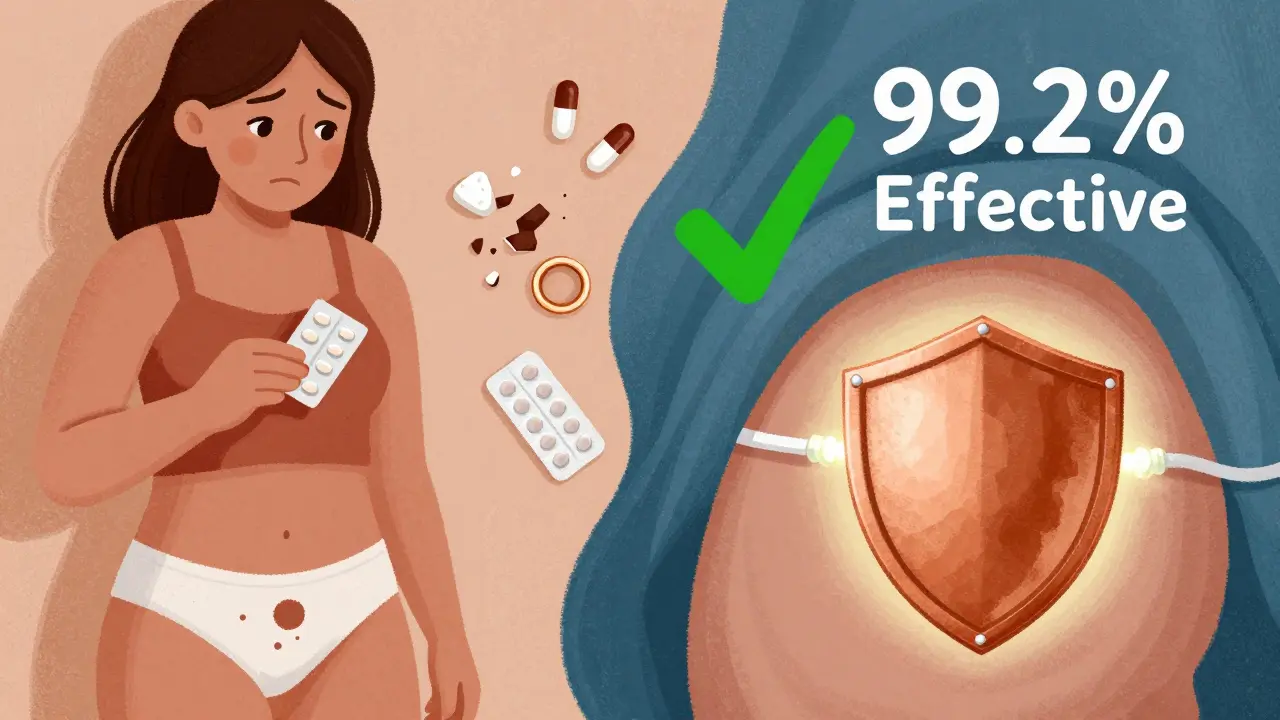
What Actually Works: Safe Alternatives
There are birth control methods that don’t care about carbamazepine. They work whether you’re on Tegretol or not.- Copper IUD (Paragard): 99.2% effective. No hormones. No interaction. Lasts up to 12 years. The gold standard.
- Hormonal IUD (Mirena, Kyleena, Liletta): Releases progestin directly into the uterus. Minimal absorption into blood. Still 99%+ effective. Even better if you want lighter periods.
- Contraceptive implant (Nexplanon): A tiny rod placed under your skin. Releases progestin slowly. Lasts 3-5 years. No liver metabolism. No interaction.
- Depo-Provera shot: Given every 3 months. Also works fine with carbamazepine. Failure rate under 1%.
What Doesn’t Work - And Why
Avoid these if you’re on carbamazepine:- Combined oral contraceptives (the pill): Too much liver metabolism. Unreliable.
- Birth control patch: Slightly better than pills, but still 20-25% less effective. Not recommended as a primary method.
- Vaginal ring (NuvaRing): Also metabolized by the liver. Risky.
- Progestin-only pills (mini-pills): Even more sensitive to enzyme induction. Failure rates spike above 20%.
What About Vomiting or Diarrhea?
If you get sick while on carbamazepine and birth control? Double trouble. Carbamazepine already lowers hormone levels. If you vomit within 2 hours of taking your pill, you lose even more. Studies show this can add another 9% to your failure risk. That’s not a coincidence - it’s a perfect storm. If you’ve had vomiting or diarrhea while on the pill and carbamazepine, treat it like a missed pill. Use backup contraception for 7 days. And talk to your doctor about switching to an IUD or implant - something that doesn’t depend on daily absorption.
Why This Matters Beyond Pregnancy
Carbamazepine is a known teratogen. That means it can cause birth defects. If you get pregnant while taking it, your baby has about a 1% risk of neural tube defects like spina bifida. That’s 10 times higher than the general population. And the risk goes up if you’re on higher doses or take it during the first trimester. This isn’t just about avoiding pregnancy. It’s about protecting your future child. That’s why experts like Dr. Hadine Joffe say: “Using reliable contraception is important while taking carbamazepine.”What to Do Right Now
If you’re on carbamazepine and using any form of hormonal birth control:- Stop assuming your pill is working. It’s not.
- Call your doctor or gynecologist today. Say: “I’m on carbamazepine. I need a contraceptive that won’t interact with it.”
- Ask about the copper IUD. It’s the safest, most effective option.
- Use condoms as backup until you have a new method in place. Even if you’re not planning to get pregnant.
- Don’t wait for breakthrough bleeding to act. By then, it might be too late.
What’s New? Better Options Are Coming
Good news: newer anti-seizure drugs don’t mess with birth control. Lacosamide (Vimpat) and brivaracetam (Briviact) show no significant interaction with hormonal contraceptives. If you’re considering switching medications, talk to your neurologist about these alternatives. But if you’re stuck with carbamazepine? Don’t wait. Your birth control isn’t failing because of you. It’s failing because of the drug. And that’s fixable.Can I still use the pill if I take carbamazepine?
No. Combined oral contraceptives, progestin-only pills, patches, and vaginal rings are all significantly less effective when taken with carbamazepine. Even with perfect use, failure rates jump from 0.3% to 20-25% per year. Relying on them puts you at high risk of unintended pregnancy.
Why does breakthrough bleeding happen with carbamazepine?
Breakthrough bleeding occurs because carbamazepine lowers hormone levels in your blood below what’s needed to maintain the uterine lining. When estrogen and progestin drop, the lining becomes unstable and sheds unpredictably. It’s a clear sign your contraception isn’t working - even if you don’t have bleeding, ovulation may still be happening.
Is the copper IUD safe to use with carbamazepine?
Yes. The copper IUD (Paragard) is 99.2% effective and has no hormones, so carbamazepine doesn’t affect it at all. It’s the most reliable, long-term option recommended by major medical groups for women on enzyme-inducing medications.
Can I take a higher-dose birth control pill to make it work?
No. Increasing estrogen to 50 mcg doesn’t reliably restore contraceptive protection, and it raises your risk of blood clots by 2.5 times. Guidelines from the American Academy of Neurology and others strongly discourage this approach, especially for women over 35 or with any clotting risk factors.
What should I do if I got pregnant while on carbamazepine and the pill?
Contact your doctor immediately. Carbamazepine increases the risk of neural tube defects like spina bifida by about 1%. Early prenatal care, including a detailed ultrasound and possibly a maternal serum alpha-fetoprotein (MSAFP) test, can help assess fetal risk. You’ll also need counseling on future contraception to prevent another unintended pregnancy.
Are there any birth control methods that work better than others with carbamazepine?
Yes. The most effective options are the copper IUD, hormonal IUD (Mirena, etc.), and the contraceptive implant (Nexplanon). All have failure rates below 0.1% and are unaffected by liver enzyme induction. The Depo-Provera shot is also effective. Avoid all oral, patch, and ring methods.
How common is this interaction?
It’s extremely common. Around 250,000 women in the U.S. alone take carbamazepine and are at risk of contraceptive failure. Studies show 30-40% of women on enzyme-inducing anti-seizure drugs experience unintended pregnancy when using hormonal birth control. Many aren’t warned - a major gap in care.
Can I switch to a different seizure medication to avoid this?
Possibly. Newer anti-seizure drugs like lacosamide (Vimpat) and brivaracetam (Briviact) don’t interfere with hormonal birth control. If you’re stable on carbamazepine, switching isn’t always easy - but if you’re struggling with contraception side effects or planning pregnancy, it’s worth discussing with your neurologist.






8 Comments
Michael Gardner December 16, 2025
So let me get this straight - you’re telling me my 10-year-old Tegretol prescription and my birth control have been playing hide-and-seek with my hormones this whole time? And no one told me? I’m not mad, I’m just disappointed. My gyno probably thought I was too dumb to understand. Guess I’m the guinea pig now.
Willie Onst December 16, 2025
Man, this hits different. I’ve been on carbamazepine since college - epilepsy’s a real party crasher - and I’ve been on the pill since I was 19. Never thought about the liver doing backflips to kill my hormones. It’s wild how medicine leaves people in the dark until something goes wrong. Thanks for the wake-up call. I’m booking an IUD appointment tomorrow. Copper for the win 🙌
Ronan Lansbury December 18, 2025
Of course the pharmaceutical-industrial complex wants you to switch to an IUD. More profit, less liability. Did you know the copper IUD was originally developed by the CIA to control Third World populations? And now it’s the ‘gold standard’? Coincidence? I think not. Also, carbamazepine is just a cover for the government’s mind-control program - the enzyme induction? That’s just the signal amplifier.
Constantine Vigderman December 19, 2025
OMG YES THIS IS REAL 😭 I was on Loretta (not Loestrin, my bad) and got preggo and thought I was just a dumbass for forgetting a pill. My neuro doc just shrugged and said ‘happens sometimes.’ NO IT DOESN’T HAPPEN ‘SOMETIMES’ - IT HAPPENS TO EVERYONE. I’m now rocking the Nexplanon and my skin’s clearer, my cramps gone, and I’m not terrified every time I pee on a stick. You’re a lifesaver. Send help (and condoms).
Tom Zerkoff December 19, 2025
It is imperative that individuals prescribed enzyme-inducing anticonvulsants receive comprehensive, evidence-based counseling regarding contraceptive efficacy. The data presented here is unequivocal: hormonal contraceptives are rendered clinically ineffective in the presence of carbamazepine. The standard of care must evolve to mandate proactive discussion and alternative provision - particularly given the teratogenic risk profile of carbamazepine. Patient autonomy cannot be compromised by systemic negligence.
Yatendra S December 21, 2025
life is just a series of invisible chemical wars inside us 🌌
we think we’re in control… but the liver? it’s the silent god. carbamazepine doesn’t care about your schedule. your pill doesn’t care about your hopes. the copper iud? it just… exists. quiet. strong. real.
maybe the answer isn’t more pills. maybe it’s less noise.
kevin moranga December 23, 2025
Let me tell you something - I’ve been on Tegretol for 14 years, and I’ve been on every birth control method under the sun. Pills? Nope. Patch? Nope. Ring? Nope. I had two unplanned pregnancies before I figured it out. And let me tell you, the copper IUD? It’s like the superhero of contraception. No hormones, no fuss, no brain chemistry drama. Just pure, unbothered, 99.2% effective peace. I’ve had mine for six years now. I forgot it was even there until I went in for a checkup and the nurse said, ‘You’re one of the lucky ones.’ I cried. Not because I was sad - because I finally felt safe. If you’re reading this and you’re on carbamazepine? Don’t wait for bleeding. Don’t wait for a scare. Go get it. Your future self will thank you. And yes, I’m still alive. And yes, I still have my period. And no, I don’t miss the pill.
Webster Bull December 24, 2025
Carbamazepine = birth control killer. IUD = free pass. Done. Go get one.