
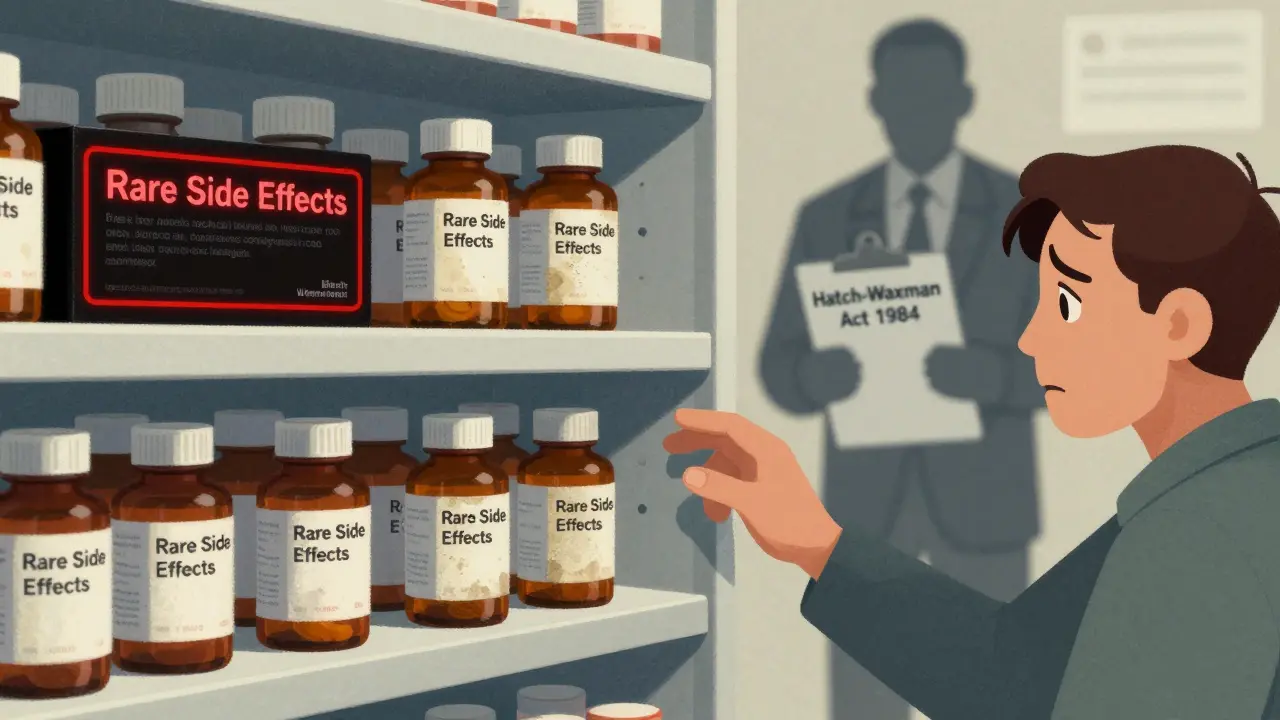
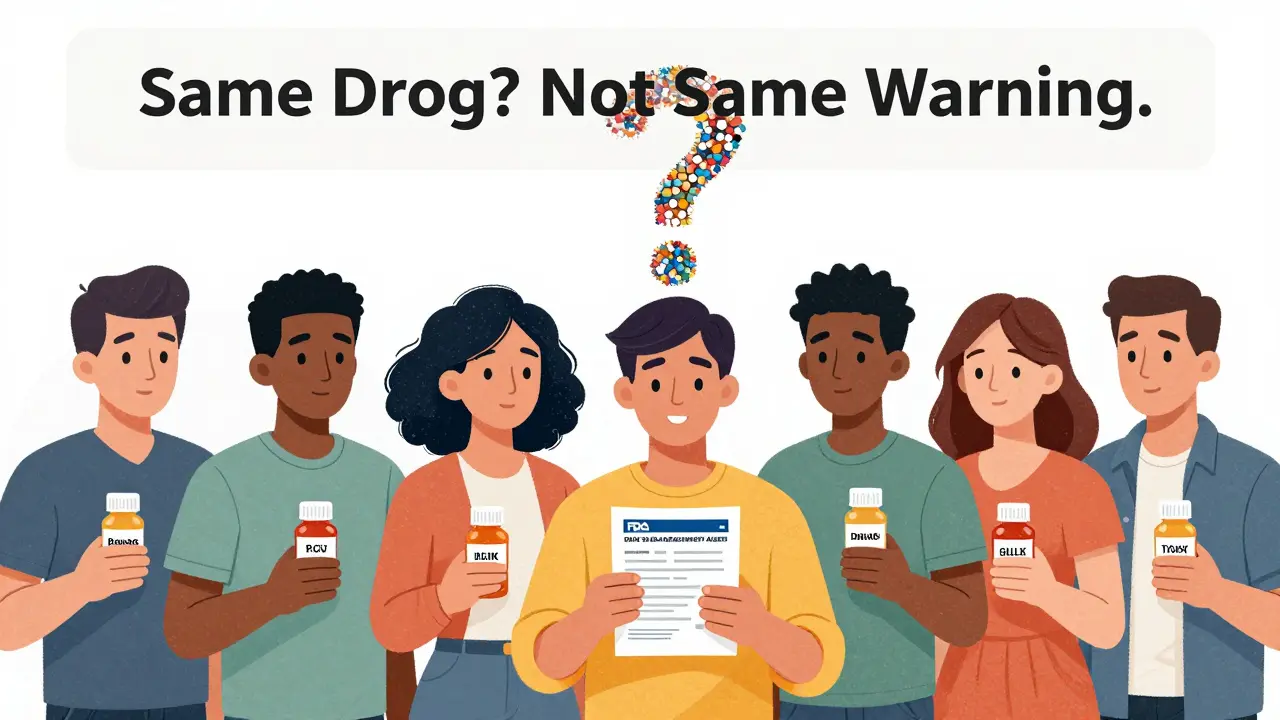
Every year, millions of Americans take generic drugs because they work just like brand-name medicines - but cost far less. What most people don’t realize is that when a safety warning pops up for a brand-name drug, the same warning doesn’t always appear on its generic version. That’s not a glitch. It’s the system. And it’s been a problem for decades.
How FDA Safety Alerts Work - and Where They Fall Short for Generics
The FDA tracks drug safety through its MedWatch program, which collects reports of side effects from doctors, patients, and pharmacies. When something dangerous shows up - like liver damage from a blood pressure pill or sudden heart rhythm changes - the FDA issues a safety alert. These alerts go out to doctors, pharmacists, and the public. They update labels. They warn people.
But here’s the catch: only the original brand-name drugmaker can update the warning label on its own. Generic drug makers? They’re stuck. Under the Hatch-Waxman Act of 1984, generic manufacturers must copy the exact label of the brand-name drug. They can’t add new warnings, even if new data shows a risk. They can’t change the language. Not without waiting months - or years - for the FDA to approve it.
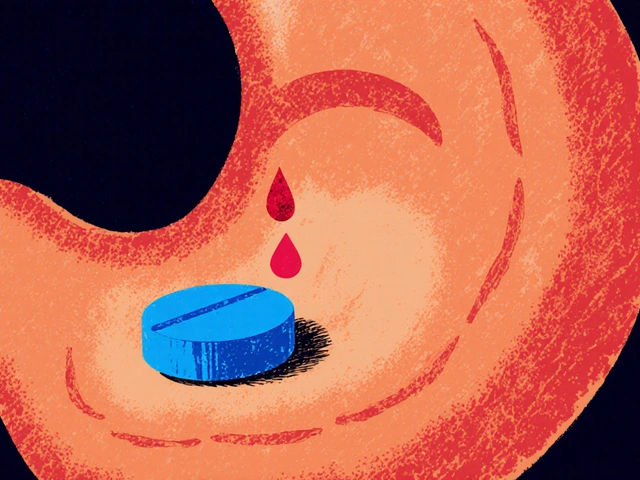
That means if a brand-name drug gets a new black box warning for kidney injury, the generic version might still say “rare side effects” for another year. Patients taking the cheaper version are left in the dark. And they’re not just a few people. Over 90% of prescriptions filled in the U.S. are for generics. Insurance companies often force patients to take them. If you’re on a generic, you’re probably not even told there’s a delay in safety updates.
Why Generic Labels Stay Out of Date
The system was designed to keep prices low and speed up access. The idea was: if a generic works the same as the brand, why make it different? But safety isn’t just about active ingredients. It’s about how the body reacts over time. And sometimes, the differences matter.
Generics must match the brand in strength, dosage, and active ingredient. But they can differ in fillers, dyes, coatings, and how the drug releases in the body. For most people, that’s fine. For some - especially those with allergies, kidney disease, or taking multiple drugs - those tiny differences can trigger side effects. The FDA’s own scientists, like Dr. Xin Fu, have pointed out that excipients (those non-active ingredients) can change how a drug behaves, especially in older adults or people with chronic conditions.
And here’s the real problem: the FDA doesn’t require generic makers to report adverse events the same way brand-name makers do. They rely on the same database - the FAERS (FDA Adverse Event Reporting System) - but they don’t have the same obligation to investigate or respond quickly. A 2019 review of the first generic version of the antipsychotic Rexulti found no safety signals in its first year. But that’s because they were watching. Most generics don’t get that level of attention.
The CBE-0 Loophole
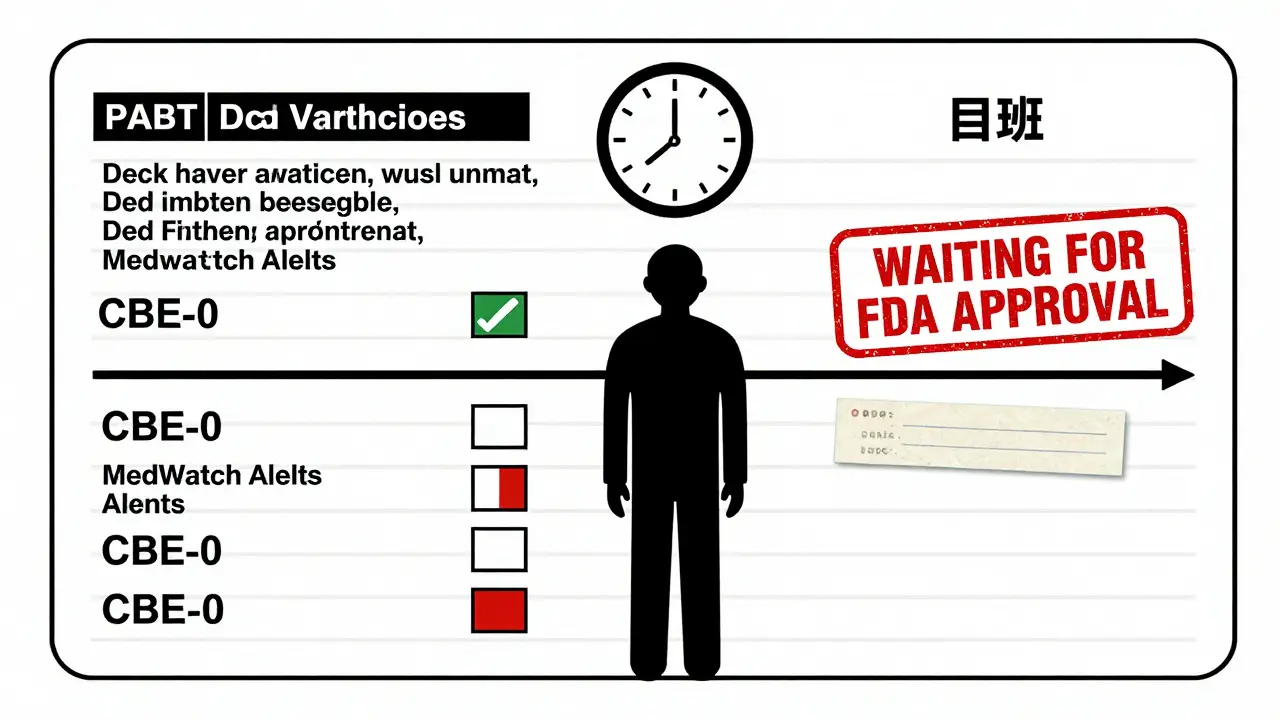
Brand-name companies can use something called a “Changes Being Effected” (CBE-0) supplement. It lets them update a label immediately - no waiting. They just notify the FDA after they’ve made the change. It’s fast. It’s flexible. It’s how warnings get added quickly when new risks appear.
Generic manufacturers can’t do this. In 2013, the FDA proposed letting them use CBE-0 too. That would’ve been a game-changer. Patients would get the same warnings, no matter which version they took. But the Generic Pharmaceutical Association (GPhA) pushed back. They argued it would open the door to lawsuits. If a generic maker adds a warning and then a patient sues, who’s liable? The brand? The generic? The FDA? The legal mess is real.
Twenty-seven consumer health groups wrote to the FDA in 2022 saying: “Patients deserve up-to-date safety info - no matter what’s on the bottle.” They’re right. But the industry says changing the rules would scare off generic makers, reduce competition, and drive prices up. So the proposal sits. Still. As of 2024, no final rule has been issued.
What You Should Do If You Take Generic Drugs
You can’t wait for the system to fix itself. Here’s what you can do right now:
- Check the FDA’s Drug Safety Alerts page - it’s updated daily. Search for your drug’s name, brand and generic. If the brand has a new warning, don’t assume your generic does too.
- Ask your pharmacist - not just “Is this generic the same?” Ask, “Has there been a safety update for the brand version? Is my generic’s label current?”
- Sign up for MedWatch alerts - you can get email notifications when new warnings are issued. Go to fda.gov/medwatch.
- Report side effects - even if you think it’s “just a headache.” If 10 people report the same reaction, it becomes data. And data drives change.
- Know your drug’s active ingredient - if you’re taking metformin, for example, the brand is Glucophage. The generic is just “metformin.” But if Glucophage gets a new warning for lactic acidosis, your generic might not reflect it. Track both names.
Complex Generics Are the New Frontier
Not all generics are the same. Simple pills? Easy to copy. But what about a patch that releases medicine slowly over days? Or an inhaler that needs perfect spray timing? Or an injectable with nanoparticles? These are called “complex generic drugs.”
They’re harder to make. Harder to test. And harder to monitor. The FDA has started special reviews for these - but the labeling rules haven’t changed. A patient using a generic asthma inhaler might get a slightly different spray pattern than the brand. That could mean less medicine reaches the lungs. No one knows until someone gets sick.
The FDA’s Office of Generic Drugs now runs proactive screening for these products. They’ve looked at the first generic versions of transdermal patches and extended-release injectables, comparing how they look, how they’re made, and how they behave in the body. But again - if a safety issue shows up, the label update still has to go through the FDA’s slow process.
Who’s Winning? Who’s Losing?
The system favors big pharma and insurance companies. Brand-name makers keep their patents longer because generics can’t change labels. Insurance companies save billions by forcing generics. Patients save money - but lose information.
There’s no clear winner here. Patients are the ones who pay the price in silence. A 72-year-old woman on a generic blood thinner might not know her brand-name version got a new warning about bleeding risk. She takes her pill. She doesn’t feel different. But the risk is there. And she has no way of knowing.
The FDA knows this. They’ve said it in reports. They’ve proposed fixes. But they haven’t acted. Why? Because the legal and economic stakes are too high. Change one rule, and you risk a flood of lawsuits. Or a collapse in generic competition. Neither option is easy.
What’s Next?
Don’t expect a quick fix. The FDA’s 2013 proposal is still open. No final decision has been made. But pressure is growing. More patients are asking questions. More doctors are pushing back. And as more complex generics hit the market - think cancer drugs, rare disease treatments - the gaps in safety communication will become harder to ignore.
For now, your best defense is awareness. Know your drug. Know the brand. Know the warning. And never assume “generic” means “same in every way.” It doesn’t. Not when it comes to safety.
Can generic drugs have different side effects than brand-name drugs?
Yes, but not because of the active ingredient. Generic drugs must contain the same active drug as the brand. However, they can use different fillers, dyes, or coatings. For most people, this doesn’t matter. But for those with allergies, sensitivities, or complex health conditions, these differences can affect how the drug is absorbed or how the body reacts. If you notice new side effects after switching to a generic, report it.
Why doesn’t the FDA require generic manufacturers to update labels immediately?
The FDA can’t force generic makers to change labels without violating the Hatch-Waxman Act of 1984, which requires generics to match the brand’s label exactly. While the FDA proposed letting them use the same fast-track process as brand-name makers (CBE-0), the proposal has been stalled since 2013 due to legal and industry pushback. Until that rule changes, generic labels lag behind.
How do I know if my generic drug has a safety alert?
Check the FDA’s Drug Safety and Availability page and search for both the brand and generic names. Also, sign up for MedWatch email alerts. Your pharmacist may not know unless you ask. Don’t rely on your prescription label - it may not reflect the latest warning. Always cross-check with the FDA’s official site.
Are generic drugs less safe than brand-name drugs?
No. All FDA-approved generics meet the same quality, strength, purity, and stability standards as brand-name drugs. The issue isn’t safety - it’s communication. The same drug, same active ingredient, same effectiveness - but the warning label might be outdated. That’s the gap, not the drug itself.
What should I do if I think my generic drug is causing side effects?
Talk to your doctor first. Then report it to the FDA through MedWatch - either online or by calling 1-800-FDA-1088. Even if you’re unsure, your report matters. The FDA uses these reports to spot patterns. One report might be ignored. But 50 reports about the same issue? That triggers an investigation. Your voice helps protect others.
Final Thought: Knowledge Is Your Shield
Generic drugs saved the U.S. healthcare system hundreds of billions of dollars. That’s huge. But safety shouldn’t be traded for savings. You have a right to know if your medicine has a new risk - no matter what’s printed on the bottle. Stay informed. Ask questions. Report what you see. The system won’t fix itself. But you can make sure it doesn’t leave you behind.


12 Comments
Shelby Price February 4, 2026
So I just checked my blood pressure med - generic lisinopril - and the label still says 'rare side effects.' Meanwhile, the brand got a black box warning for angioedema last month. I had no idea. Thanks for pointing this out. 😕
pradnya paramita February 6, 2026
From a pharmacovigilance standpoint, this is a systemic failure rooted in regulatory asymmetry. The Hatch-Waxman Act created a legal fiction that bioequivalence implies therapeutic equivalence - but excipient variability, dissolution profiles, and polymorphic differences can alter PK/PD parameters in vulnerable populations. The FDA's FAERS database is passive, and generics are under-monitored because manufacturers aren't obligated to conduct post-marketing surveillance like originators. Until the CBE-0 provision is extended, this is a patient safety liability waiting to explode.
Joseph Cooksey February 6, 2026
Oh, here we go again - the same old ‘generic drugs are dangerous’ fearmongering. Let’s be real: 90% of prescriptions are generics because they work. Same active ingredient. Same FDA approval. Same bioavailability. If you’re having side effects, maybe it’s your liver, not the pill. People panic because they don’t understand pharmacology. You think your body can tell the difference between a tablet made in New Jersey vs. Hyderabad? Please. The real problem is people who Google symptoms and then demand brand-name drugs because they think ‘more expensive = better.’ That’s not science - that’s marketing brainwashing.
And don’t even get me started on ‘reporting side effects.’ I’ve seen people report ‘I felt tired after taking metformin’ like it’s a crime scene. Chill out. If you’re tired, maybe stop eating 3 pizzas a day.
Harriot Rockey February 7, 2026
This is so important 💙 I switched to a generic thyroid med last year and started having palpitations - didn’t connect it until I saw the brand got a new warning about arrhythmia risk. I called my pharmacist and they had NO IDEA. Thank you for listing actionable steps - especially signing up for MedWatch. I just did it! 🙌 If you’re on meds, please do this. Your life could depend on it.
Nathan King February 8, 2026
It is an incontrovertible fact that the regulatory framework governing generic pharmaceuticals is archaic and fundamentally misaligned with contemporary pharmacological understanding. The inability of generic manufacturers to unilaterally update labeling constitutes a violation of the principle of informed consent. Patients are being exposed to differential risk profiles without disclosure. This is not merely bureaucratic inefficiency - it is a moral failure of public health governance. The FDA's inaction since 2013 is indefensible.
Katherine Urbahn February 8, 2026
Let me be perfectly clear: This is not a ‘gap’ - it is a dangerous, intentional, corporate-designed loophole that puts lives at risk. The Generic Pharmaceutical Association doesn’t care about you. They care about profits. They’re terrified of liability - so they’re letting people die quietly. And the FDA? They’re hiding behind ‘process.’ But process doesn’t save lives - transparency does. And if you’re taking a generic drug right now - and you don’t know whether your label is current - you are being lied to. Period.
Jhoantan Moreira February 10, 2026
I appreciate how thoughtful this post is. I'm from the UK and we have a similar issue with generics - but our system allows label updates if new evidence emerges. It’s not perfect, but at least we don’t have to wait 3 years for a bureaucratic stamp. I hope the FDA listens - because people deserve to know what’s in their medicine, no matter the price tag. 🙏
Zachary French February 11, 2026
Y’all are acting like this is some secret conspiracy. Newsflash: the FDA’s been screaming about this since 2010. The problem isn’t the FDA - it’s Congress. They won’t touch this because Big Pharma pays them to keep the status quo. And the generics lobby? They’re basically saying: ‘Let people get sick, but keep our margins.’ Classic. Meanwhile, I’m on a generic statin that’s been on the market since 2008 - and yeah, my label still says ‘rare muscle pain.’ But I’ve seen 3 people in my gym with rhabdo. Coincidence? Nah. This is a slow-motion disaster waiting for a viral tweet to blow up.
rahulkumar maurya February 12, 2026
As someone who studied pharmaceutical policy at LSE, I find it deeply ironic that the U.S. - a nation that prides itself on innovation - is clinging to a 40-year-old law that treats patients like lab rats. The CBE-0 mechanism exists for a reason: to respond to emerging safety data. Denying generics this tool isn’t protecting competition - it’s protecting corporate liability at the expense of autonomy. The real question isn’t ‘can generics change labels?’ It’s ‘why are we still pretending patients don’t deserve the same information as those who can afford brand-name drugs?’
And for the record - excipient differences aren’t ‘minor.’ A 2021 study in JAMA showed that 14% of elderly patients on generic warfarin had INR fluctuations linked to fillers. That’s not ‘rare.’ That’s statistically significant. And we’re still letting insurance companies force these on people without disclosure? This isn’t capitalism. It’s negligence dressed up as efficiency.
Janice Williams February 13, 2026
Oh please. You’re all acting like generic drugs are poison. The FDA approves them. They’re tested. They’re safe. If you want to be paranoid, take the expensive brand - but don’t drag everyone else into your fear-based narrative. People need affordable medicine. This post is just another example of how misinformation spreads faster than actual science. Wake up.
Justin Fauth February 14, 2026
Y’all are losing your minds over a pill. This isn’t Russia. This isn’t China. We’re the U.S.A. We have the best drug system in the world. If you don’t like your generic, go to the doctor and ask for the brand. Pay the extra $50. No one’s forcing you to take it. Stop crying and take responsibility. This is why America’s healthcare is broken - because people think they’re entitled to perfect safety with zero cost. Grow up.
Meenal Khurana February 14, 2026
Check your label. Ask your pharmacist. Report side effects. Done.