
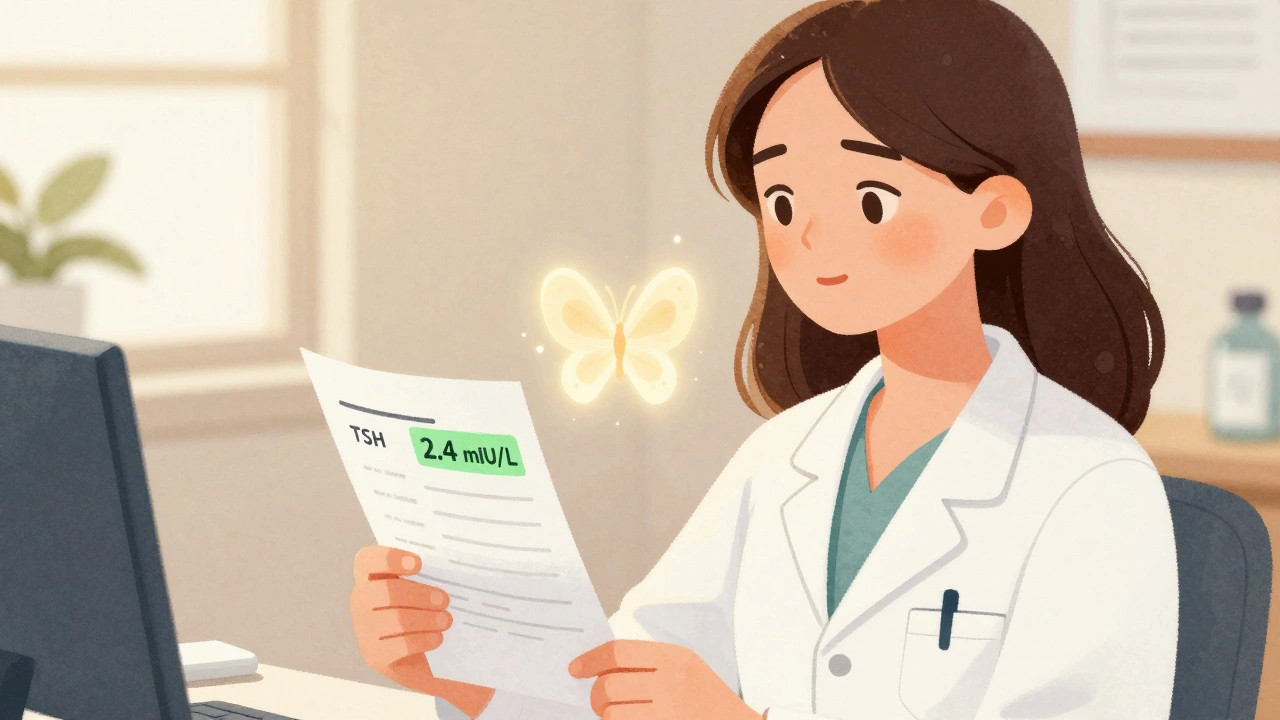
Trying to get pregnant? If you’ve been trying for months without success, your thyroid might be the hidden factor. Many women don’t realize that even a slightly off thyroid can mess with ovulation, hormone balance, and embryo implantation - all before you even miss a period. The key number doctors look at is TSH, or thyroid-stimulating hormone. And when you’re planning a pregnancy, the target isn’t the same as for someone who’s not trying to conceive.
Why TSH Matters More Than You Think
Your thyroid is a tiny butterfly-shaped gland in your neck, but it controls a lot. It tells your body how fast to burn energy, how to make proteins, and - crucially - how to regulate the hormones that trigger ovulation. If your thyroid is sluggish (hypothyroidism), your body doesn’t make enough of the active thyroid hormone, T4. That throws off estrogen and progesterone, which can stop you from ovulating at all.
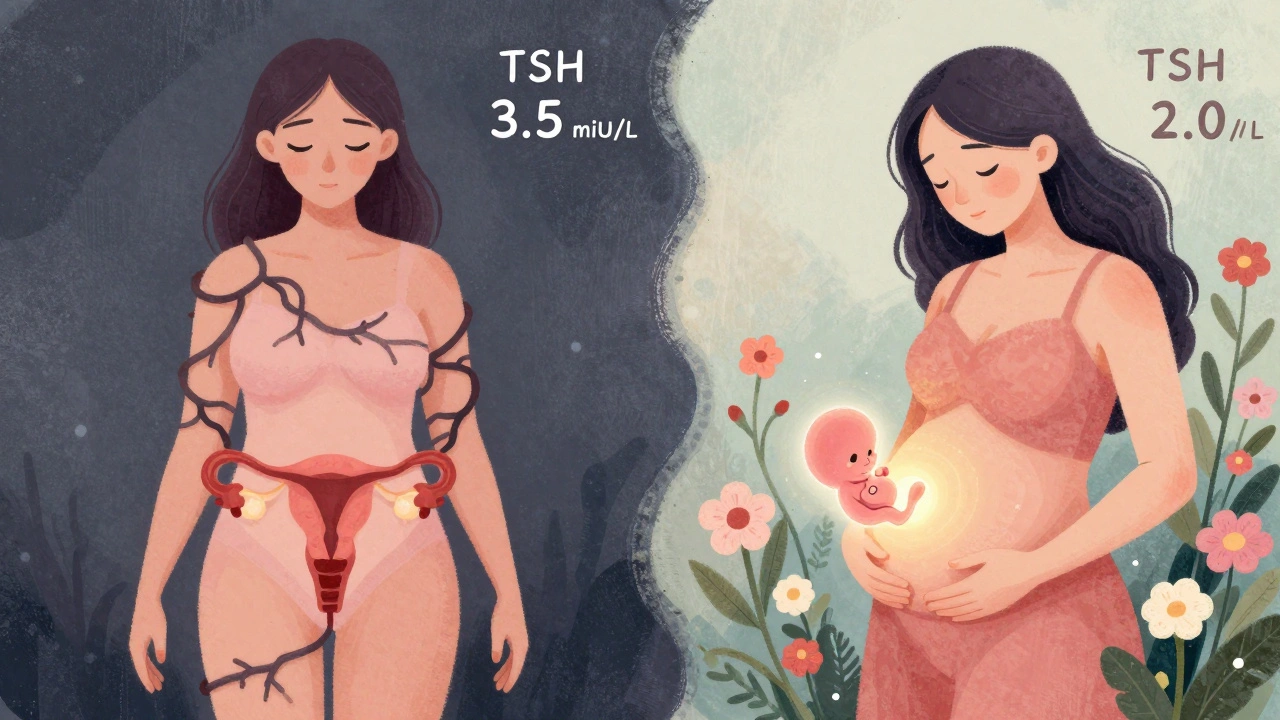
Even if your TSH is in the "normal" range - say, 3.0 or 3.5 mIU/L - it might still be too high for pregnancy. Research shows women with unexplained infertility are nearly twice as likely to have TSH levels above 2.5 mIU/L compared to women who conceive easily. A 2018 study found that 4.8% of women with unexplained infertility had TSH ≥2.5, while only 2.6% of fertile women did. That’s not a small gap. It’s a signal.
The Magic Number: TSH Below 2.5 mIU/L
The American Thyroid Association (ATA) has been clear since 2017: if you have hypothyroidism and are planning to get pregnant, your TSH should be under 2.5 mIU/L before you stop using birth control. This isn’t a suggestion. It’s a medical standard backed by dozens of studies showing that higher TSH levels during early pregnancy increase the risk of miscarriage, preterm birth, and even lower IQ scores in children.
Here’s why 2.5 is the cutoff: during the first 10 weeks of pregnancy, the baby can’t make its own thyroid hormone. It relies entirely on mom’s supply. If your thyroid is already working hard just to keep your TSH at 3.0, it won’t have the reserve to support the baby’s brain development. That’s why the target drops from the general population range (up to 4.5 mIU/L) to 2.5 for preconception.
What If You Have Hashimoto’s?
If you’ve been diagnosed with Hashimoto’s thyroiditis - the most common cause of hypothyroidism - your body is attacking your thyroid. That means your thyroid is already damaged and can’t ramp up production easily when pregnancy hits. For these women, the goal isn’t just under 2.5. It’s closer to 1.25-1.75 mIU/L. Why? Because your thyroid needs to work harder during early pregnancy, and if it’s already struggling, you need to give it a bigger head start.
Studies from the American Thyroid Association in 2023 show that women with Hashimoto’s who kept TSH under 1.5 before conception had significantly lower rates of early miscarriage compared to those who were just under 2.5. It’s not about being perfect - it’s about giving your thyroid the best chance to keep up.
Screening: Should You Get Tested?
The American Society for Reproductive Medicine (ASRM) recommends TSH testing for all women seeking fertility help. That’s because thyroid problems are one of the most common - and easiest - treatable causes of infertility. About 15-20% of women who can’t get pregnant have abnormal TSH levels. And 10-15% have thyroid antibodies (like TPOAb), which signal autoimmune thyroid disease even if TSH looks fine.
Even if you don’t have symptoms - no fatigue, no weight gain, no dry skin - you could still be affected. Many women only find out they have thyroid issues after a miscarriage. That’s why screening before you start trying is so important. A simple blood test can save months of frustration.
Levothyroxine: The Treatment That Works
If your TSH is too high, the fix is usually levothyroxine - a synthetic form of T4. It’s safe, cheap (as little as $4-$10 a month), and effective. But here’s what most women don’t know: once you get pregnant, your dose needs to go up - often by 25-50%.
Why? Because pregnancy increases your body’s demand for thyroid hormone. Your liver makes more binding proteins, your kidneys clear hormone faster, and your baby starts using your supply. If you don’t increase your dose, your TSH will creep up right when your baby needs it most.
And here’s the problem: a 2019 study found that only 37% of women with hypothyroidism got their dose adjusted in time after conception. Many waited until their first prenatal visit - by then, the baby’s brain development may have already been affected. The fix? Test TSH every 4 weeks before conception, and again as soon as you get a positive pregnancy test.
What About Natural Thyroid Pills?
Some women turn to desiccated thyroid (like Armour Thyroid) because it’s "natural." But here’s the truth: it’s not safe for pregnancy. These products contain both T3 and T4, and T3 levels spike and crash throughout the day. That’s bad for fetal development. The American Society of Reproductive Medicine and InVia Fertility Center both warn against using them during preconception or pregnancy. Stick with levothyroxine. It’s stable, predictable, and proven.
How to Take Levothyroxine Right
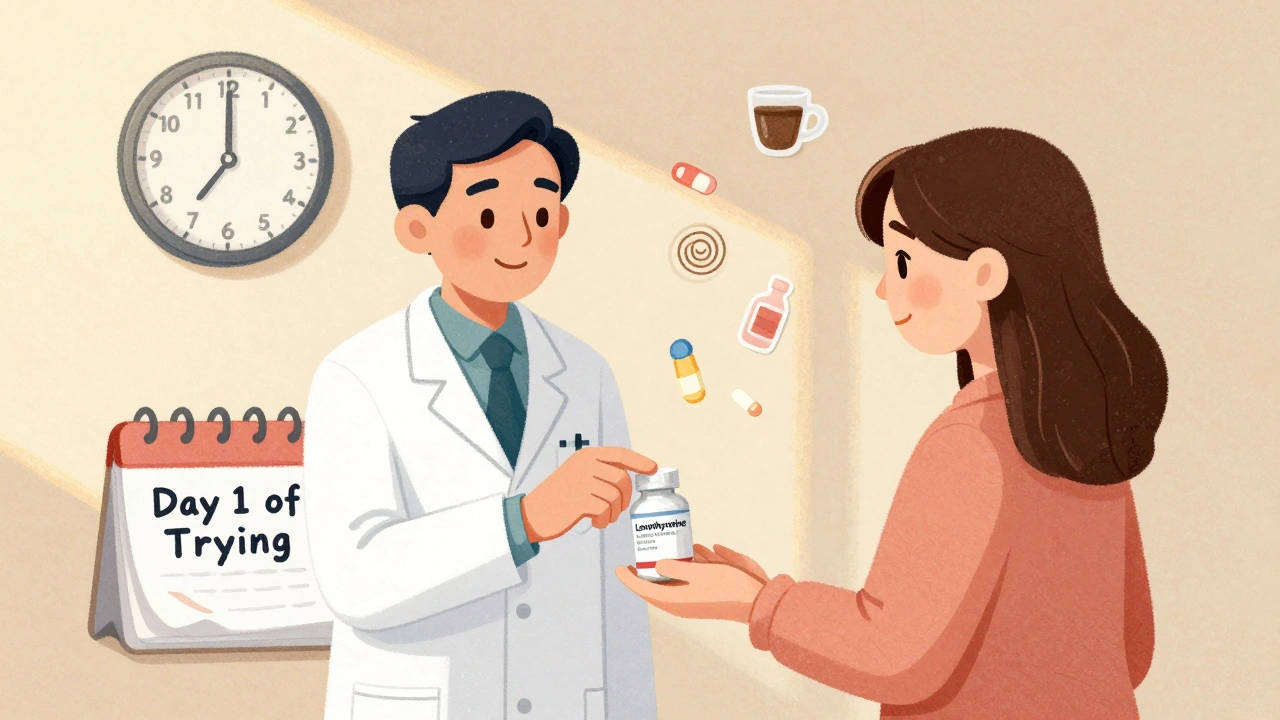
Getting the dose right isn’t enough. How you take it matters just as much. Levothyroxine is absorbed best on an empty stomach. Take it first thing in the morning with a full glass of water. Wait at least 30 minutes before eating or drinking anything else - especially coffee, which blocks absorption.
Avoid calcium, iron, and antacids for at least 4 hours after taking your pill. These minerals bind to levothyroxine and stop your body from using it. Many women take prenatal vitamins with iron at breakfast - that’s a problem. Space them out. Take your thyroid pill at night instead, if that’s easier. Just make sure it’s on an empty stomach and consistent every day.
What If Your TSH Is Normal But You Have Antibodies?
Some women have normal TSH but test positive for thyroid antibodies. That means your immune system is attacking your thyroid - even if it’s still working fine now. These women have a 45% higher risk of miscarriage, according to pooled studies. The good news? Levothyroxine treatment cuts that risk by nearly half.
The ASRM says there’s not enough evidence to treat all antibody-positive women with normal TSH. But many reproductive endocrinologists do - especially if you’ve had a prior miscarriage. It’s a judgment call, but it’s one backed by real data. If you’ve lost a pregnancy and have antibodies, ask your doctor about a trial of low-dose levothyroxine.
What’s New in 2025?
The guidelines are evolving. The European Thyroid Association now recommends even lower targets in the earliest weeks of pregnancy: under 1.8 mIU/L in weeks 1-4, under 2.2 mIU/L in weeks 5-8. Why? Because the baby’s brain starts developing at week 4 - before many women even know they’re pregnant.
A major NIH trial (NCT03856002) wrapping up in late 2024 is testing whether personalized TSH targets - based on your thyroid’s reserve and antibody levels - lead to better live birth rates than the one-size-fits-all 2.5 target. Early results suggest it might. But for now, the safest bet is still to aim for under 2.5 before conception.
Cost vs. Benefit: Why This Is Worth It
Levothyroxine costs about $4-$10 a month. A single miscarriage? That can cost over $7,200 in medical care, lost wages, and emotional toll. A preterm birth? That’s tens of thousands. A study in the Journal of Managed Care & Specialty Pharmacy found that optimizing TSH before pregnancy saves $1,850-$2,400 per pregnancy by reducing miscarriages and early deliveries.
And that’s not even counting the emotional cost. If you’ve been through a loss, you know it’s not just money. It’s sleepless nights, grief, and the fear that it might happen again. Fixing your thyroid might be the single most effective step you can take before trying to conceive.
What to Do Next
If you’re planning a pregnancy:
- Ask your doctor for a TSH test - and ask for it before you stop birth control.
- If your TSH is above 2.5, get tested for thyroid antibodies (TPOAb).
- If you have Hashimoto’s or antibodies and a history of miscarriage, discuss levothyroxine with your doctor.
- If you’re already on levothyroxine, get your TSH checked every 4 weeks until it’s under 2.5.
- Once pregnant, schedule a TSH test within 2 weeks of a positive test. Don’t wait for your OB appointment.
Thyroid health isn’t just about energy or weight. It’s about your ability to carry a baby to term. And if you’re trying to conceive, it’s one of the most powerful tools you have - and it’s as simple as a pill and a blood test.



8 Comments
Storz Vonderheide December 2, 2025
I wish more doctors would talk about this. I spent two years trying to get pregnant, and no one ever mentioned thyroid testing until after my third miscarriage. When I finally got my TSH checked, it was 3.8. Started on levothyroxine, dropped to 1.9 in six weeks, and got pregnant two cycles later. It’s not rocket science - it’s basic science that gets ignored because it’s cheap and easy. Why do we wait for heartbreak to do the simple stuff?
Pamela Mae Ibabao December 2, 2025
Oh please. Another ‘TSH under 2.5’ post. My endo told me 3.0 is fine, my OB said 2.5 is arbitrary, and my fertility clinic just laughed and said ‘you’re 32, just do IVF.’ Meanwhile, I’m taking levothyroxine because I read this on Reddit and now I’m scared to breathe. Can we just admit that the guidelines are all over the place and this is more about profit than science?
Gerald Nauschnegg December 4, 2025
Wait - so if I have Hashimoto’s and my TSH is 2.4 but I have high TPOAb, should I be on meds even if I’m not trying to conceive? I’ve been told ‘no’ by two doctors and ‘yes’ by two others. And now I’m reading that antibodies alone increase miscarriage risk by 45%? That’s wild. I’ve had two losses. I’m 34. I’m not waiting for another study. I’m getting on levothyroxine tomorrow. Someone tell me I’m not crazy.
Palanivelu Sivanathan December 5, 2025
Bro... the thyroid is the spiritual center of your metabolism, man! It's not just a gland - it's your body's inner fire, your kundalini energy, your chi! When your TSH is high, you're not just infertile - you're energetically blocked! I went from TSH 4.1 to 1.3 in 3 weeks with kelp, selenium, and chanting Om while standing on my head at sunrise! Science doesn't understand the soul's connection to the thyroid! And levothyroxine? That's just chemical slavery to Big Pharma! The body knows how to heal itself - if you let it! 🙏🔥
Erik van Hees December 7, 2025
Let’s be real - the 2.5 cutoff is a myth. The ATA guidelines were written by endocrinologists who don’t understand fertility. The real threshold is 2.0, not 2.5. I’ve seen 30+ cases in my clinic where women with TSH 2.3 had miscarriages. And if you’re under 30, you need to be at 1.5. Also, if you’re taking prenatal vitamins with iron, you’re doing it wrong - you need to space them 4 hours apart. Most women don’t know this. And no, desiccated thyroid is not safer - it’s a time bomb. T3 spikes kill fetal neural crest cells. Period. Don’t listen to influencers. Listen to the data.
Cristy Magdalena December 8, 2025
I’m so tired of people treating this like it’s just a number. I had a TSH of 2.7. I was told ‘it’s fine.’ I lost two babies. I didn’t cry because I was sad - I cried because I felt like my body was a broken machine they didn’t care to fix. And now, after years of therapy, I’m finally on levothyroxine - and I’m terrified to get pregnant again because I don’t trust the system. If you’re reading this and you’re trying - don’t wait. Demand the test. Demand the treatment. Even if they laugh. Even if they say ‘it’s not necessary.’ Your baby deserves a fighting chance.
Adrianna Alfano December 9, 2025
OMG I just found out my TPOAb is positive and my TSH is 2.1 and I’ve been trying for 18 months and I didn’t even know antibodies mattered?? I’m crying right now because I thought I was just ‘bad luck’ but it’s my immune system attacking my thyroid?? I’m going to my doctor tomorrow. I’ve been taking my pill with coffee because I’m lazy and I thought it was fine. I feel so stupid. But also… thank you for this post. I didn’t know any of this. I’m gonna start taking it at night now. Please someone tell me I’m not too late.
Casey Lyn Keller December 9, 2025
So… what if the whole TSH thing is just a placebo? What if the real reason women get pregnant after taking levothyroxine is because they finally started taking care of themselves - sleeping, eating better, reducing stress - and the pill is just a coincidence? I’ve seen people go from TSH 4.5 to 1.8 and still miscarry. And the cost savings argument? That’s a marketing tactic. The real cost is the emotional trauma no study can measure. Maybe we’re all just chasing numbers to feel in control.