

Ever seen a prescription filled with a generic drug and wondered if it’s really the same? You’re not alone. Many people hear the 80-125% rule and think it means a generic drug could have up to 25% less or 25% more of the active ingredient than the brand-name version. That’s not just wrong-it’s dangerously misleading. The truth is far more precise, and it’s backed by decades of science, strict testing, and real-world patient data.
What the 80-125% Rule Actually Measures
The 80-125% range isn’t about how much active ingredient is in the pill. It’s about how quickly and completely your body absorbs that ingredient. This is called bioequivalence. When a generic drug is tested, regulators don’t just check the tablet’s weight or chemical composition. They measure what happens inside your bloodstream after you take it.
Two key numbers are tracked: AUC (area under the curve), which tells you how much of the drug gets into your system over time, and Cmax (peak concentration), which shows how fast it gets there. These are measured in clinical studies using healthy volunteers. Blood samples are taken every 30 to 60 minutes for up to 72 hours after taking the drug. Then, scientists compare the generic version to the brand-name version.
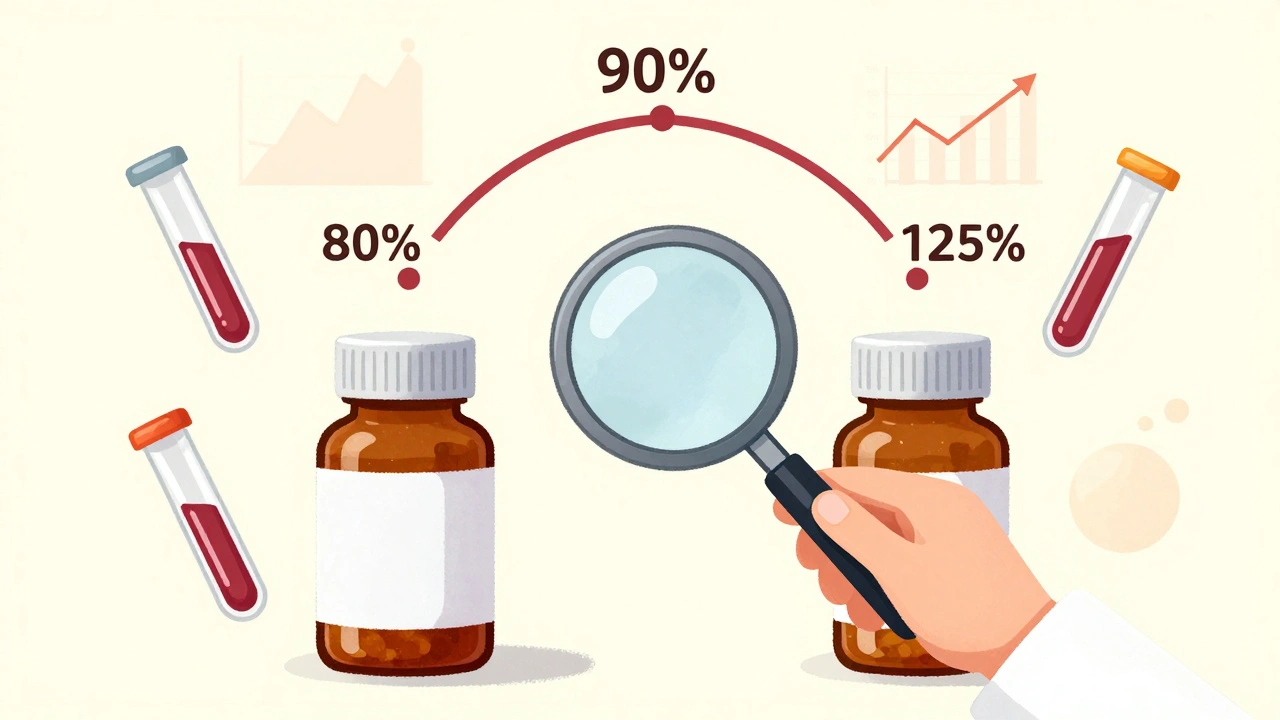
The rule says the 90% confidence interval of the ratio between the two must fall entirely between 80% and 125%. That sounds complicated, but here’s what it means in plain terms: if the brand drug gives you an average AUC of 100 units, the generic’s AUC must be between 80 and 125 units. But here’s the catch-the entire range of likely values (the 90% confidence interval) must fit within those bounds. That’s not just a single point. It’s a statistical safety net.
For example, if a generic has an average AUC of 90 units with a 90% CI of 83-97, it passes. But if the average is 85 with a 90% CI of 78-92, it fails-even though 85 is within 80-125-because part of the range dips below 80. The FDA doesn’t just want the average to be close. They want to be 90% sure the true difference is small.
Why 80-125% and Not 90-110%?
You might think a 90-110% range would be tighter and better. But that’s not how drug absorption works. The way your body processes drugs follows a log-normal distribution, not a straight line. That means differences aren’t evenly spread-they’re skewed. So, regulators use logarithms to make the math work.
On a log scale, 80% equals -0.223 and 125% equals +0.223. That’s symmetric around 100% (which is 0). So the 80-125% range is actually a ±20% variation on the log scale. If they used 80-120%, it wouldn’t be balanced. The 125% upper limit was chosen because it reflects what’s statistically sound, not arbitrary.
This is why the FDA didn’t just pick numbers out of a hat. It was based on expert analysis in the early 1990s, using real pharmacokinetic data from hundreds of drugs. The goal was to allow for normal biological variation-differences in stomach acid, metabolism, or even gut motility-without compromising safety or effectiveness.
Real-World Results: Are Generics Really the Same?
Here’s the most important part: in practice, most generics are even closer than the rule allows. A review of over 2,000 bioequivalence studies by the FDA between 2008 and 2012 showed that 98% of generics had average absorption rates between 95% and 105% of the brand drug. The average difference? Just 3.5%.
That’s not a fluke. A 2016 study in JAMA Internal Medicine tracked over 2 million patients on heart medications like statins and beta-blockers. Half took brand names, half took generics. The results? Identical rates of heart attacks, strokes, and hospitalizations. No meaningful difference.
Even more convincing: the FDA’s Sentinel Initiative, which monitors drug safety across 200 million patient records, found no significant difference in adverse events between brand and generic drugs for 94% of the 1,500+ drugs studied between 2015 and 2020.
So why do people still worry? Partly because of how the rule is explained-or not explained. A 2020 survey of 1,200 pharmacists found that 78% fielded questions about the 80-125% rule at least once a week. And 63% said that once they explained the real meaning, patient concerns disappeared.
When the Rule Isn’t Enough: Narrow Therapeutic Index Drugs
There are exceptions. Some drugs have a very narrow window between effective and toxic doses. These are called narrow therapeutic index (NTID) drugs. Examples include warfarin (a blood thinner), levothyroxine (for thyroid), and some anti-seizure meds.
For these, the 80-125% rule is too loose. The FDA tightened the standard to 90-111% for NTIDs. That’s a much smaller range, and it’s backed by stricter study designs. In fact, for drugs like levothyroxine, even small differences in absorption can cause symptoms like fatigue, weight gain, or heart palpitations. That’s why pharmacists are trained to stick with the same generic brand for these patients unless absolutely necessary.
But even here, the system works. A 2019 FDA guidance document laid out exactly how to test these drugs, and since then, there’s been no spike in adverse events linked to switching generics for NTIDs.
Why This Rule Saves Billions-and Lives
The 80-125% rule isn’t just science. It’s economics. In 2021, generic drugs saved the U.S. healthcare system $373 billion. That’s because they’re cheaper to make, but still held to the same high standard.
Today, 90% of all prescriptions in the U.S. are filled with generics. Yet they make up only 23% of total drug spending. That’s the power of this rule: it lets people access life-saving medications without paying brand-name prices.
And it’s not just the U.S. The European Medicines Agency, Health Canada, and over 50 other countries use the same 80-125% standard. The World Health Organization and the International Council for Harmonisation have endorsed it as the global benchmark.
Even the Supreme Court weighed in. In a 2022 case, Smith v. Mylan, Justice Kavanaugh wrote that the FDA’s bioequivalence standards had “withstood three decades of real-world testing.” That’s not legal opinion-it’s scientific consensus.
What Pharmacists Want You to Know
Most pharmacists support generics. In a 2022 survey by the Generic Pharmaceutical Association, 97% said they prescribe generics as the first choice when available. Only 1.2% of cases involved brand preference due to concerns about effectiveness.
But they also know patients need clarity. That’s why the FDA launched its #GenericsWork campaign in 2021. It’s not marketing-it’s education. Videos, infographics, and Q&A sessions explain the 80-125% rule in simple terms. Over 1.2 million people watched it.
If you’ve been told your generic isn’t “as good,” ask for the data. Ask what the 90% confidence interval was. Ask if it’s an NTID. Most of the time, the answer will be: “It passed every test. It’s the same.”
What You Can Do
- Don’t refuse generics because of the 80-125% myth. The numbers don’t mean what you think.
- Ask your pharmacist to explain the difference. They’re trained to do this. Most will take five minutes to show you the science.
- Stick with the same generic brand for NTIDs. If you’re on warfarin or levothyroxine, consistency matters. Let your pharmacist know if you switch.
- Report side effects. If you notice a change after switching, tell your doctor. But don’t assume it’s the generic’s fault-many changes are due to other factors like diet, stress, or other medications.
The bottom line? The 80-125% rule isn’t a loophole. It’s a shield. It protects patients from unsafe generics while making life-saving drugs affordable. The science is solid. The data is overwhelming. And the results? Millions of people getting the same care, at a fraction of the cost.
Does the 80-125% rule mean generic drugs can have 25% less active ingredient?
No. The 80-125% rule does not refer to the amount of active ingredient in the pill. It measures how much of that ingredient your body absorbs into the bloodstream. Generic drugs contain the same amount of active ingredient as the brand name. The rule ensures that the rate and extent of absorption are similar enough to produce the same clinical effect.
Are generic drugs as safe as brand-name drugs?
Yes. The FDA requires generics to meet the same strict manufacturing standards as brand-name drugs. They’re made in the same type of facilities, under the same quality controls. Over 200 million patient records monitored by the FDA’s Sentinel Initiative show no significant difference in safety or adverse events between brand and generic drugs for 94% of medications.
Why do some people feel different on a generic drug?
Sometimes, people notice changes because of placebo effect, stress, diet, or other medications-not the generic itself. For drugs with a narrow therapeutic index (like warfarin or levothyroxine), switching between different generic brands can cause slight absorption differences. In those cases, sticking with one generic brand is recommended. But for most drugs, any perceived difference is not scientifically supported.
Is the 80-125% rule the same in other countries?
Yes. The European Medicines Agency, Health Canada, and over 50 other countries use the same 80-125% bioequivalence standard. It’s the global benchmark endorsed by the International Council for Harmonisation. Some emerging economies have minor adjustments for specific drugs, but the core rule is widely accepted.
Can I trust a generic drug if it’s much cheaper?
Absolutely. The lower cost comes from reduced marketing, R&D, and patent expenses-not lower quality. Generic manufacturers must prove their product is bioequivalent through rigorous clinical testing. The FDA reviews every application. A cheap generic isn’t a compromise-it’s a smart choice backed by science.
What’s Next for Bioequivalence?
The FDA is working on new tools to improve testing for complex drugs like inhalers, topical creams, and injectables. Traditional blood tests don’t always capture how these drugs work. By 2025, the agency plans to use computer modeling to predict absorption patterns-called model-informed drug development.
But the 80-125% rule isn’t going anywhere. It’s been proven, tested, and trusted for over 30 years. It’s not perfect-but it’s the best system we have. And for most people, most of the time, it means getting the same medicine at a price you can afford.


8 Comments
Declan Flynn Fitness December 2, 2025
Been on generics for years - no issues. My blood pressure meds? Same effect, half the cost. People freak out over numbers they don’t understand. The science’s solid. Chill out and let your pharmacist do their job.
Michelle Smyth December 3, 2025
Ah, the 80-125% bioequivalence paradigm - a statistical sleight-of-hand masquerading as regulatory rigor. One must interrogate the log-normal distributional assumptions underpinning the confidence interval, lest we succumb to the ideological seduction of pharmaceutical neoliberalism. The FDA’s ‘consensus’ is merely hegemonic epistemic closure.
Patrick Smyth December 4, 2025
I switched to generic lisinopril last year and my heart started racing. I felt like I was being slowly poisoned. My wife cried. I had to go to the ER. How can you tell me this is safe? This isn’t science - it’s corporate greed wearing a lab coat.
Walker Alvey December 5, 2025
So you’re telling me the government lets companies make pills that could be 25% weaker and calls it ‘the same’? Brilliant. Next they’ll say a 25% smaller airplane is still a 747.
Adrian Barnes December 5, 2025
The 80-125% confidence interval is not a tolerance threshold - it is a probabilistic approximation of therapeutic equivalence, predicated upon the assumption of homogeneity in pharmacokinetic parameters across a healthy, non-comorbid population. The real-world heterogeneity of metabolic phenotypes, GI transit times, and CYP450 polymorphisms renders this model fundamentally inadequate for polypharmacy patients, particularly the elderly and those with renal impairment. This is not science - it is actuarial risk management disguised as medical policy.
James Steele December 6, 2025
Let’s be real - the 80-125% rule is the pharmaceutical industry’s way of saying ‘close enough for government work.’ Sure, the math checks out on paper, but have you ever seen the factory where these generics are made? Some of ‘em are churned out in places where the QA team has a 3-hour lunch break and a PowerPoint slide titled ‘Does It Look Like a Pill?’ The FDA’s got 1,200 inspectors for 12,000 facilities. It’s not a system - it’s a lottery.
And don’t get me started on NTIDs. Levothyroxine? I’ve seen patients go from ‘I feel like a superhero’ to ‘I can’t get out of bed’ just because they switched from Teva to Mylan. The difference isn’t in the math - it’s in the fillers. Corn starch vs. lactose. Dye vs. no dye. Your gut doesn’t care about confidence intervals - it cares about what it can’t digest.
Yeah, 98% of generics are fine. But the 2%? That’s the one that lands you in the ER. And who pays for that? You do. In pain. In time. In trauma. The ‘billions saved’ line is a nice PR slogan - but it’s not a human story.
Louise Girvan December 7, 2025
THEY’RE LYING TO YOU!!! THE FDA IS IN BED WITH BIG PHARMA!!! THE 80-125% RULE IS A TRAP!!! THEY WANT YOU TO DIE SO THEY CAN SAVE MONEY!!! I KNOW A GUY WHO GOT SEIZURES AFTER SWITCHING!!! THEY’RE HIDING THE DATA!!!
Dennis Jesuyon Balogun December 8, 2025
Let me speak plainly - you are not wrong to question this. But your fear is not rooted in the data - it is rooted in a system that has failed to communicate. The 80-125% rule is not a loophole - it is a bridge built over decades of global pharmacokinetic research. What you feel as risk is not the drug - it is the silence between you and your healthcare provider.
In Nigeria, we don’t have the luxury of brand-name drugs. We take generics. We have learned to trust the science, not the noise. We ask: What is the AUC? What is the CI? Who manufactured it? Not ‘is it the same?’ - but ‘is it safe?’ And the answer, in 99% of cases, is yes.
But you are right to demand clarity. The system must do better. Not by tightening the rule - but by training pharmacists to explain it. By funding patient education. By making the data visible. The science is not the enemy. The silence is.
So next time you hear ‘80-125%,’ don’t panic. Ask: ‘Can you show me the study?’ Then listen. The answer is not in fear - it is in understanding. And understanding is the first medicine.