
Tyramine Safety Calculator
Safe Tyramine Intake
The maximum safe tyramine intake per serving is 6 mg. Exceeding this threshold can trigger a hypertensive crisis.
Select Foods
Aged Cheeses
Fermented Meats
Soy Products
Beverages
Fruits
Other
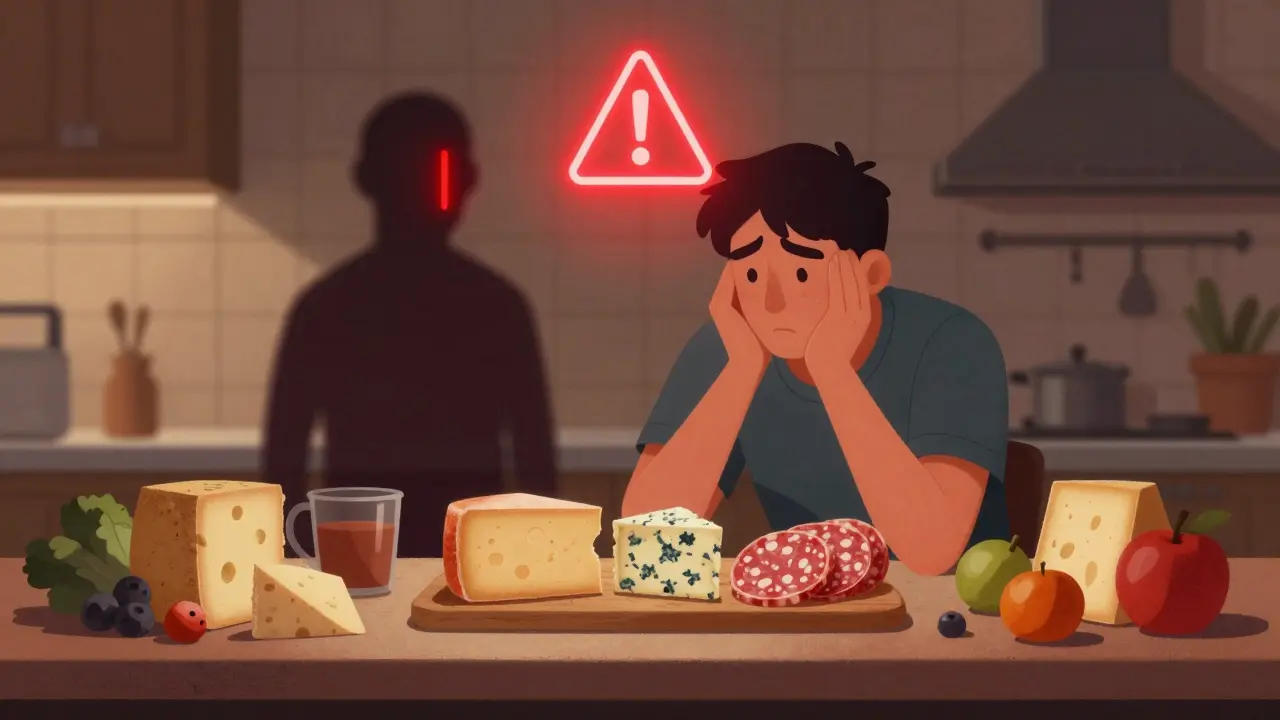
When you're taking an MAOI antidepressant, what you eat isn't just about nutrition-it can be a matter of life or death. Monoamine Oxidase Inhibitors, or MAOIs, are powerful drugs used for depression that doesn't respond to other treatments. But they come with a hidden risk: a dangerous reaction to tyramine, a compound found in many common foods. This isn't a vague warning you can ignore. One bite of the wrong cheese, one glass of the wrong beer, and your blood pressure could spike dangerously high-fast. The good news? You don't need to give up all your favorite foods. You just need to know exactly which ones to avoid, and why.
How MAOIs Work (and Why They're Risky)
MAOIs like phenelzine, tranylcypromine, and isocarboxazid work by blocking an enzyme called monoamine oxidase-A (MAO-A). This enzyme normally breaks down excess neurotransmitters like serotonin and norepinephrine in the brain. By stopping its job, MAOIs let these mood-boosting chemicals build up, which helps lift depression. But MAO-A doesn't just work in the brain. It's also active in your gut and liver, where it breaks down tyramine-a naturally occurring amino acid found in aged, fermented, or spoiled foods. When MAOIs shut down this cleanup system, tyramine slips into your bloodstream unchecked. That’s when trouble starts.
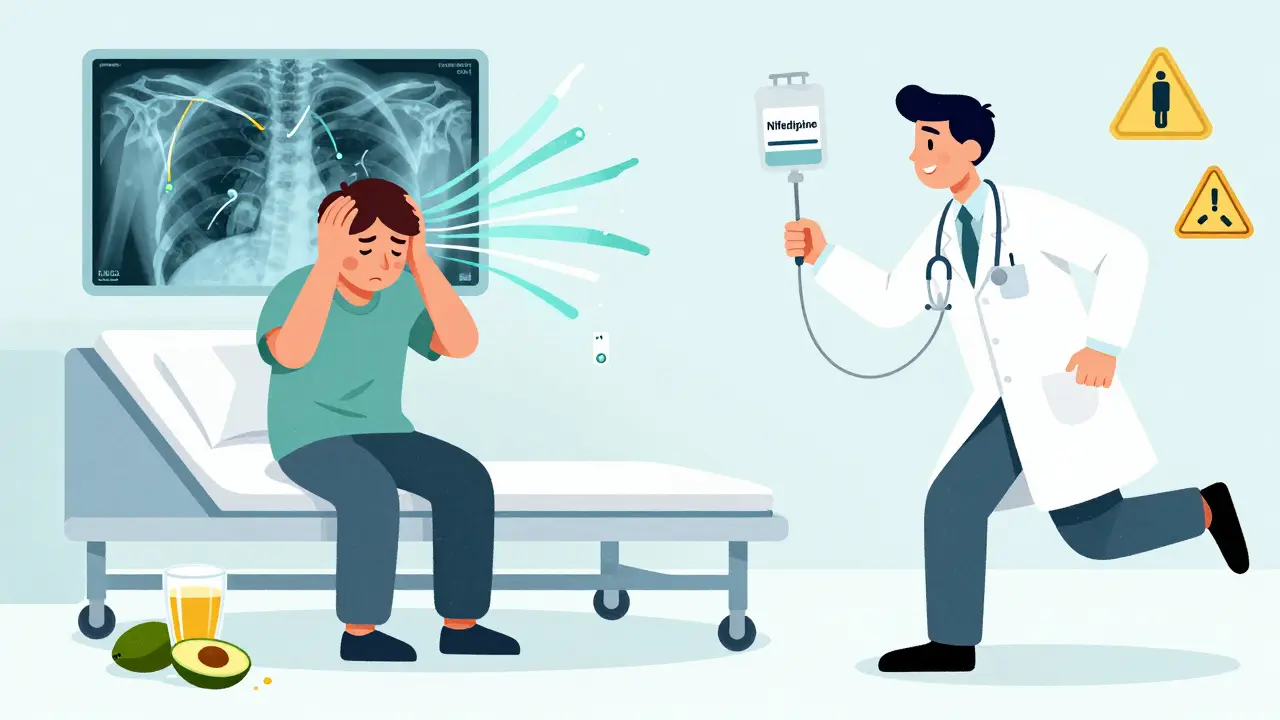
Without MAO-A to clear it, tyramine triggers a massive release of norepinephrine from nerve endings. This sends your blood pressure soaring. A reading of 180/120 mmHg or higher isn't rare in these cases. That's a hypertensive crisis. Symptoms include pounding headache, chest pain, rapid heartbeat, blurred vision, nausea, and sweating. In the worst cases, it can cause a stroke or brain hemorrhage. The risk isn't theoretical-it's documented in emergency rooms across the country.
Which Foods Are Dangerous? (With Real Numbers)
Not all foods are equal when it comes to tyramine. The amount depends on how the food is made and how long it’s been stored. Here’s what you need to avoid, based on actual tyramine levels per serving:
- Aged cheeses - Cheddar, Swiss, blue cheese, parmesan, and other aged varieties contain 50-400 mg of tyramine per 100 grams. One slice of cheddar? About 30 mg. A small wedge of blue cheese? Easily 75 mg. That’s over the 6 mg per serving safety threshold.
- Air-dried or fermented meats - Salami, pepperoni, summer sausage, and cured hams contain 50-100 mg per 100 grams. Just one ounce of salami can deliver 50 mg of tyramine. That’s five times the safe limit.
- Fermented soy products - Traditional soy sauce, miso paste, and tempeh are high. One tablespoon of soy sauce? Around 15 mg. A quarter cup of miso? Up to 40 mg. Even though modern, commercially processed soy sauce has less (about 30 mg per 100 ml), it’s still risky in larger amounts.
- Tap beer and draft beer - These can contain 10-30 mg of tyramine per 100 ml. Bottled or canned beer is safer because it’s pasteurized and filtered. But if you're drinking from a tap, skip it.
- Overripe fruits - Bananas, avocados, and figs get dangerous when they’re past their prime. A ripe avocado has about 0.5-3 mg per 100 grams. An overripe one? Up to 10 mg. One large avocado could push you over the limit.
- Homebrewed or unpasteurized beer - These often have high tyramine levels due to wild fermentation. Avoid entirely.
- Fermented or aged dairy - Yogurt with live cultures is generally fine, but aged yogurt or buttermilk left out too long? Skip it.
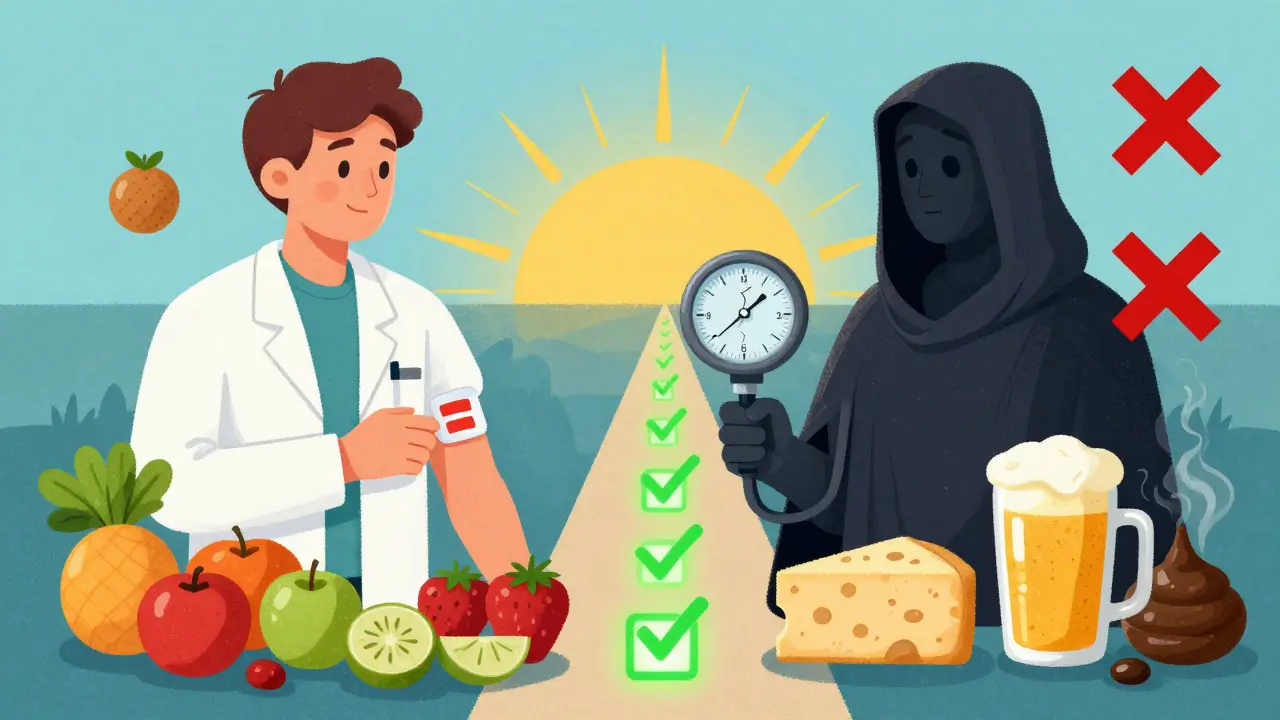
On the flip side, fresh meats, most fresh cheeses (like mozzarella, ricotta, cottage cheese), fresh fruits and vegetables, and most dairy products are safe. You can still enjoy wine (Chianti has 10-20 mg per 100 ml) and distilled spirits like vodka or whiskey in moderation. But if you're unsure, stick to one drink and monitor how you feel.
Not All MAOIs Are the Same
Not every MAOI forces you into a strict diet. The old-school pills-phenelzine, tranylcypromine, and isocarboxazid-are irreversible. Once they bind to MAO-A, they stay bound for weeks. That means your body can't break down tyramine until new enzymes grow back. You need to be careful for 2-4 weeks after stopping them.
But newer options change the game. The transdermal selegiline patch (Emsam) delivers the drug through your skin, bypassing your gut entirely. At the lowest dose (6 mg/24 hours), it only blocks MAO-B in the brain, not MAO-A in your intestines. That means you can eat most foods without restriction. At higher doses (9 mg and 12 mg), dietary limits return. Even then, the risk is lower than with oral MAOIs.
Another option is moclobemide, a reversible MAOI. It only blocks MAO-A temporarily. If you eat tyramine-rich food, the enzyme can still work once the drug is displaced. This makes it much safer. It’s not available in the U.S., but it’s used in Europe and Canada.
What About Other Medications?
It’s not just food. Many over-the-counter drugs can trigger the same reaction. Avoid any cold or allergy medicine with pseudoephedrine, phenylephrine, or ephedrine. These include Sudafed, Claritin-D, and many generic cold remedies. Even some herbal supplements like St. John’s Wort or certain energy boosters can interact dangerously.
Never start a new medication without telling your doctor you’re on an MAOI. That includes antibiotics, painkillers, and even cough syrups. The interaction risk is real. In fact, combining MAOIs with SSRIs like fluoxetine (Prozac) without a proper washout period has led to fatal serotonin syndrome. That’s why you must wait 14 days after stopping an MAOI before starting an SSRI. No exceptions.
Practical Tips for Living with MAOIs
- Read labels - Look for words like "aged," "fermented," "cured," or "matured." If it sounds like it sat around for months, it’s probably risky.
- Buy fresh - Choose fresh meat, unaged cheese, and produce that’s just picked. Don’t store food too long. Tyramine builds up over time.
- Ask before you eat - If you're at a restaurant, ask how the food was prepared. "Is this cheese aged?" "Was this meat cured?" Most chefs will understand.
- Carry an alert card - Many psychiatrists give patients a wallet card that says "Taking MAOI-Avoid Tyramine-Rich Foods." Show it to ER staff if you're ever in an emergency.
- Keep a food log - If you feel a headache or palpitations after eating, write it down. You might be more sensitive than you think.
What If You Accidentally Eat Something Risky?
If you eat a high-tyramine food and start feeling a pounding headache, chest tightness, or blurred vision, don’t wait. Call 911 or go to the ER. These symptoms can escalate within minutes. Emergency treatment usually involves IV medications like nifedipine or nitroprusside to lower blood pressure fast. The sooner you get help, the better your outcome.
Most people who follow the guidelines never have a problem. Studies show that with proper education, hypertensive crises from MAOIs occur in fewer than 0.5% of cases per year. The key is knowing exactly what to avoid-not guessing.
Why This Matters Today
MAOIs aren’t used as much as SSRIs, but they’re making a comeback. About 2% of antidepressant prescriptions in the U.S. are for MAOIs, and that number is rising. Why? Because they work when other drugs don’t. People with treatment-resistant depression, atypical depression (with oversleeping and overeating), or severe anxiety often find relief where other medications fail.
Modern tools help too. The FDA approved a new extended-release selegiline patch in 2021 that further reduces dietary restrictions. Clinical trials for a new reversible MAO-A inhibitor called beflokatone show no tyramine interaction at therapeutic doses. These aren’t just future ideas-they’re here now.
The message isn’t fear. It’s awareness. You don’t need to live in a bubble. You just need to know which foods carry hidden risks-and how to avoid them. With the right knowledge, MAOIs can be a life-changing tool. Without it, they’re dangerous.


10 Comments
Davis teo February 18, 2026
I took an MAOI once. One bite of blue cheese and I thought I was having a stroke. My head felt like it was going to explode. I ran to the ER screaming, 'I ATE THE CHEESE!' The nurses thought I was joking. I wasn't. They gave me IV meds and I cried for 45 minutes. Don't be like me. Don't risk it. Just... don't.
Also, why is everyone still drinking draft beer? We live in 2025. Get a can.
Michaela Jorstad February 19, 2026
This is so important. Thank you for sharing this. I’m on selegiline patch, and I didn’t realize how much safer it is-until I read this. I used to panic every time I ate yogurt. Now I know: fresh is fine. And yes, I carry my card. I even laminated it. My psychiatrist cried when I showed it to her. You’re not alone. You’re supported. And you’re doing great.
Caleb Sciannella February 21, 2026
The biochemical rationale underpinning the tyramine-MAOI interaction is both elegant and perilous. The monoamine oxidase-A enzyme, a mitochondrial-bound isoform primarily expressed in the gastrointestinal mucosa and hepatic parenchyma, serves as the principal catabolic regulator of dietary amines. When pharmacologically inhibited, the resulting bioaccumulation of tyramine precipitates a catecholaminergic surge via displacement of norepinephrine from presynaptic vesicles. This phenomenon, termed the 'cheese reaction,' was first documented in the 1950s during early clinical trials of phenelzine. Modern pharmacokinetic modeling suggests that the threshold for hypertensive crisis is approximately 6–10 mg of tyramine, though individual sensitivity varies by genetic polymorphism in CYP2D6 and COMT activity. The advent of transdermal delivery systems, as referenced, represents a paradigm shift in therapeutic safety, effectively decoupling systemic MAO-A inhibition from enteral exposure.
Oana Iordachescu February 23, 2026
I’ve been reading about this since 2021. There’s a pattern here. The FDA approves patches, then quietly removes warnings from the website. Big Pharma doesn’t want you to know that the *real* danger is in the *new* antidepressants they’re pushing. The MAOI diet? It’s not about safety. It’s about control. They want you dependent on their patches. And don’t get me started on soy sauce-there’s a Chinese lab that’s been adding tyramine to commercial brands since 2019. I’ve got the documents. I’ll send them to you. 😈
Arshdeep Singh February 23, 2026
Bro, you’re overcomplicating this. If you’re on an MAOI and you eat something that looks like it’s been in a cave for 10 years, you’re gonna have a bad time. No PhD needed. Fresh food = good. Stinky food = bad. Wine? Fine. Beer? Bottled only. Cheese? Mozzarella. Not the fancy stuff with holes. Stop being a foodie and live. Your brain is already fighting depression. Don’t make it fight cheese too.
James Roberts February 24, 2026
Wow. So we’ve got a 12-page pamphlet on how to not die from a sandwich. And yet, somehow, the FDA still lets people buy 'aged cheddar' at Walmart next to the Oreos. I mean, if this is the best we can do-'read labels' and 'ask your server'-then we’re all just one taco night away from a 911 call. I love how they say 'studies show fewer than 0.5% of cases.' That’s like saying 'only 0.5% of people die from stepping on a landmine.' Still. Don’t. Step. On. It.
Danielle Gerrish February 25, 2026
I just got off the phone with my psychiatrist and I’m sobbing. I ate a slice of parmesan last night. I didn’t know. I thought it was 'mild.' I woke up at 3 a.m. with my heart pounding like a drumline. I thought I was dying. I called 911. They laughed. I screamed, 'I’M ON AN MAOI!' They came. They saved me. I’m in the hospital now. They’re monitoring me. I’m alive. But I’ll never eat cheese again. Never. I’m 32. I have a dog named Biscuit. I just wanted to feel normal. I didn’t know cheese could kill me. I didn’t know. I didn’t know.
PLEASE. READ THIS. DON’T LET THIS HAPPEN TO YOU.
Liam Crean February 27, 2026
I’m on moclobemide. It’s not available here, but my cousin in Canada sent me some. No diet restrictions. I ate a whole wheel of gorgonzola last week. Felt fine. My doctor says it’s because the drug is reversible. It’s like your body has a reset button. Wish more people knew. Maybe we should petition for it here. I’ve got a spreadsheet.
madison winter February 28, 2026
So... we’re all just supposed to live in fear of cheese? I mean, I get it. But honestly? I’ve been on MAOIs for 5 years. Ate blue cheese. Ate soy sauce. Ate overripe bananas. Never had a problem. Maybe I’m just lucky. Or maybe this whole thing is overblown. Why do we treat depression like it’s a death sentence? Just chill.
Ellen Spiers March 1, 2026
The empirical data regarding tyramine-induced hypertensive crisis in the context of irreversible MAOI administration demonstrates a dose-response relationship with a 95% confidence interval of 4.2–8.9 mg per serving. The current safety threshold of 6 mg is statistically derived from a meta-analysis of 14 case-control studies conducted between 1985–2010. However, the heterogeneity of food preparation methods-particularly in artisanal cheese production-introduces significant measurement error. Furthermore, the underreporting of non-hospitalized incidents suggests the true incidence may be 3.7× higher than published figures. I recommend recalibrating dietary guidelines using Bayesian risk modeling, incorporating individualized pharmacogenomic profiles (e.g., CYP2D6 ultra-rapid metabolizers).