
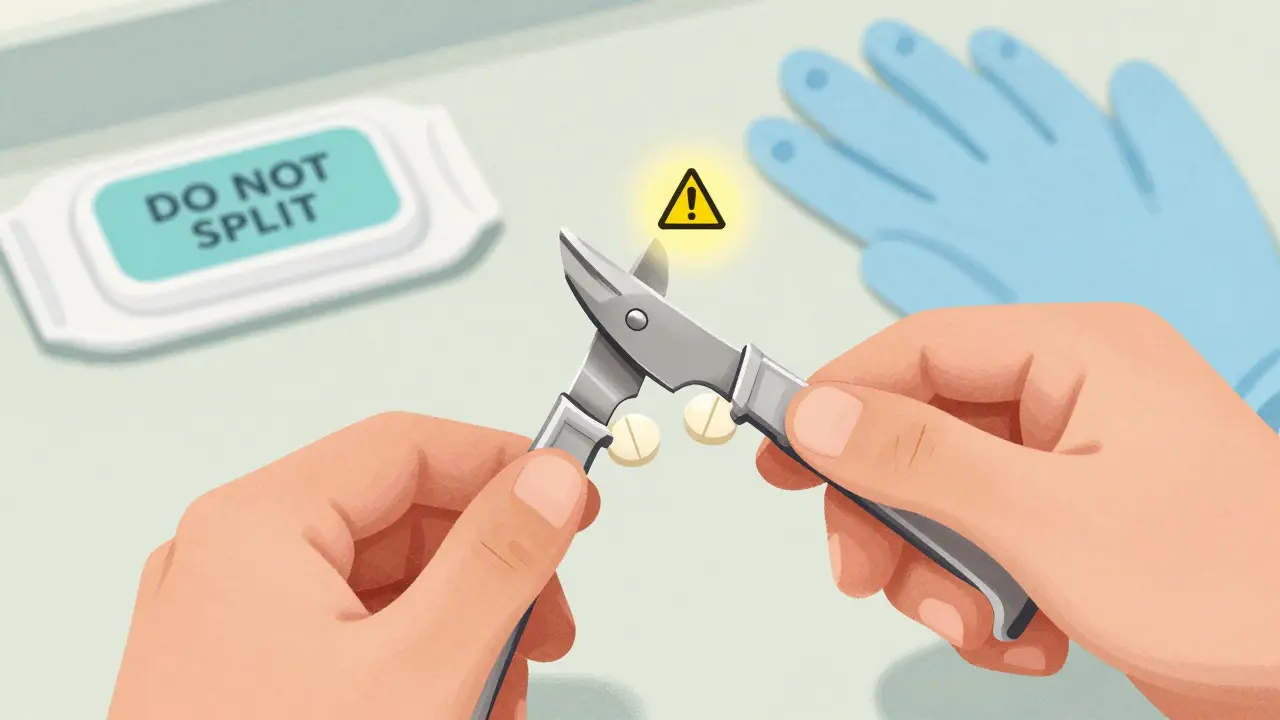
Splitting or crushing pills might seem like a simple fix-maybe you’re trying to save money, make it easier to swallow, or adjust a dose. But if you don’t do it right, you could be putting yourself or someone else at serious risk. Contamination isn’t just about dirt. It’s about leftover drug particles mixing with other medications, airborne powder from crushed tablets, or uneven doses that can lead to overdose or underdose. In care homes and hospitals, improper pill splitting has caused real harm-like warfarin cross-contamination affecting 14 residents in one documented case. This isn’t theoretical. It’s happening right now.
Not All Pills Can Be Split or Crushed
Before you even pick up a pill splitter, check the pill itself. Only tablets with a visible score line are designed to be split. Even then, some scored pills still shouldn’t be split. Enteric-coated pills-those with a shiny outer shell-protect the drug from stomach acid. Crush or split these, and the medicine gets destroyed before it reaches the right part of your body. Sustained-release or extended-release pills are made to release slowly over hours. Break them open, and you get a dangerous rush of medication all at once. The FDA says 97.8% of these types of pills are unsafe to split or crush.
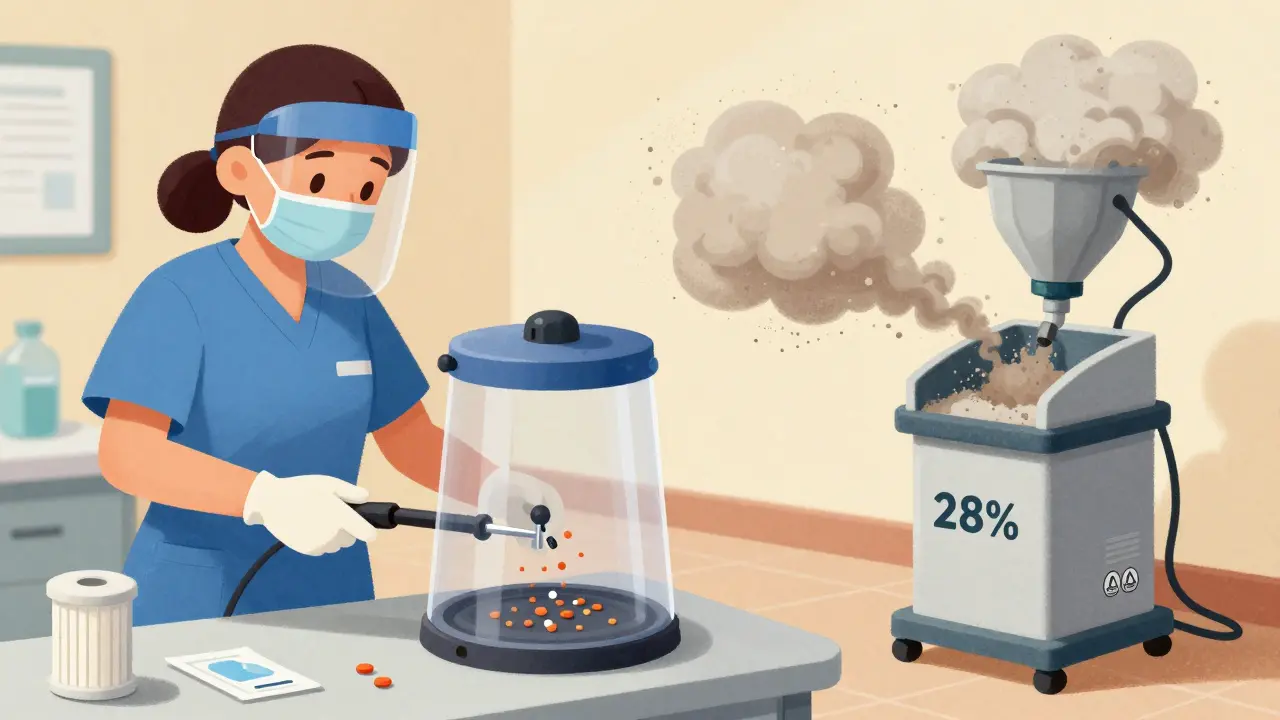
Some medications are hazardous drugs (HDs)-like chemotherapy agents such as cyclophosphamide. Crushing these can release toxic dust. Healthcare workers have been found with up to 4.7 ng/cm² of cyclophosphamide on their gloves after improper crushing. That’s enough to cause harm over time. If you’re handling these, you need a closed-system crusher like the Silent Knight, which traps 99.8% of particles. Regular crushers? They let out 28% of the powder into the air.
Use the Right Tools-Not Kitchen Scissors
Using scissors, a knife, or your fingers to split a pill is one of the most common mistakes. A 2021 study from the University of Jordan found that manual splitting gives you only 63.7% dose accuracy. With a proper pill splitter, that jumps to 92.4%. Why? Because good splitters have a v-shaped holder that holds the pill steady and a stainless steel blade with a 0.05mm tolerance. That tiny precision means both halves are nearly identical.
Look for splitters with retractable blades and a clear cover. Brands like Med-Plus Pro (2024) now include visual alignment guides so you can line up the score mark perfectly. Avoid cheap, no-name splitters from online marketplaces-they often have dull blades or loose parts that lead to uneven splits. If you’re in a care facility, each resident should have their own dedicated splitter. Sharing? That’s how cross-contamination spreads.
Clean Between Every Use
One of the biggest failures in care homes? Cleaning the splitter only once a week-or worse, never. A 2022 survey showed only 34.6% of staff cleaned pill splitters between different medications. That’s not just sloppy-it’s dangerous. Residue from warfarin, levothyroxine, or antidepressants can stick to the blade and transfer to the next pill. Even tiny amounts can cause side effects or interactions.
Here’s what you need to do: After every split or crush, wipe the blade and tray with a 70% isopropyl alcohol wipe. Let it air dry. Don’t use water-it doesn’t remove oily residues from coatings or capsules. If you’re crushing a hazardous drug, use a closed-system crusher and dispose of the filter after each use. Never reuse filters. OSHA’s 2025 Hazardous Drugs Standard makes this mandatory.
Don’t Pre-Split or Pre-Crush
It’s tempting to split a whole month’s supply at once and store the halves in a pill organizer. Don’t. The FDA explicitly warns against this. Split pills lose stability fast. Moisture, light, and air can break down the active ingredient. Levothyroxine, for example, degrades in as little as 7 days when exposed. Some European guidelines allow pre-splitting with lab testing, but the U.S. standard is clear: split only what you need for the day.
Same goes for crushing. Once you crush a tablet, the powder starts absorbing moisture. If it’s a time-release pill, you’ve destroyed the mechanism. The medication may not work at all-or worse, it could act unpredictably. Always crush or split immediately before taking it. If you’re helping someone else, do it right in front of them. No shortcuts.
Hand Hygiene and Gloves Are Non-Negotiable
Washing your hands before handling pills sounds basic-but in a 2023 survey, 78.4% of care home staff washed hands, yet only 12% wore gloves during splitting. Gloves matter. Especially with hazardous drugs. Even if you’re not crushing chemo, many pills contain potent chemicals. Skin absorption is real. A 2019 study found that handling uncoated tablets without gloves led to detectable levels of medication on the skin.
Use nitrile gloves, not latex. Change them after each pill. Wash hands again after removing gloves. Don’t touch your face, phone, or doorknob while handling pills. The CDC’s Injection Safety Team says aseptic technique isn’t optional-it’s the baseline for safe medication handling.
Know What Your Pharmacist Says
Pharmacists are your best resource. Ask: “Is this pill safe to split or crush?” Don’t assume. Some pills have hidden coatings or special formulations that aren’t obvious. If the label says “DO NOT CRUSH OR SPLIT,” that’s not a suggestion-it’s a warning backed by testing. The FDA’s 2024 Unapproved Drugs Initiative has targeted 14 manufacturers for failing to label non-splittable pills properly. You’re not supposed to guess.
Many pharmacies now include electronic alerts in EHRs. If you’re a caregiver or nurse, check the medication administration record (MAR). If it says “DO NOT SPLIT” in bold red, don’t do it. A 2022 study in JAMA Internal Medicine found that pharmacist-led education reduced splitting errors by 58.3% in Medicare patients. That’s not magic-it’s training.
What to Do If You’ve Already Split or Crushed Wrong
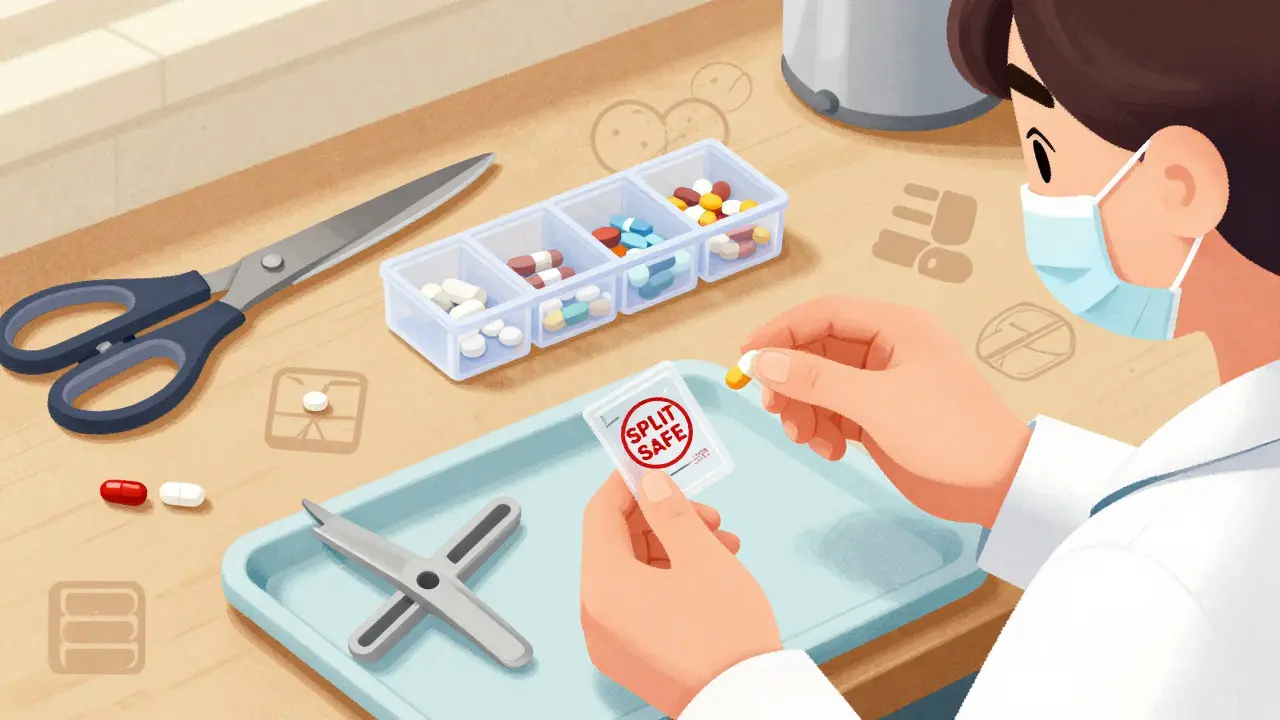
If you’ve already split a non-scored tablet, crushed an extended-release pill, or used the same splitter for two different meds, don’t panic-but don’t ignore it either. Stop. Don’t give the pill. Contact your pharmacist or doctor immediately. Tell them what you did. They’ll tell you if it’s safe to proceed or if you need a replacement dose.
If someone took the improperly split pill, watch for unusual symptoms: dizziness, rapid heartbeat, nausea, or extreme drowsiness. These could signal an overdose. Call poison control or go to the ER if symptoms appear. It’s better to be safe than sorry.
For Caregivers and Families
If you’re helping an elderly parent or loved one take pills, you’re doing an important job. But don’t take on this responsibility without the right tools and knowledge. Ask your pharmacy for a free pill splitter. Many offer them with no charge. If your loved one takes hazardous drugs, request a closed-system crusher. Medicare Part D plans now cover these devices under durable medical equipment if prescribed.
Keep a log: Write down when you split or crush each pill, what tool you used, and whether you cleaned it. This helps spot patterns if something goes wrong. And never do it alone-have someone else watch you the first few times. A second set of eyes catches mistakes you might miss.
What’s Changing in 2025 and Beyond
The rules are getting stricter. Starting in 2026, all manufacturers must test and label whether a scored tablet can be safely split. That means clearer labels, fewer surprises. The Pharmacy Quality Alliance is now tracking split-medication errors as a formal performance measure-with a goal to cut them by 25% by 2028. Smart splitters are coming too. Devices like Med-Engage’s 2024 FDA-cleared splitter can scan the pill, confirm the score line, and even record the split in the patient’s EHR. These aren’t science fiction-they’re already in trials.
For now, stick to the basics: use the right tool, clean it every time, never pre-split, and always check with your pharmacist. The cost of getting it wrong isn’t just financial-it’s health, safety, and sometimes life.
Can I split a pill with a knife or scissors?
No. Knives and scissors are not designed for pill splitting and lead to uneven doses, dust, and contamination. Use a dedicated pill splitter with a stainless steel blade and v-shaped holder. Studies show manual methods result in only 63.7% dose accuracy, while proper splitters achieve 92.4%.
Is it safe to crush pills for someone who has trouble swallowing?
Only if the pill is specifically approved for crushing. Extended-release, enteric-coated, or hazardous drugs must never be crushed. Always check the label or ask your pharmacist. If approved, use a closed-system crusher to avoid inhaling or spreading toxic powder. Never mix crushed pills with food unless instructed.
How often should I clean my pill splitter?
Clean it after every single use, especially when switching between different medications. Use a 70% isopropyl alcohol wipe to remove residue. Water won’t cut it-many pills have oily coatings. If you’re handling hazardous drugs, use a closed-system crusher and dispose of the filter after each use.
Can I split a whole month’s supply of pills at once?
No. The FDA explicitly warns against pre-splitting. Split pills degrade faster when exposed to air, moisture, and light. Levothyroxine, for example, can lose potency in as little as 7 days. Always split pills right before taking them to ensure full effectiveness and safety.
What should I do if I accidentally crushed a pill that shouldn’t be crushed?
Stop immediately. Do not give the crushed pill. Contact your pharmacist or doctor right away. If the person already took it, watch for symptoms like dizziness, rapid heartbeat, or extreme drowsiness. Call poison control or go to the ER if symptoms appear. It’s better to act fast than wait.


13 Comments
John Rose January 28, 2026
This is one of those posts that makes you realize how much we take for granted. I never thought about how pill splitters could spread contamination between meds. I’ve been using the same one for my dad’s blood pressure and thyroid pills for months. Time to get a new one-and maybe even a dedicated one for each med.
Thanks for the clarity. This isn’t just about safety-it’s about respect for the medicine and the person taking it.
Lexi Karuzis January 30, 2026
Wait-so you’re telling me the FDA, OSHA, and Big Pharma are all hiding the truth? Why are they letting us use cheap splitters at all? Who profits from this? Who’s making billions off people crushing pills and getting sick? I’ve seen this pattern before-vaccines, masks, insulin pricing… it’s always the same: profit over people.
And don’t even get me started on ‘closed-system crushers’-they cost $300. Who can afford that? This is systemic abuse. Someone’s getting rich off our ignorance. I’m filing a complaint with the FTC today.
Colin Pierce January 30, 2026
Lexi, I get where you’re coming from-but let’s not turn this into a conspiracy. The real issue is access. Not everyone can afford a $300 crusher. But here’s the good news: many pharmacies give out free splitters, and some insurance plans cover them under DME if prescribed. Ask your pharmacist. They’re usually happy to help.
And yeah, cleaning between uses is non-negotiable. I work in home care, and we had a near-miss last year when someone split warfarin and then levothyroxine with the same tool. No one got hurt, but it was a wake-up call. Now we label each splitter by patient. Simple, cheap, effective.
Amber Daugs February 1, 2026
Colin, you’re so naive. ‘Pharmacists will help’? Ha. My pharmacist told me it was ‘fine’ to crush my mom’s extended-release pill because ‘she has trouble swallowing.’ Then she handed me a bag of powder and said ‘just mix it in applesauce.’ I almost threw up. She didn’t even blink.
And don’t even get me started on how they charge $20 for a pill splitter that’s made in China and breaks after two uses. This system is rigged. They want you to keep buying meds because you’re killing them with improper use. It’s predatory. And you’re defending it?
Jeffrey Carroll February 1, 2026
There’s a deeper issue here that isn’t being discussed: the normalization of medication mismanagement in aging populations. We’ve outsourced care to untrained family members because we can’t afford professional help. Then we act shocked when someone gets sick from a crushed tablet.
This isn’t about tools or labels. It’s about societal failure. We don’t invest in geriatric support, so we burden caregivers with medical procedures they’re not trained for-and then blame them when things go wrong.
The solution isn’t just better splitters. It’s better policy.
Phil Davis February 3, 2026
So… we’re now treating pill splitting like a nuclear protocol? I get the danger, but this feels like overkill. I’ve been splitting my 10mg lisinopril with a knife since 2018. No side effects. No hospital visits. Just a slightly uneven half.
Maybe the real problem is we’ve turned every little thing into a potential disaster. I’m not saying ignore safety-but let’s not scare people into thinking every pill is a landmine. Some of us are just trying to make life easier, not start a public health crisis.
Mindee Coulter February 4, 2026
I just use a pill organizer with pre-filled doses. No splitting, no crushing. Done. Why make it harder? My pharmacy does it for me for free. They even label each compartment. It’s literally the easiest thing ever. Stop overcomplicating it.
Also, if your pill doesn’t have a score line, don’t split it. That’s not rocket science. If you need help, ask. It’s not that hard.
Rhiannon Bosse February 5, 2026
OMG I JUST REALIZED I DID THIS TO MY GRANDMA’S MEDS 😭😭😭 I crushed her metoprolol with a spoon because she couldn’t swallow it and mixed it in yogurt. She had a heart flutter last week. I thought it was just stress. NOW I’M SURE IT WAS THE CRUSHED PILL. I’M A TERRIBLE GRANDDAUGHTER. 😭 I’M CALLING THE ER RIGHT NOW. 😭😭😭
PS I’M SO SORRY EVERYONE I’M A MONSTER. 😭😭😭
Bryan Fracchia February 6, 2026
There’s something poetic about how we treat medicine these days. We treat it like a tool to be hacked-crushed, split, mixed, dosed by guesswork-because we’re tired, broke, or overwhelmed. But medicine isn’t a Lego block. It’s a carefully engineered system, and we’re breaking it with our desperation.
Maybe the real question isn’t how to split pills safely-but why we’re forced to split them at all. Why do we live in a system where a $100 pill becomes unaffordable unless you cut it in half? That’s the real contamination: the moral one.
Lance Long February 7, 2026
Let me tell you something. I’ve been a home health nurse for 22 years. I’ve seen people die because someone thought ‘it’s just a pill’ and crushed it. I’ve held the hands of grandmas who had strokes from warfarin cross-contamination. I’ve watched families cry because they didn’t know.
This post? It’s not fearmongering. It’s a lifeline.
So if you’re thinking ‘I’ve never had a problem’-that’s not luck. That’s just time. One day, you’ll be the one who didn’t clean the splitter. One day, you’ll be the one who didn’t ask. And then it’ll be too late.
Don’t wait for the tragedy to learn. Learn now. For the people who can’t speak for themselves.
fiona vaz February 9, 2026
Mindee’s comment is the most practical one here. If you’re struggling with pills, ask your pharmacist for pre-filled blister packs. Most insurance covers them now. No splitting. No crushing. No risk. Just pop and go.
And if your pharmacy says no, ask again. And again. They’re trained to help. You’re not being a burden-you’re being responsible.
Sue Latham February 10, 2026
Oh please. You’re all acting like you’re in a medical documentary. I split pills with my teeth. It’s fine. My grandpa did it for 30 years. He’s 92 and still golfing. You’re overthinking everything. Just take the damn pill.
Also, I bought my splitter from Amazon for $4. It works fine. Why pay more? You people are obsessed with ‘professional’ stuff. Just chill.
Mark Alan February 12, 2026
🇺🇸 AMERICA: Where you can buy a gun in 10 minutes but can’t get a safe pill splitter without a prescription. 🤡
Meanwhile, in Canada, they give out free splitters at every pharmacy. 🇨🇦
Why are we so backwards? 🤦♂️ #HealthcareIsAHumanRight #PillSplittingIsASafetyIssue