
Medication Guide Action Plan
Your Medication Safety Checklist
Follow these 5 critical steps to maximize your safety with high-risk medications:
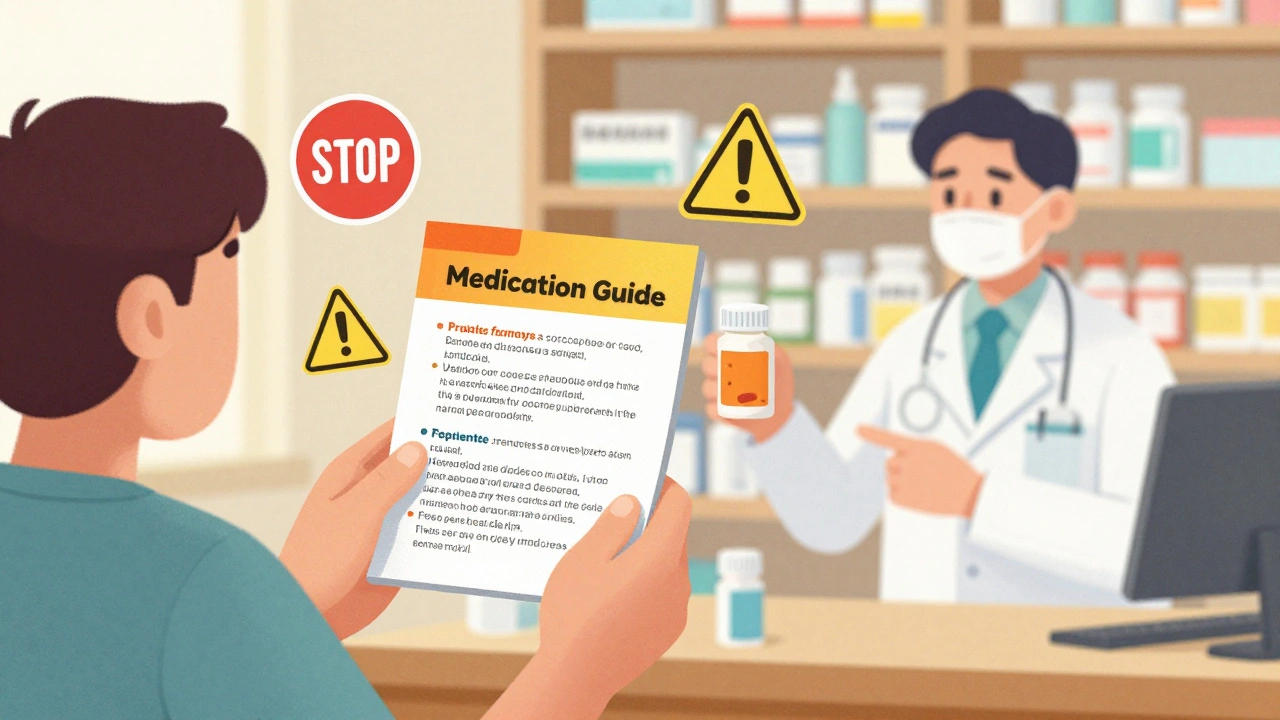
Have you ever picked up a prescription and been handed a small booklet that felt more like a manual than a simple instruction sheet? That’s a Medication Guide. It’s not just extra paper - it’s a lifeline designed by the FDA to keep you safe when taking high-risk medicines.
What Exactly Is a Medication Guide?
A Medication Guide is a printed handout that comes with certain prescription drugs. It’s not optional. The U.S. Food and Drug Administration (FDA) requires it for about 150 medications - mostly those with serious, sometimes life-threatening risks. These include opioids, certain antidepressants, blood thinners, biologics for autoimmune diseases, and some cancer drugs. Unlike the tiny label on your pill bottle that says "Take once daily," or the dense 50-page booklet your doctor gets (called a package insert), a Medication Guide is written for you. It’s meant to be read by someone who isn’t a doctor. The FDA demands it be written at a sixth-grade reading level or lower. That means short sentences. Clear headings. No jargon. Bold text for the biggest warnings. Every Medication Guide must include:- The brand name and generic name of the drug
- What it’s approved to treat
- The most serious side effects you need to watch for
- What to avoid while taking it (like alcohol, other meds, or certain foods)
- How to store it properly
- How to dispose of it safely
Why the FDA Made These Guides Mandatory
In the early 2000s, the FDA noticed a pattern. Patients were getting seriously hurt - sometimes dying - from drugs that had clear, preventable risks. But those risks were buried in technical language only doctors understood. Many patients didn’t know they were at risk because no one explained it in plain terms. That’s when the FDA created 21 CFR Part 208 - the rule that made Medication Guides required by law. The goal? To make sure patients know what they’re getting into before they start a drug. For example, a patient taking Tysabri for multiple sclerosis might not realize they’re at risk for a rare brain infection called PML. But the Medication Guide spells it out: "This medicine can cause a serious brain infection that may lead to death or severe disability. Call your doctor right away if you notice vision changes, weakness on one side, or confusion." That kind of warning saved lives. One patient on PatientsLikeMe shared how reading the guide helped her catch early signs of PML. She got tested, started treatment, and avoided permanent damage.How Medication Guides Are Different From Other Patient Info
You might get other handouts at the pharmacy - maybe a sheet with dosage info or a QR code to a website. But those aren’t the same. Here’s how Medication Guides stand out:- They’re FDA-approved - every word is reviewed and cleared by federal regulators. No guesswork.
- They’re required by law - pharmacists must give you one with every refill, not just the first time.
- They’re standardized - if you get the same drug from two different pharmacies, the guide is identical. No variations.
- They focus on safety - not just how to take it, but what could go wrong and what to do about it.
But Do People Actually Read Them?
Here’s the hard truth: many don’t. On Reddit, pharmacists shared that 63% of patients throw the guide away without reading it. Reasons? "Too long." "I already talked to the pharmacist." "I didn’t think it mattered." That’s a problem. A 2020 study in JAMA Internal Medicine found only 38% of patients who received a Medication Guide actually read it thoroughly. And if you don’t read it, you can’t use it to protect yourself. But here’s the flip side: a 2022 survey showed that 65% of patients said they’d read the guide if it were shorter and easier to understand. That’s not a reason to scrap the system - it’s a reason to fix it.What’s Being Done to Make Them Better
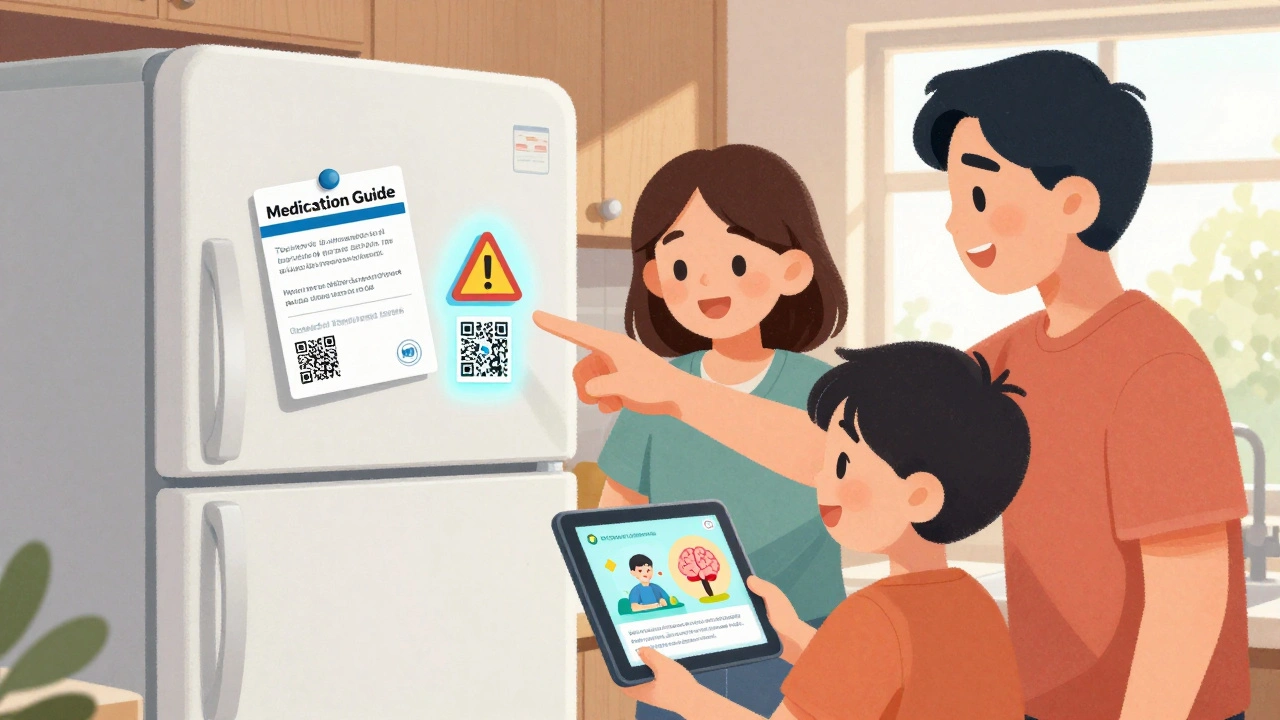
The FDA knows Medication Guides aren’t perfect. That’s why they’re changing. Starting in 2024, every new guide must be tested to prove it actually changes patient behavior. That’s new. Before, they just had to exist. Now, they have to work. Newer guides are starting to include:- Simple icons that show risk levels - red for danger, yellow for caution
- Tear-off reminder cards you can stick on your fridge
- QR codes that link to short video explanations

What You Should Do With Your Medication Guide
Don’t just take it and toss it. Here’s what to do:- Ask your pharmacist to walk you through it. They’re trained to explain the key risks. Don’t be shy - it’s their job.
- Find the "Warnings" section. Read it out loud. If something sounds scary, write it down.
- Ask: "What’s the one thing I need to call my doctor about right away?" That’s usually the most important point.
- Keep it somewhere visible. Tape it to your medicine cabinet. Put it in your pill organizer. Don’t let it disappear in a drawer.
- Bring it to every doctor visit. It helps your provider know what you’ve been told - and spot gaps in your care.
What Happens If You Don’t Get One?
If you’re getting a drug that requires a Medication Guide, you should get one - every time. If you don’t, the pharmacy broke the law. Call the pharmacy and ask for it. If they say they don’t have it, ask them to contact the manufacturer. Many pharmacies run out, especially with cancer drugs. But they’re required to get it to you. You can also download a copy from the FDA’s website (search "FDA Medication Guides"). But don’t rely on that. The one you get at the pharmacy is the official version - and it’s the one your pharmacist is trained to explain.Why This Matters More Than You Think
Medication Guides aren’t about bureaucracy. They’re about survival. A 2023 meta-analysis in The Lancet found that for drugs with required guides, serious side effects dropped by nearly 20% compared to similar drugs without them. That’s not a small number. That’s thousands of hospitalizations and deaths prevented every year. Think of it this way: a Medication Guide is like a seatbelt for your health. You might not need it every time you drive. But when you do, it could save your life. If you’re on a high-risk medication - opioids, antipsychotics, blood thinners, biologics - don’t skip this step. Read it. Ask questions. Keep it. Your future self will thank you.Are Medication Guides required for all prescription drugs?
No. Only about 150 out of thousands of prescription drugs require a Medication Guide. These are drugs with serious risks - like opioids, certain antidepressants, biologics, and cancer treatments. The FDA only requires them when the risks are high enough that patients need to understand them clearly to stay safe.
Can I get a Medication Guide online instead of from the pharmacy?
Yes. You can download official copies from the FDA’s website. But the one you get at the pharmacy is the legally required version, and your pharmacist is trained to explain it. If you’re getting a drug that requires a guide, you should get it at the pharmacy - even if you already read it online.
What if I don’t understand the Medication Guide?
Ask your pharmacist or doctor to explain it. They’re required to help you understand the risks. If the language is still too confusing, ask for a simplified version or request a video explanation if the guide has a QR code. You have the right to understand your medication - no one should make you feel bad for asking.
Do I need a Medication Guide for every refill?
Yes. By law, pharmacists must give you a new copy with every refill - even if you’ve taken the drug for years. Risks don’t disappear over time, and the guide might have been updated with new safety information.
Why do some Medication Guides look different now?
The FDA is updating them to be clearer. Newer guides use icons, color coding, and simpler language. Some even include QR codes that link to videos. If your guide looks different from last time, it’s probably improved - not changed by mistake.




10 Comments
James Kerr December 2, 2025
Just got my new blood thinner script today and read the guide for the first time - turns out I was supposed to avoid grapefruit and watch for unexplained bruising. Glad I didn’t ignore it. 🙌
shalini vaishnav December 3, 2025
How can a country like the US rely on such simplistic, condescending pamphlets? In India, we trust our doctors to explain risks - not some FDA-approved toddler-level text. This is infantilizing patients, not helping them.
vinoth kumar December 5, 2025
Really appreciate this breakdown! I’m a pharmacy tech in Delhi and we don’t have these guides here - but after reading this, I’m pushing my boss to implement something similar. Simple language saves lives. Period.
bobby chandra December 6, 2025
Let’s be real - this isn’t just paperwork, it’s a lifeline wrapped in bold fonts and tear-off cards. The FDA finally stopped treating patients like lab rats and started treating them like humans who can actually *read*. Kudos. 🚀
Archie singh December 7, 2025
They’re forcing these guides because Big Pharma knows people won’t read the real package insert - the one with the 17-page list of side effects. This is damage control disguised as care. You think they care about you? They care about lawsuits.
Gene Linetsky December 8, 2025
QR codes? Videos? You think that’s new? I’ve been scanning those codes since 2020. The real story? The FDA only made these mandatory after the opioid crisis went nuclear. They’re playing catch-up. And now they’re slapping on glitter and calling it innovation.
Ignacio Pacheco December 9, 2025
So… the FDA made a guide that’s actually readable… and people still ignore it? The real problem isn’t the guide - it’s that we’ve trained people to treat health info like junk mail. We’re the problem.
Jim Schultz December 10, 2025
63% of patients throw these away? That’s not ignorance - that’s systemic failure. If you’re handing someone a 12-page legal document in 6th-grade font and expecting them to care, you’re not educating - you’re performing a ritual. And it’s failing.
Kidar Saleh December 10, 2025
In the UK, we have patient leaflets - but they’re often too clinical. What the U.S. is doing here? It’s revolutionary. Simple, clear, visual - it’s not dumbing down. It’s leveling up. We need this here.
Chloe Madison December 12, 2025
Read it. Keep it. Bring it to every appointment. It’s not just advice - it’s your legal right. And if your pharmacist doesn’t explain it? Ask for a new one. You deserve to understand what’s in your body.