
By 2025, nearly 92% of all prescriptions filled under Medicare Part D are generic drugs. That’s not just a statistic-it’s a lifeline for millions of seniors and people with disabilities who rely on affordable medications to manage chronic conditions like high blood pressure, diabetes, and depression. But understanding how these generics are covered isn’t simple. Formularies, tiers, coinsurance, and out-of-pocket caps all interact in ways that can make your monthly drug bill skyrocket-or drop to zero. Here’s how it really works.
What Is a Medicare Part D Formulary?
A formulary is just a list of drugs your Medicare Part D plan covers. Think of it like a menu: if it’s not on the list, you’re paying full price. Every plan has its own formulary, and they’re not all the same. But they all follow federal rules set by the Centers for Medicare & Medicaid Services (CMS). For example, every plan must cover at least two different generic drugs in each major drug category-like blood pressure meds or antidepressants. And they must cover at least 85% of all drugs in those categories, including generics.There are six protected drug classes where coverage is even stricter: immunosuppressants, antidepressants, antipsychotics, anticonvulsants, antiretrovirals, and antineoplastics. For these, plans must cover every single FDA-approved generic version. No exceptions. This is meant to ensure you don’t get stuck without the right treatment.
The Five-Tier System: Where Generics Fit In
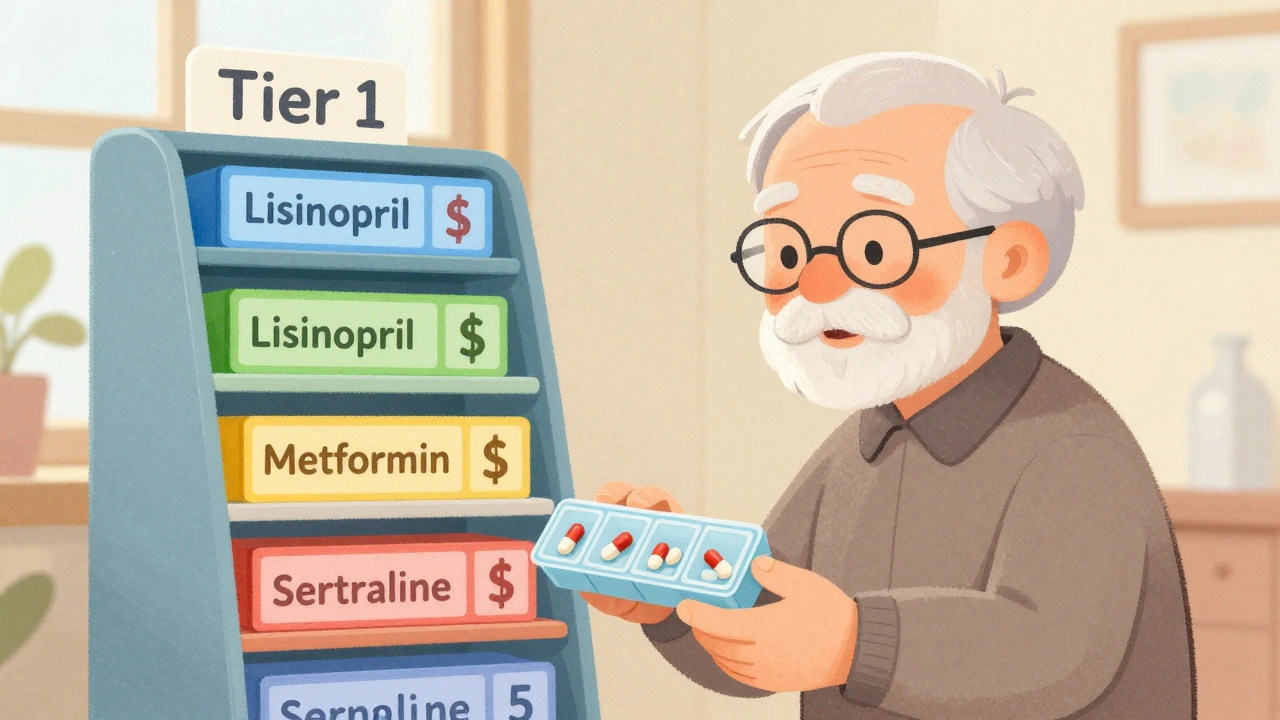
Part D plans organize drugs into five tiers. The lower the tier, the less you pay. Generics almost always land in Tier 1 or Tier 2.- Tier 1 (Preferred Generics): These are the cheapest. You might pay $0 to $15 for a 30-day supply. Most plans put common generics here-like lisinopril for blood pressure or metformin for diabetes.
- Tier 2 (Non-Preferred Generics): Slightly more expensive. You could pay $20 to $40, or 25-35% coinsurance. This tier often includes newer generics or ones with less competition.
- Tier 3 (Preferred Brand-Name Drugs): Brand-name drugs with generic alternatives. Expect $40-$100.
- Tier 4 (Non-Preferred Brand-Name Drugs): No generic available yet. Costs can hit $100-$200.
- Tier 5 (Specialty Drugs): High-cost medications, often for cancer or rare diseases. Some generics here still cost hundreds.
Here’s the key: if your generic is on Tier 1, you’re getting the best deal. If it’s on Tier 2, you’re paying more-but still way less than the brand version.
How Much Do You Pay for Generics in 2025?
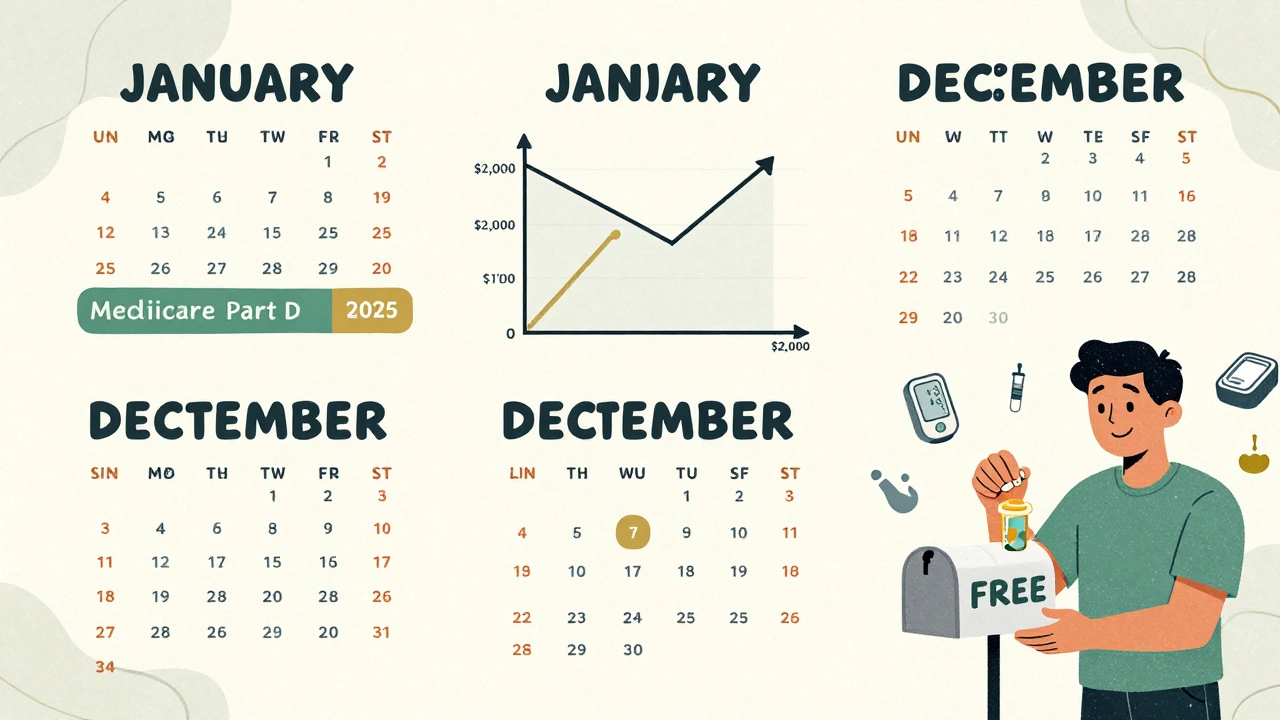
Your out-of-pocket costs depend on what phase of coverage you’re in. In 2025, there are four phases:- Deductible Phase: You pay 100% until you hit $615 (up from $590 in 2024). Not all plans have a deductible-52% of stand-alone Part D plans in 2025 offer $0 deductibles for generics.
- Initial Coverage Phase: After the deductible, you pay 25% coinsurance for generics. The plan pays the rest. This applies until your total out-of-pocket spending hits $2,000.
- Catastrophic Coverage Phase: Once you hit $2,000 out-of-pocket, you pay nothing. Not $0.25. Not $1. Zero. This is new as of January 1, 2025. Before this, you paid 5% coinsurance even after hitting the gap. Now, it’s gone.
- Out-of-Pocket Cap: The $2,000 limit is a hard cap. Once you hit it, you’re protected for the rest of the year. In 2026, it rises to $2,100.
Here’s a real example: If you take three Tier 1 generics that cost $10 each, your monthly cost is $30. Over a year, that’s $360. You’d hit the $2,000 cap in under 6 months. After that, your meds are free.
Why Generics Cost So Much Less Than Brands
Generics work the same as brand-name drugs. Same active ingredients. Same FDA approval. But they cost 80-90% less because they don’t need to pay for research, marketing, or patent protection.Here’s the math: In 2023, generics made up 92% of Part D prescriptions but only 18% of total drug spending. That’s because a $10 generic saves you $100 compared to the brand. And it saves the program billions. Medicare pays 75% of the cost for generics during initial coverage, compared to 72.5% for brand-name drugs. That small difference adds up fast.
But here’s the twist: when you pay for a brand-name drug, 70% of the drug’s cost-including manufacturer discounts-counts toward your $2,000 cap. For generics, only what you actually pay counts. That means if you take mostly brand-name drugs, you hit the cap faster. If you take generics, you pay less upfront, but it takes longer to reach the cap. For most people, that’s still better.
What’s Changed in 2025?
The Inflation Reduction Act didn’t just tweak Part D-it rewrote the rules.- Hard $2,000 cap: No more “donut hole.” You don’t pay anything after hitting $2,000 out-of-pocket.
- Price negotiation: Starting in 2029, CMS will negotiate prices for certain generics. Insulin glargine is already on the list.
- Price comparison tools: By 2026, every Part D plan must offer a tool in their member portal showing you the lowest-cost generic alternative for your meds.
These changes are already saving people an average of $450 a year on generics, according to CMS. And by 2027, 95% of beneficiaries will have access to $0 copays for at least half of commonly used generics.
What You Need to Do to Save Money
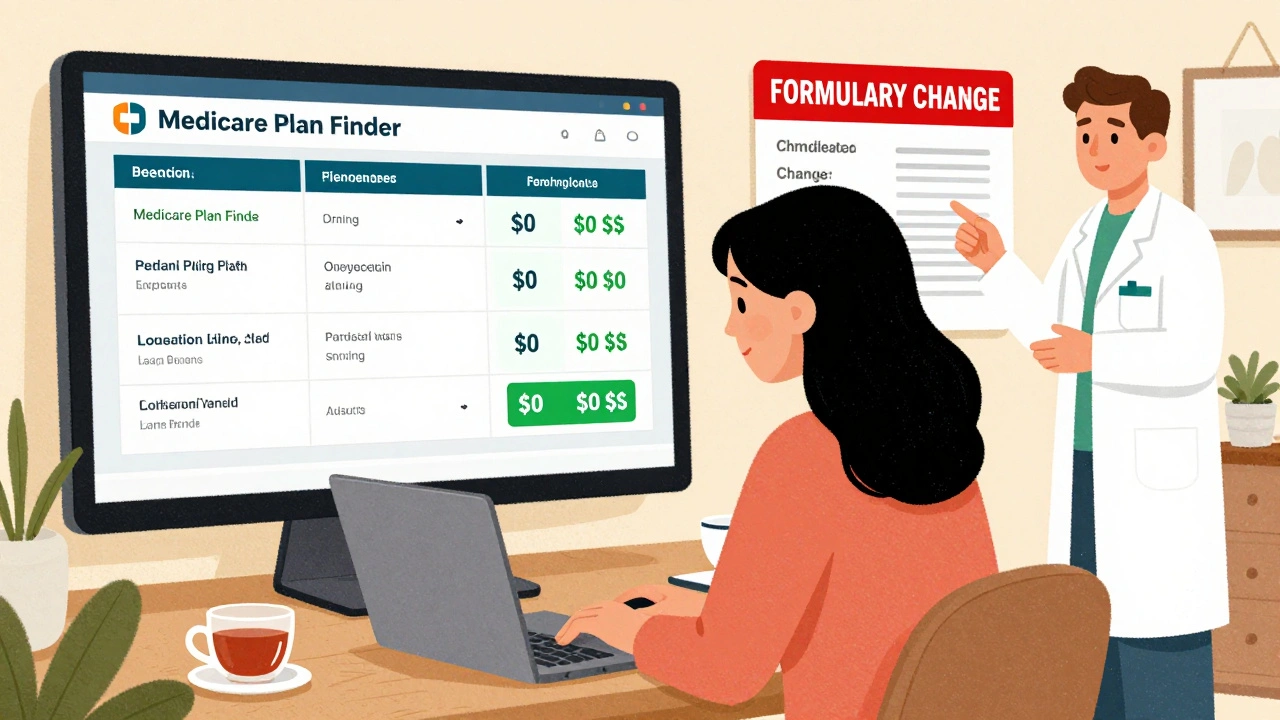
You can’t just assume your plan covers your meds. Here’s how to protect yourself:- Check your plan’s formulary every fall. 37% of plans change at least one generic’s tier each year. That could mean your $0 drug suddenly costs $40.
- Use the Medicare Plan Finder. Enter your exact medications and zip code. KFF found people who use it save $427 a year on average.
- Ask for a coverage determination. If your generic isn’t covered, you can appeal. 83% of these requests get approved.
- Choose a $0 deductible plan. If you take multiple generics, skipping the deductible can save you hundreds.
- Ask your pharmacist about substitutions. Sometimes they switch your generic to another in the same class. If your plan doesn’t cover that one, you’ll pay full price. Ask them to stick with your formulary-approved version.
Common Problems and How to Fix Them
Not everything runs smoothly. Here’s what trips people up:- Therapeutic interchange: Your plan covers one generic for blood pressure, but not another-even though they’re identical. You get stuck paying full price. Solution: Request a coverage determination or switch plans.
- Authorized generics: These are brand-name drugs sold as generics by the same company. They’re not always covered under the same rules. Check if your plan treats them as brand or generic.
- Confusing tiers: 62% of beneficiaries don’t understand their plan’s tier system. Use the plan’s website or call customer service. Ask: “Is my generic on Tier 1?”
One user on Reddit said their plan switched their generic blood pressure med to a different one they didn’t cover. They paid $120 a month until they appealed. Another user said their three generics now cost $0-saving them $300 a month.
What Experts Say
Dr. Richard Frank from Harvard says the tiered system has saved the program $15.3 billion a year by pushing people toward generics. But Juliette Cubanski from KFF warns that 25% coinsurance can still be a burden for people on fixed incomes. And CMS itself admits formulary differences confuse beneficiaries-62% face coverage gaps when comparing plans.The good news? Satisfaction is high. In 2024, 87% of beneficiaries taking mostly generics reported being satisfied with their drug coverage, compared to 76% for those on brand-name drugs.
What’s Next?
By 2030, CMS expects 94% of Part D prescriptions to be generics. New patents are expiring every year. More generics will hit the market. And with price negotiation starting in 2029, even more savings are coming.For now, your best move is simple: know your drugs, know your plan, and check your formulary every year. The system works-but only if you use it right.
Are all generic drugs covered under Medicare Part D?
Not every generic is covered. Each Part D plan has its own formulary, and while federal rules require plans to cover most generics, they can exclude certain ones-for example, if they’re used for weight loss, fertility, or cosmetic purposes. But for essential medications like blood pressure, diabetes, or cholesterol drugs, plans must cover at least two generic options in each therapeutic class. Always check your plan’s list before enrolling.
Why is my generic drug not on my plan’s formulary?
Plans choose which generics to include based on cost, effectiveness, and agreements with manufacturers. Sometimes, they cover one generic in a class but not another-even if they’re chemically identical. This is called therapeutic interchange. If your drug isn’t covered, you can request a coverage determination. In 2023, 83% of these requests were approved. You can also switch plans during Open Enrollment.
Do I pay more for non-preferred generics?
Yes. Non-preferred generics are usually on Tier 2 and cost more than preferred generics on Tier 1. You might pay a fixed copay of $20-$40 or 25-35% coinsurance, compared to $0-$15 for Tier 1. The difference is often small per prescription, but if you take multiple generics, it adds up. Always compare plans to find one with your meds on the lowest tier.
What happens if I hit the $2,000 out-of-pocket cap?
Once you hit $2,000 in out-of-pocket spending on covered drugs in 2025, you enter catastrophic coverage. From that point on, you pay nothing for your generic (or brand-name) drugs for the rest of the calendar year. This cap is hard-you can’t go over it. This rule, introduced in 2025, eliminates the old “donut hole” and means your meds are free after you reach the limit.
How can I find the lowest-cost generic plan for my meds?
Use the official Medicare Plan Finder tool at medicare.gov. Enter your exact medications, dosage, and zip code. The tool shows you plans sorted by total annual cost-including premiums and out-of-pocket drug costs. KFF found users who use this tool save an average of $427 per year. Don’t rely on what your neighbor uses-your meds and location matter.
Can I switch plans if my generic gets removed from the formulary?
Yes. If your plan removes a generic you rely on, you can switch to another plan during the Annual Enrollment Period (October 15-December 7). In some cases, you may qualify for a Special Enrollment Period if your drug is removed mid-year. Contact Medicare or your plan to ask if you’re eligible. Don’t wait until you run out of medication-act as soon as you get notice of a formulary change.


13 Comments
ian septian December 8, 2025
Generics on Tier 1? Free after $2k. That’s it. Stop overcomplicating it.
Lola Bchoudi December 9, 2025
Let’s be real-the tiered formulary system is a masterclass in obfuscation. Preferred generics aren’t just cheaper-they’re strategically placed to nudge beneficiaries toward cost-effective options without triggering prior auth hell. The 85% coverage mandate? A baseline, not a ceiling. And that 2025 $2,000 cap? It’s not generosity-it’s CMS finally admitting the donut hole was a policy failure dressed as a deductible. The real win is the therapeutic interchange loophole being exposed. Pharmacies swap generics all the time under the radar. If your lisinopril suddenly becomes benazepril and you’re stuck paying $40, you didn’t get a better deal-you got a bait-and-switch. Always verify the NDC code, not just the drug name.
Kathy Haverly December 11, 2025
Oh please. They say generics are 80-90% cheaper, but have you seen the ‘authorized generics’? Same pill, same manufacturer, same packaging-except now it’s labeled ‘brand’ so they can charge more and still count it toward your cap. That’s not competition-that’s corporate fraud. And don’t get me started on how the $2,000 cap only counts what YOU pay for generics, but for brands, the manufacturer’s discount counts too. So if you’re on a brand, you hit the cap faster… because Big Pharma gets a subsidy. This system doesn’t protect patients-it protects profits under the guise of reform.
Steve Sullivan December 12, 2025
bro this is actually kinda beautiful 🤯
you pay $360 a year for 3 generics, hit $2k cap in 6 months, then everything’s FREE for the rest of the year? like… who designed this? a wizard? i used to pay $180/month for my blood pressure med before switching to generic-now i pay $0 after july. i cried. not joking. also-use the plan finder. i did. saved me $500. ps: if your pharmacist tries to swap your generic without asking, say NO. they’re just trying to move inventory.
Morgan Tait December 13, 2025
They say ‘92% of prescriptions are generics’-but did you know the same corporations that make the brand-name drugs also own the ‘generic’ versions? It’s the same factory, same pills, same label… just without the logo. And now they’re pushing ‘authorized generics’ so they can still profit off the cap loophole. The Inflation Reduction Act? More like the Inflation Redistribution Act. They’re not lowering prices-they’re just moving the money around so it looks like a win. And don’t get me started on the 2029 price negotiation. You think they’ll negotiate on insulin glargine? Nah. They’ll just rebrand it as ‘premium generic’ and charge $120 anyway. This isn’t reform-it’s theater.
George Taylor December 15, 2025
...And yet, despite all this, 87% of beneficiaries report satisfaction? That’s statistically impossible. Either the survey was designed by CMS, or people are too confused to realize they’re being exploited. The ‘$0 copay’ for half of commonly used generics by 2027? That’s a bait-and-switch too-because the other half? Still Tier 2. And if your drug isn’t on the ‘commonly used’ list? Tough luck. You’re paying $40. Again. The system isn’t broken-it’s engineered to keep you just below the threshold of outrage. You’re not a patient. You’re a revenue stream with a Medicare card.
Andrea Petrov December 15, 2025
Let’s not pretend this is about affordability. This is about control. The formularies are curated by PBMs who have secret rebates with manufacturers. If your generic isn’t on Tier 1, it’s because the PBM didn’t get a kickback from that manufacturer. The ‘coverage determination’ you’re told to appeal? It’s a trap. They approve 83%-but only after you’ve spent three weeks on hold, faxed forms, and missed two doses. Meanwhile, your doctor gets paid to prescribe the PBM’s preferred drug, not yours. This isn’t healthcare. It’s a three-way financial shell game-and you’re the one paying the piper.
Simran Chettiar December 16, 2025
One must contemplate the epistemological paradox inherent in the so-called 'generic drug revolution.' If a pharmaceutical compound is chemically identical to its branded counterpart, yet its market perception is rendered inferior due to branding, then one is compelled to interrogate the ontological status of 'value' within capitalist pharmaceutical ecosystems. The tiered formulary, far from being a mechanism of cost containment, functions as a neo-liberal apparatus of subjectivization-forcing the elderly to internalize the moral imperative of choosing 'preferred' generics, thereby transforming therapeutic necessity into a performative act of fiscal virtue. The $2,000 cap, while ostensibly benevolent, merely reinforces the illusion of agency within a system that remains fundamentally extractive. One wonders: is liberation found in the absence of copayments-or in the dismantling of the formulary itself?
Nikhil Pattni December 18, 2025
Okay, let me break this down like I’m explaining to my 72-year-old aunt who still thinks ‘generic’ means ‘cheap knockoff.’ So, yes, generics are the same as brand, FDA-approved, same active ingredient, same side effects. But here’s the thing-your plan might cover ‘metformin’ but not ‘metformin ER’-even though they’re the same drug, just extended release. And if your pharmacy switches you to a different generic because the manufacturer gave them a bonus? You’re stuck. And if you’re on Social Security and your rent is $800, $20 extra for a Tier 2 drug? That’s your bus fare, your groceries, your insulin. The $2,000 cap sounds great, but what if you’re on 5 meds? You hit it in 4 months, sure-but what if you get sick in March and need a new drug that’s not on your formulary? You pay full price until October. And the Plan Finder? It’s useless if you don’t know your NDC code. Most seniors don’t. They just show the bottle. And the pharmacist? They’ll just give you whatever’s cheapest that day. So you end up with a different pill, different side effects, and no idea why your knees are swelling. This isn’t healthcare. It’s a maze with no exit. And they call it ‘affordable.’
William Umstattd December 20, 2025
Let me be clear: this system is a moral disgrace. The fact that we celebrate a $2,000 cap as a victory while seniors still choose between insulin and groceries is not progress-it’s shame. And the ‘authorized generics’? That’s not innovation. That’s greed in a lab coat. Big Pharma doesn’t want you to save money-they want you to think you’re saving money while they still pocket the difference. The real scandal? The same companies that profit from brand-name drugs are now the ones producing the ‘cheap’ generics. They’re not competing-they’re colluding. And the government? They’re the bouncer letting them in the club. If this is reform, then I’d hate to see what the original crime looked like.
Sarah Gray December 21, 2025
First, ‘preferred generics’ is a misleading term. It implies a clinical preference, when in fact it’s purely a financial arrangement between the PBM and manufacturer. Second, the claim that generics are 80-90% cheaper is statistically misleading: it’s based on average wholesale price, not retail cost to the patient. Third, the $2,000 out-of-pocket cap only applies to drugs covered under the formulary-so if your plan excludes your specific generic, you pay 100%. Fourth, the 83% approval rate for coverage determinations is irrelevant if the process takes 30 days and you’re out of medication by day 14. Fifth, the ‘$0 deductible plan’ is a mirage-premiums are inflated to compensate. Sixth, the Plan Finder tool doesn’t account for pharmacy network restrictions. Seventh, ‘therapeutic interchange’ is not a feature-it’s a violation of informed consent. Eighth, the 92% generic rate is meaningless if 40% of those are non-preferred. Ninth, the Inflation Reduction Act does not cap drug prices-it caps your liability. Tenth, the fact that you’re still reading this means you’ve been trapped in this system longer than you should have been.
Darcie Streeter-Oxland December 21, 2025
It is, regrettably, incumbent upon the reader to acknowledge that the ostensible benevolence of the $2,000 out-of-pocket cap is predicated upon a structural framework that remains fundamentally inequitable. The assertion that generics are ‘affordable’ presumes a level of financial liquidity and pharmaceutical literacy that is neither universal nor reliably attainable among the elderly. Moreover, the proliferation of tiered formularies, while ostensibly rational, serves primarily to obfuscate the true cost of care. One must further observe that the reliance upon consumer-driven tools such as the Medicare Plan Finder presupposes digital competence-an assumption that is demonstrably flawed. The system, in its current iteration, does not empower; it merely reframes burden as choice. This is not reform. It is administrative theatre.
Steve Sullivan December 23, 2025
lol @ above comment-i just called my pharmacist and asked ‘is this the same pill i got last month?’ they said ‘yeah but cheaper’ and handed me a new bottle. no explanation. no paperwork. just… different. so i asked ‘why?’ they said ‘your plan switched it.’ i said ‘what’s the difference?’ they said ‘none. but if you don’t like it, switch plans.’
so yeah. it’s all a game. and we’re the pawns. 🤡