
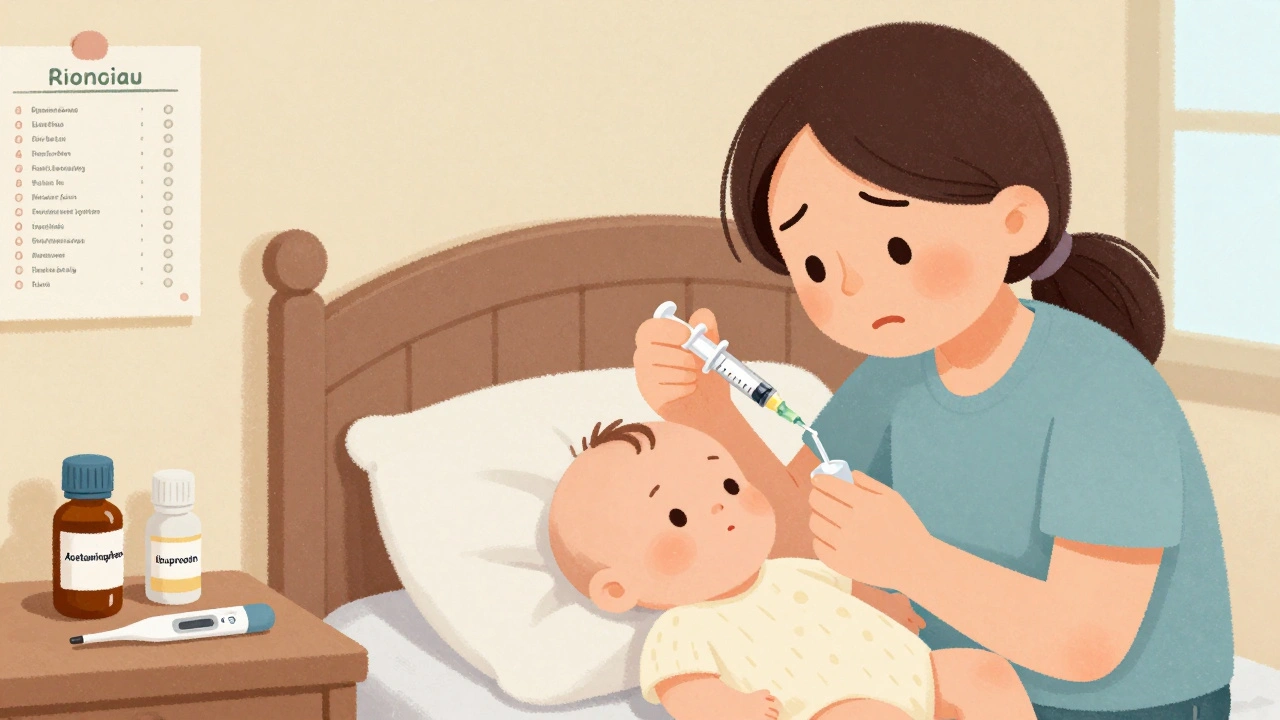
When your baby or toddler has a fever, the first thing most parents reach for is a fever reducer. But with two common options-acetaminophen and ibuprofen-how do you know which is safer, more effective, or right for your child? It’s not just about lowering the number on the thermometer. It’s about doing it safely, correctly, and without making things worse.
What’s the difference between acetaminophen and ibuprofen?
Acetaminophen (also called paracetamol) and ibuprofen are both fever reducers and pain relievers, but they work differently in the body. Acetaminophen mainly affects the brain’s temperature control center. Ibuprofen, on the other hand, reduces inflammation and blocks chemicals that cause pain and fever throughout the body. That’s why ibuprofen often works better for earaches, teething pain, or sore muscles-conditions where swelling plays a role.
For fever alone, studies show ibuprofen lowers temperature more reliably. One major review of 85 studies found that at the four-hour mark, kids treated with ibuprofen were nearly twice as likely to be fever-free compared to those given acetaminophen. The difference isn’t huge for every child, but it’s consistent across multiple trials.
Age limits matter-especially under two
The American Academy of Pediatrics (AAP) doesn’t recommend acetaminophen for babies under three months unless a doctor says so. For ibuprofen, the cutoff is six months. Why? Because very young infants have immature kidneys and livers. Their bodies can’t process these medicines the same way older kids can. Giving them too much, or even the right amount at the wrong time, can lead to serious side effects.
If your baby is under three months and has a fever of 100.4°F (38°C) or higher, call your pediatrician immediately. Fever in newborns can be a sign of something serious like a bacterial infection. Don’t wait to give medicine-get medical advice first.
Dosing by weight, not age
One of the biggest mistakes parents make? Dosing by age. A 15-pound baby and a 20-pound toddler might both be labeled as “6-11 months,” but their medicine needs are completely different. The correct dose for acetaminophen is 7-15 mg per kilogram of body weight every 4-6 hours. For ibuprofen, it’s 4-10 mg per kilogram every 6-8 hours.
Here’s a real example: A 12-pound (5.4 kg) baby needs about 40-80 mg of acetaminophen per dose. That’s roughly 1.25 mL of the infant drops (160 mg/5 mL). But if you guess and give 2.5 mL thinking “it’s for a 10-pound baby,” you’re giving nearly double the safe dose. That’s how accidental overdoses happen.
Always use the measuring device that comes with the bottle. Never use a kitchen spoon. The FDA required all pediatric liquid medications to include calibrated dosing tools in 2020-and for good reason. A 2021 audit from a children’s hospital found that 68% of dosing errors were due to parents using spoons or syringes from other bottles.
Which one works better?
For fever: Ibuprofen wins. Studies show it reduces fever faster and keeps it down longer. One study found kids on ibuprofen stayed fever-free for up to two more hours than those on acetaminophen.
For pain: It’s close. Both help with teething, earaches, and injuries. But if your child has swollen gums or a sprained ankle, ibuprofen’s anti-inflammatory effect gives it an edge. For simple headaches or mild discomfort, acetaminophen works just fine.
Here’s what parents report: On parenting forums, 78% say ibuprofen brings down fevers more effectively. But 32% also mention stomach upset, especially if given on an empty stomach. Acetaminophen is gentler on the tummy-no surprise there.
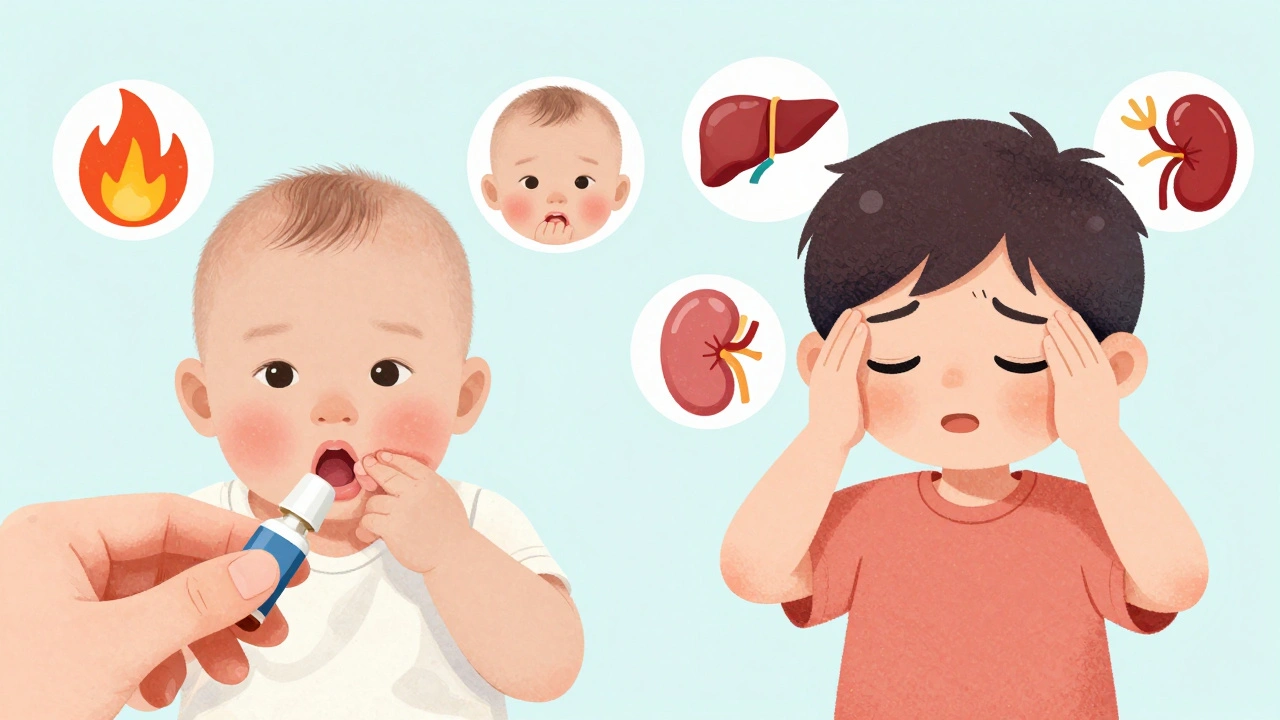
Safety risks you can’t ignore
Both medicines are safe when used right. But wrong use? That’s where the danger lies.
Acetaminophen: Too much can cause liver damage. The maximum daily dose for kids is 75 mg per kilogram. That sounds like a lot-but it’s easy to hit by accident. Many cold and flu mixes for kids also contain acetaminophen. If you give one of those along with Tylenol, you’re doubling up. A 2021 study found that 29% of acetaminophen-related liver injuries in kids under six came from hidden ingredients in combination products.
Ibuprofen: Too much can stress the kidneys, especially if the child is dehydrated. That’s why you shouldn’t give it if your child hasn’t had fluids in hours or has vomiting or diarrhea. Also, never give ibuprofen to a child with chickenpox-it can increase the risk of a rare but dangerous skin infection.
And here’s something most parents don’t know: Some research links early acetaminophen use (especially in the first year) to a higher chance of developing asthma later. A 2022 meta-analysis found a 1.6 times higher risk. It’s not a guarantee-but it’s a reason to use it only when needed, not as a daily preventive.
Alternating meds? Don’t do it without a doctor
Many parents swear by alternating acetaminophen and ibuprofen every few hours to keep fever down. It sounds smart. But it’s risky. You’re doubling the chance of giving the wrong dose, mixing up timing, or accidentally overdosing. A 2023 AAP study found that alternating didn’t significantly improve fever control compared to using one medicine correctly.
Plus, if you’re alternating, you’re giving medicine every 3-4 hours. That’s a lot. Kids don’t need constant fever reduction. They need rest, fluids, and comfort. If fever is still high after 48 hours, or if your child seems worse, it’s time to see a doctor-not give more medicine.
What about brand names vs. generics?
Children’s Tylenol, Children’s Motrin, Advil, and generics-all contain the same active ingredients. The difference? Price and flavor. Generics make up 76% of sales. They’re just as safe and effective. Save your money. Just make sure the concentration is right: infant drops are 160 mg per 5 mL. Don’t use adult liquid or tablets. Ever.
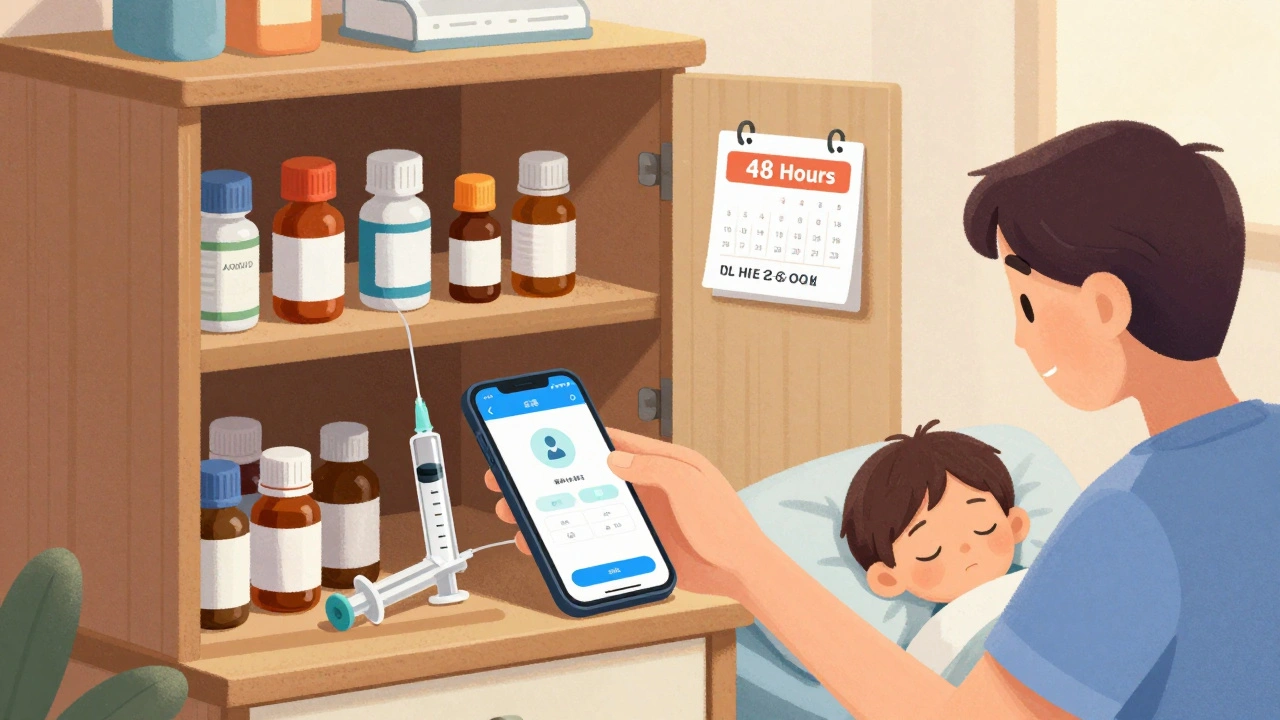
Also, check the expiration date. Old medicine doesn’t break down into poison, but it loses strength. A 2023 study found that 40% of home medicine cabinets had expired pediatric doses. If it’s more than a year past the date, toss it.
What to do when the fever won’t break
Medicine isn’t the only tool. Dress your child in light clothes. Keep the room cool. Offer fluids often-even small sips help. A lukewarm bath can feel soothing, but never use ice water or alcohol rubs. Those can cause shivering, which raises body temperature even more.
If your child is under 2, and the fever lasts more than 48 hours, or if they’re lethargic, not eating, crying nonstop, or have a rash, call your doctor. Fever is a symptom, not the enemy. The real goal is to help your child feel better, not to chase a number.
What’s changing in 2025?
The AAP is updating its fever guidelines in January 2025. New data on acetaminophen and asthma risk, plus more research on ibuprofen use in infants under six months, will shape the next version. For now, stick with the current advice: use the right dose, by weight, and only when necessary.
Also, new dosing apps and smart syringes are hitting the market. Some connect to your phone and remind you when to give the next dose. They’re not necessary-but if you’re confused or anxious, they can help reduce mistakes.
Bottom line: Choose wisely, dose accurately
For most kids over six months, ibuprofen is the better choice for fever and pain. It works faster, lasts longer, and helps with inflammation. For babies three months and older, acetaminophen is still a solid, gentler option-especially if they have stomach sensitivity or are dehydrated.
But here’s the real rule: Always dose by weight, never by age. Use the right tool. Never mix meds unless your doctor says so. And when in doubt, call your pediatrician.
Fever is scary. But with the right info, you’re not powerless. You’re a parent who knows how to help-without risking more harm than good.
Can I give ibuprofen to my 4-month-old with a fever?
No. The American Academy of Pediatrics advises against giving ibuprofen to infants under six months unless a doctor specifically recommends it. Their kidneys aren’t fully developed yet, and the risk of kidney stress is higher. For babies 3-6 months, use acetaminophen only, and always check with your pediatrician first.
Is acetaminophen safer than ibuprofen for babies?
It’s not about which is safer overall-it’s about which is safer for your child’s age and condition. Acetaminophen is easier on the stomach and kidneys, so it’s preferred for younger babies. But ibuprofen is just as safe for kids over six months, and often more effective. The biggest risk with both is incorrect dosing, not the medicine itself.
How many doses can I give in one day?
For acetaminophen, no more than five doses in 24 hours (every 4-6 hours). For ibuprofen, no more than four doses in 24 hours (every 6-8 hours). Never exceed the maximum daily dose: 75 mg/kg for acetaminophen, 40 mg/kg for ibuprofen. Write down each dose and time to avoid double-dosing.
Can I use adult Tylenol or Advil for my child?
Never. Adult formulations are too concentrated. One teaspoon of adult liquid acetaminophen can be a lethal overdose for a toddler. Always use pediatric-specific products with clear dosing labels. If you only have adult medicine, call poison control or your doctor immediately-don’t guess the dose.
My child threw up after taking the medicine. Should I give another dose?
If your child vomited within 20 minutes of taking the dose, you can give another full dose. If it was more than 20 minutes later, wait until the next scheduled dose. Giving extra medicine increases overdose risk. Watch for signs of dehydration-dry mouth, no wet diaper in 6 hours-and call your doctor if you’re worried.
How long should I wait before switching from acetaminophen to ibuprofen?
Don’t switch unless your doctor tells you to. If one medicine isn’t working after a full dose cycle (4-6 hours for acetaminophen, 6-8 hours for ibuprofen), call your pediatrician. Alternating without guidance increases dosing errors and doesn’t improve outcomes. Stick to one, use it correctly, and know when to seek help.
What if my child has a rash after taking the medicine?
Stop the medicine immediately. A rash could be a sign of an allergic reaction. Look for other symptoms like swelling, trouble breathing, or hives. Call your doctor or go to urgent care right away. Don’t assume it’s just a harmless reaction-medication allergies in kids can escalate quickly.
Can I give fever medicine before vaccines?
No. Giving acetaminophen or ibuprofen before vaccination isn’t recommended. Studies show it can reduce the immune response to some vaccines. If your child has a fever or is in pain after the shot, then it’s fine to give medicine. But don’t pre-treat to prevent discomfort-it’s unnecessary and may make the vaccine less effective.




14 Comments
Ashley Farmer December 7, 2025
I remember when my daughter was 4 months and spiked a fever after her 4-month shots. I was terrified, but I followed the AAP guidelines and called the pediatrician instead of reaching for the medicine. They said to keep her cool, offer breastmilk, and watch for lethargy. We didn’t give anything until 12 hours later-and she was fine. Trust your gut, but trust the guidelines more.
Parents, you’re not failing if you wait. You’re protecting them.
Also, never use a kitchen spoon. I used one once. Never again.
Olivia Hand December 9, 2025
Acetaminophen is basically a slow-burning landmine in your medicine cabinet. I didn’t know my ‘cold & flu’ syrup had it too until my kid’s liver enzymes spiked. That was the day I started reading every ingredient label like it was a legal contract. Turns out, 29% of pediatric liver injuries? Yeah, that’s not a statistic-it’s my kid’s emergency room bill.
And don’t get me started on the ‘alternating’ trend. It’s not smart. It’s a math nightmare with a side of anxiety.
Generics? Yes. Brand names? Only if you like paying extra for glitter.
Desmond Khoo December 11, 2025
IBUPROFEN IS THE MVP 🏆
My 18-month-old used to scream for hours with teething pain. Acetaminophen? Meh. Ibuprofen? 30 minutes later, she was giggling and eating applesauce. I don’t care what the studies say-my kid’s smile is the real data point.
Also, never use a kitchen spoon. I learned that the hard way. Now I’ve got a whole drawer of those little syringes. Worth every penny.
And yes, I’ve got the app. It beeps. I love it. 😊
Ted Rosenwasser December 12, 2025
Most of you are missing the forest for the trees. The real issue isn’t dosing-it’s the medical-industrial complex pushing these drugs as solutions instead of symptoms. Fever is a natural immune response. Suppressing it with pharmaceuticals is like putting a lid on a boiling pot-you’re not fixing the heat, you’re just delaying the explosion.
Studies linking acetaminophen to asthma? You think that’s a coincidence? The AAP is compromised. The FDA is captured. You’re being manipulated into dependency.
Try cold compresses. Hydration. Rest. Let the fever do its job. You’ll thank me when your kid isn’t on a lifelong medication treadmill.
Helen Maples December 13, 2025
Let’s be clear: Dosing by weight is non-negotiable. If you’re using age-based charts, you’re gambling with your child’s liver. The AAP guidelines exist for a reason. Not because they’re trendy, but because they’re evidence-based.
Also, the claim that ibuprofen is ‘better’ for inflammation? That’s not opinion-it’s meta-analysis. Eighty-five studies. Consistent results. You don’t get to ignore that because it’s inconvenient.
And if you’re alternating meds without a doctor’s instruction? That’s not ‘being proactive.’ That’s negligence. And if you’re using adult Tylenol? You’re not a parent-you’re a liability.
Stop winging it. Read the label. Measure accurately. Call your pediatrician when in doubt. It’s not hard. It’s just not sexy.
David Brooks December 15, 2025
My son had a fever of 104.2°F. I was shaking. I gave him ibuprofen. He slept for 4 hours straight. I cried. Not because he was sick-but because I finally felt like I could DO something right.
That night, I didn’t care about studies or brands or dosing charts. I cared that he was breathing easy.
But the next day? I printed out the weight-based chart. I bought the syringe. I labeled every bottle. Because now I know: Being a parent means being prepared-not just reactive.
You’ve got this. I believe in you.
Kurt Russell December 15, 2025
Let me tell you what no one says: The real danger isn’t the medicine-it’s the guilt. You feel like you have to ‘do something’ when your kid has a fever. But sometimes, the best thing you can do is hold them, sing to them, and wait.
I used to panic every time my daughter’s temperature went above 100.5. Then I learned: Fever isn’t the enemy. Fear is.
Use the right dose? Yes. But also trust your instincts. If they’re smiling, drinking, and responding to you? They’re going to be okay.
And if you’re still worried? Call your pediatrician. They’ve seen it all. They won’t judge you. They’ll help you.
You’re not alone. I’ve been there. You’re doing great.
Stacy here December 17, 2025
Acetaminophen is a corporate weapon disguised as medicine. Did you know Tylenol’s parent company also owns a major vaccine manufacturer? Coincidence? I think not.
The ‘asthma link’? That’s just the tip of the iceberg. The CDC has been quietly burying studies since 2017 showing a direct correlation between early acetaminophen use and neurodevelopmental delays.
And don’t even get me started on the ‘smart syringes’-they’re tracking your usage. Who’s collecting that data? Who’s selling it?
You think you’re protecting your child? You’re being monitored. Wake up.
Go outside. Let them sweat it out. Cold water. Bare feet. The body knows how to heal itself. The system doesn’t want you to know that.
Kyle Flores December 17, 2025
My cousin’s kid had a fever and they gave him ibuprofen-forgot to check the weight. Ended up in the ER. Scary stuff.
I used to dose by age too. Then I learned the hard way. Now I weigh my kid every time I give meds. Yeah, it’s a pain. But so is a hospital stay.
Also, I use the generic stuff. Same thing, half the price. No need to pay for the rainbow packaging.
And if your kid throws up? Wait. Don’t just give more. I learned that one the hard way too.
Parenting’s messy. But you’re doing better than you think.
Ryan Sullivan December 19, 2025
While your anecdotal experiences are emotionally compelling, they lack statistical validity. The meta-analysis cited in the original post-published in The Lancet Child & Adolescent Health-is methodologically rigorous, with a pooled effect size of 0.82 for fever reduction at 4 hours. Your reliance on ‘my kid felt better’ is a classic appeal to anecdote fallacy.
Furthermore, the 2022 asthma correlation study demonstrated a hazard ratio of 1.6, which, while statistically significant, is confounded by reverse causality: asthmatic children are more likely to receive acetaminophen due to respiratory symptoms, not the other way around.
Do not confuse emotional resonance with clinical efficacy. You are not a researcher. You are a caregiver. Stick to the protocol.
Wesley Phillips December 21, 2025
Look I get it. Everyone’s scared. But let’s be real-kids get fevers. It’s normal. You don’t need a PhD to read a bottle.
Use the syringe. Weigh them. Don’t mix. Done.
Also, stop buying those $12 ‘children’s’ bottles. The generic is literally the same stuff. Save your cash for pizza night.
And if you’re still stressing? Take a breath. Your kid’s not gonna die from a fever. They’re gonna grow up. And they’ll probably be fine.
Peace out.
Kyle Oksten December 21, 2025
There’s a deeper question here: Why do we equate fever with danger? Fever is not a disease. It’s a signal. A biological alarm. Our culture has been trained to fear it, to silence it, to medicate it into oblivion.
But what if the body’s response is the most intelligent thing happening? What if our job isn’t to suppress it-but to support it?
Hydration. Rest. Comfort. That’s the real medicine.
The drugs? They’re tools. Not solutions. Use them wisely. But don’t mistake them for control.
We’ve forgotten how to trust biology. That’s the real epidemic.
Sam Mathew Cheriyan December 23, 2025
Acetaminophen is a tool of the new world order. I read a blog by a guy who worked at the FDA-he said they push it because it’s cheap to make and keeps parents from asking questions. Ibuprofen? That’s the big pharma’s backup plan. Both are lies.
My kid had a fever. I gave him ginger tea and a cold towel. He was fine in 6 hours. No pills.
They don’t want you to know this. But you do now.
Stay woke.
Ashley Farmer December 23, 2025
Thank you for saying this. I’ve been getting so many DMs from moms asking if they should alternate. I just told them: ‘No. Just pick one. Do it right. And call your doctor if it doesn’t improve.’
It’s not about being perfect. It’s about being careful.
And yes, the syringe. Always the syringe.