
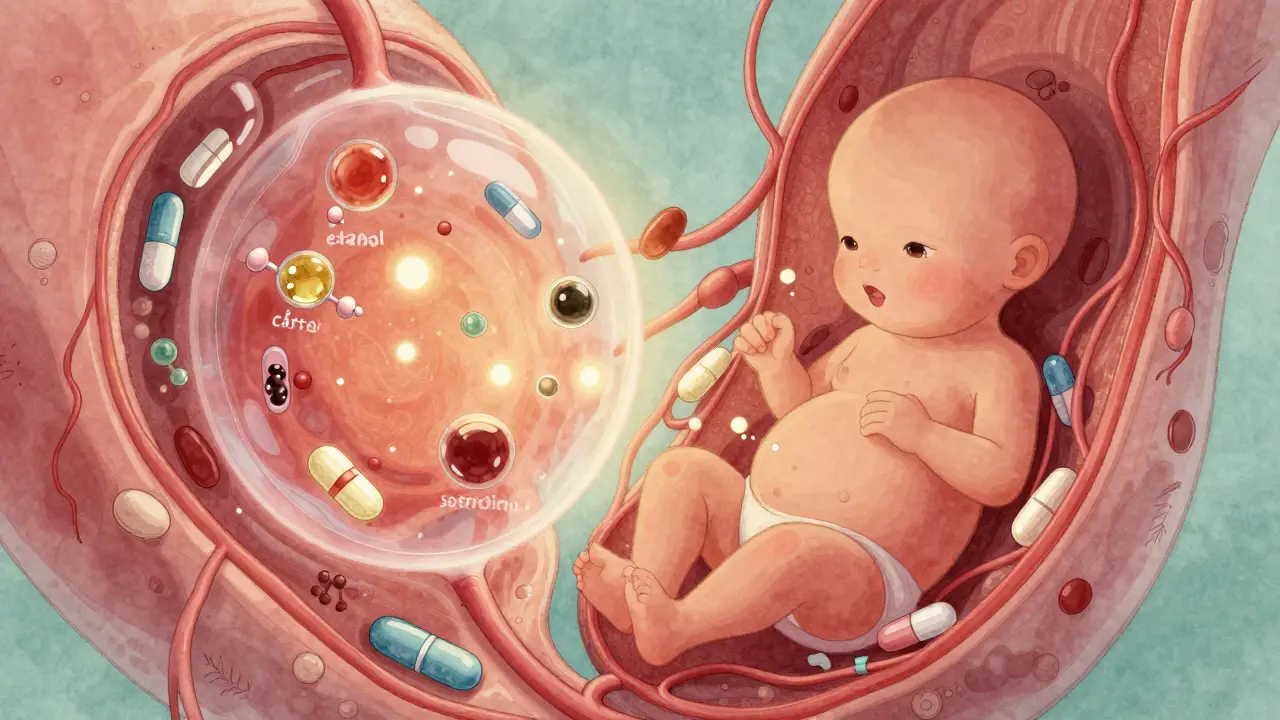
When you take a pill during pregnancy, it doesn’t just stay with you. It travels through your bloodstream, crosses the placenta, and reaches your baby. For decades, many assumed the placenta was a protective wall - a shield keeping harmful substances out. But that’s not true. The placenta is not a filter. It’s a selective gatekeeper, and sometimes, it lets through exactly what you hoped it wouldn’t.
The Placenta Isn’t a Barrier - It’s a Highway
The placenta weighs about half a kilogram and has a surface area bigger than a small bedroom. It’s packed with blood vessels, cells, and transport systems that move oxygen, nutrients, and yes - medications - between you and your baby. It doesn’t block drugs because they’re dangerous. It blocks them because of their size, chemistry, and how they interact with proteins in the placental tissue.
Small, fat-soluble molecules slip through easily. Ethanol, nicotine, caffeine - they cross quickly. That’s why a single glass of wine can raise your baby’s blood alcohol level almost as high as yours. On the other hand, big molecules like insulin (over 5,800 Daltons) barely make it across. Less than 0.1% of maternal insulin reaches the fetus.
But size isn’t the whole story. A drug’s charge matters too. If it’s ionized (charged) at body pH, it struggles to pass through the lipid membranes of placental cells. That’s why some antibiotics and antivirals have low transfer rates - not because they’re safe, but because they’re poorly absorbed.
Transporters: The Bouncers of the Placenta
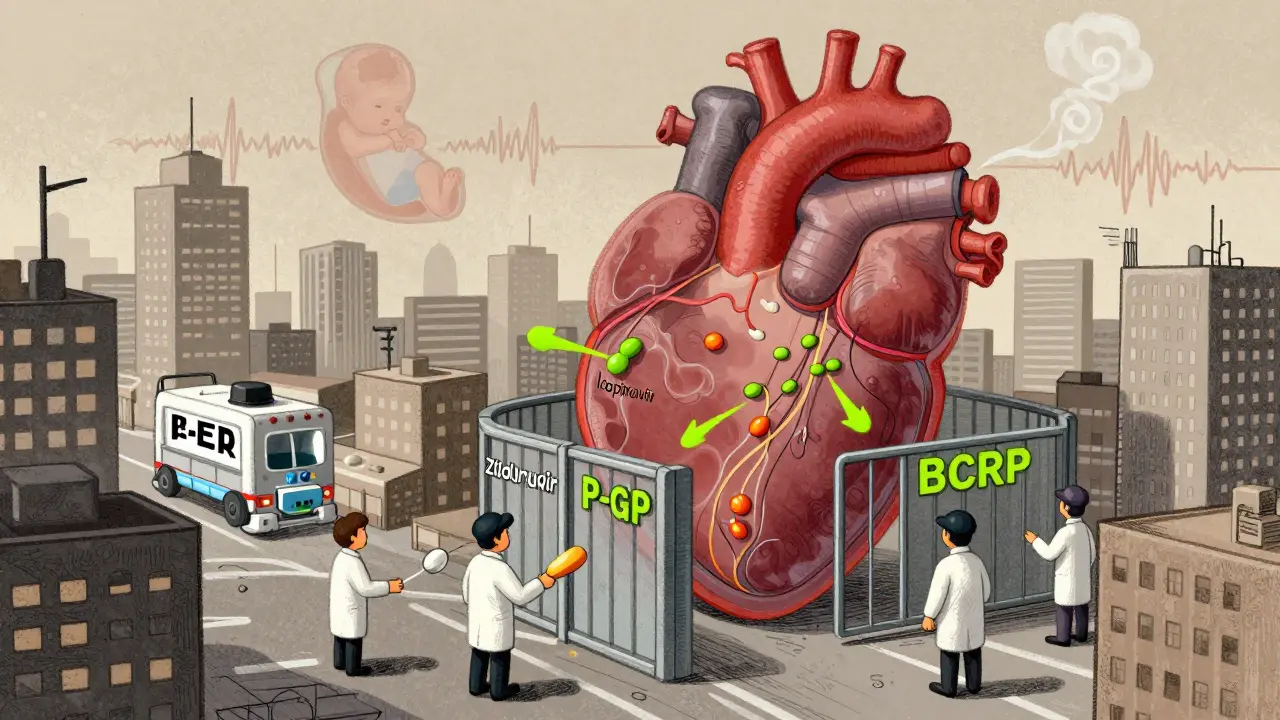
Here’s where things get even more complex. The placenta isn’t just passive. It has its own active defense system. Special proteins called efflux transporters - like P-glycoprotein (P-gp) and BCRP - act like bouncers. They spot certain drugs and pump them right back into your bloodstream, away from the baby.
Take HIV medications. Lopinavir, a common antiviral, only reaches about 60% of the mother’s concentration in the baby’s blood. Why? Because P-gp is kicking it out. But zidovudine? It slips through easily - it uses different transporters, ones that actually help it move into the fetus. That’s why one drug in the same class can be safer than another, even if they treat the same infection.
Even something as simple as quinidine - a heart rhythm drug - doesn’t affect digoxin’s transfer, even though both are used for cardiac conditions. Why? Because digoxin doesn’t bind to the same transporters. This isn’t random. It’s precise. And that precision is why blanket warnings like “don’t take any meds while pregnant” are dangerously misleading.
What Happens When Drugs Get Through?
Once a drug crosses the placenta, your baby’s body handles it differently than yours. Their liver is immature. Their kidneys are still developing. Their blood-brain barrier isn’t fully formed. That means even small amounts can have big effects.
SSRIs like sertraline cross the placenta almost completely - cord-to-maternal ratios of 0.8 to 1.0. That’s nearly equal levels. About 30% of babies exposed to these drugs in the third trimester show temporary symptoms after birth: jitteriness, feeding trouble, breathing issues. These aren’t birth defects. They’re withdrawal-like reactions. And they usually resolve in days.
Opioids are another story. Methadone and buprenorphine cross easily. Fetal concentrations reach 65-75% of maternal levels. That’s why 60-80% of babies born to mothers on these medications develop neonatal abstinence syndrome - a condition where the baby goes through withdrawal after birth. It’s not because the drug is evil. It’s because the baby’s body got used to it. Stopping suddenly after birth causes the crash.
Antiseizure drugs like valproic acid cross just as easily. And that’s why they carry a 10-11% risk of major birth defects - heart problems, neural tube defects, facial changes - compared to 2-3% in the general population. Phenobarbital? Also crosses easily. But it doesn’t cause the same level of structural damage. The difference? How the drug interacts with developing brain cells.
Timing Matters More Than You Think
Not all pregnancies are the same when it comes to drug transfer. The placenta changes dramatically over time.
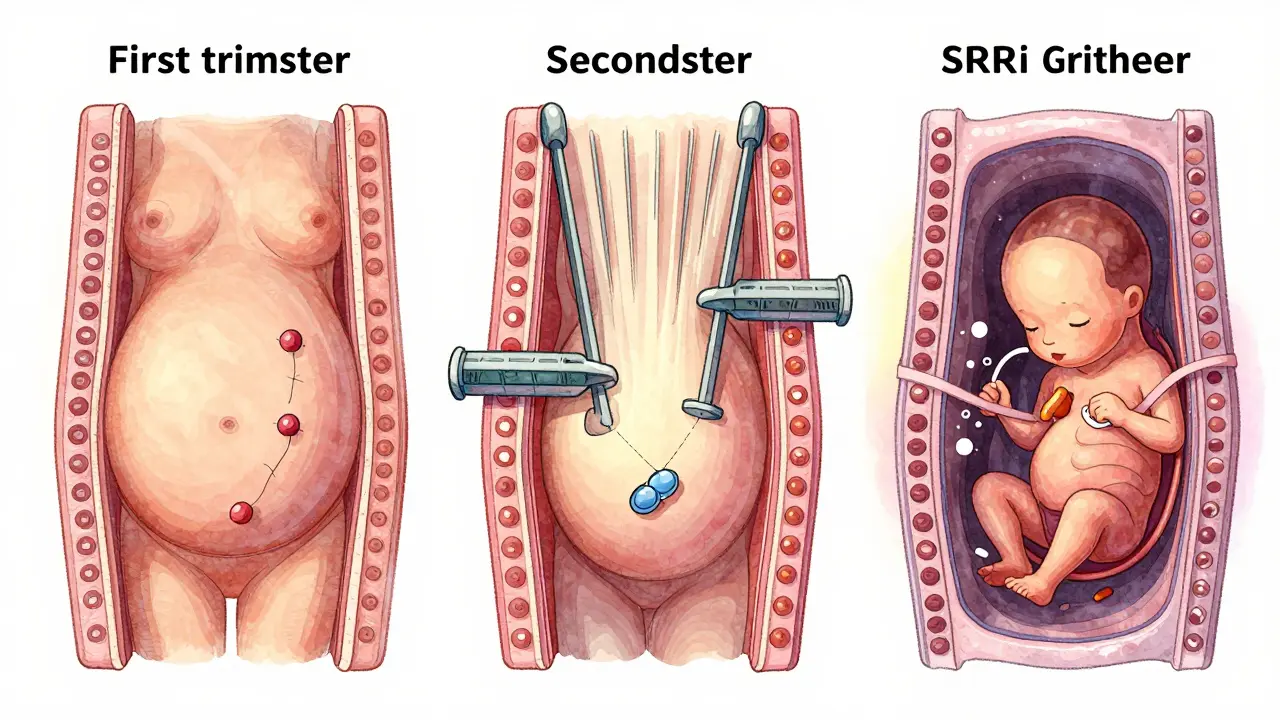
In the first trimester, the barrier is looser. Tight junctions between placental cells aren’t fully formed. Efflux transporters like P-gp are still ramping up. That’s why some drugs - like thalidomide - caused catastrophic limb defects when taken early in pregnancy. The baby’s limbs were forming. The placenta couldn’t stop the drug. And the drug didn’t care - it targeted developing cells.
By week 28, the placenta becomes more selective. Transporters are fully active. But that doesn’t mean it’s safer. It just means the risks shift. Drugs that cause long-term neurological changes - like certain antidepressants or antipsychotics - may have subtle effects even if they don’t cause visible birth defects.
And here’s the catch: most research is done on term placentas. That’s because they’re easier to get after birth. But the most critical development - brain wiring, organ formation - happens in the first 12 weeks. We’re making safety decisions based on data from the last trimester, while the most vulnerable period is the first.
What About Protein Binding and Dose?
Not all of a drug in your blood is free to cross. Many drugs bind tightly to proteins like albumin. Only the unbound portion can move through the placenta. Warfarin, for example, is 99% bound. Even though it’s small and fat-soluble, very little gets through. That’s why it’s often considered safer than other blood thinners in pregnancy - though it’s still not risk-free.
Dose matters too. A single dose of an antibiotic won’t do the same thing as daily use for weeks. Chronic exposure builds up. That’s why taking ibuprofen occasionally in early pregnancy is low-risk, but using it long-term in the third trimester can cause premature closure of a fetal heart vessel - a rare but serious problem.
What’s New in Research?
Scientists are no longer guessing. They’re measuring. Placenta-on-a-chip devices now mimic the human placenta in a lab dish. These tiny systems can test how a new drug moves across placental tissue - in real time. One study showed glyburide (a diabetes drug) crosses at about 5.6% in these chips - matching real placental data almost exactly.
The NIH’s Human Placenta Project is using radioactive tracers to watch drugs move through the placenta in living women - non-invasively. For the first time, we can see where a drug goes: liver, brain, heart - without harming the baby.
And there’s hope. Researchers are designing drugs that can’t cross the placenta - or ones that are meant to. Imagine a cancer drug that only targets placental cells to treat preeclampsia, without touching the baby. Or a neuroprotective agent delivered only to the fetal brain. But these are double-edged swords. If we can target the fetus, we can also accidentally overload it.
What Should You Do?
Don’t stop your meds without talking to your doctor. Untreated depression, seizures, high blood pressure, or infections can be far more dangerous to your baby than the medication.
Ask these questions:
- Is this drug known to cross the placenta?
- Is there a safer alternative with less transfer?
- What’s the evidence for harm - and at what dose and stage of pregnancy?
- Can we monitor levels in my blood to make sure I’m not taking too much?
For example, if you’re on an SSRI and pregnant, switching to sertraline (which has the most safety data) is often better than staying on paroxetine, which has stronger links to heart defects. If you have epilepsy, lamotrigine is often preferred over valproic acid. These aren’t guesses. They’re based on decades of data.
And if you’re prescribed a new drug - even an over-the-counter one - check if it’s been studied in pregnancy. Most haven’t. That doesn’t mean it’s dangerous. It just means we don’t know yet.
The Bigger Picture
Right now, 45% of prescription drugs have no reliable safety data for pregnancy. That’s not because manufacturers are careless. It’s because testing on pregnant women is ethically and legally restricted. We’re flying blind in too many cases.
But things are changing. The FDA now requires placental transfer data for new drugs. Regulatory agencies demand it. Researchers are building better models. And doctors are learning to think beyond “avoid all meds.”
The goal isn’t zero exposure. It’s smart exposure. The goal isn’t to never take a pill. It’s to take the right pill, at the right time, at the right dose - with eyes wide open.
Your baby isn’t a separate person floating in a bubble. They’re connected - chemically, biologically, emotionally. And that connection works both ways. What you take matters. But so does what you don’t take.
Can I take ibuprofen while pregnant?
Occasional use of ibuprofen in early pregnancy is generally low-risk. But long-term or high-dose use, especially after 20 weeks, can cause problems like reduced amniotic fluid or premature closure of a fetal heart vessel. Acetaminophen is usually preferred for pain relief during pregnancy.
Do antidepressants harm the baby?
Some antidepressants, like sertraline and citalopram, cross the placenta but have the most safety data. Untreated depression carries risks too - preterm birth, low birth weight, developmental delays. The decision isn’t about avoiding meds entirely, but choosing the safest option for your mental health and your baby’s development.
Why do some drugs affect the fetus more than others?
It depends on molecular size (under 500 Da crosses easier), fat solubility (log P >2 helps), protein binding (only unbound drug crosses), and whether the placenta’s transporters push it back. Timing matters too - early pregnancy is riskiest for structural defects.
Is it safe to take antibiotics during pregnancy?
Many antibiotics, like penicillin, amoxicillin, and cephalosporins, cross the placenta but have decades of safe use. Others, like tetracyclines, can stain baby teeth and affect bone growth - so they’re avoided. Always use the lowest effective dose for the shortest time needed.
Can I take herbal supplements while pregnant?
Many herbal products aren’t tested for safety in pregnancy. Some, like black cohosh or goldenseal, may stimulate contractions or affect fetal hormones. Others, like ginger in small amounts, are considered safe for nausea. Always talk to your provider before taking any supplement.
What if I took a medication before I knew I was pregnant?
Most exposures in the first two weeks after conception - before the placenta fully forms - either have no effect or result in miscarriage. If you took something during that time, don’t panic. Talk to your doctor. Most medications taken before pregnancy confirmation don’t cause birth defects. But if you’re concerned, get a detailed review of the drug and timing.
If you’re pregnant and on any regular medication - prescription, over-the-counter, or supplement - talk to your provider. Don’t assume it’s safe. Don’t assume it’s dangerous. Get the facts. Your baby’s health depends on informed choices, not fear.




9 Comments
Indra Triawan January 7, 2026
It’s wild how we treat pregnancy like it’s some sacred bubble, but the body’s just doing its dumb, biological thing. The placenta doesn’t care if you’re ‘good’ or ‘bad’-it just moves molecules. I used to think if I avoided caffeine, I was doing my baby a favor. Turns out, it’s not about avoiding everything-it’s about knowing what actually crosses, and why. My OB didn’t even mention transporters. Just said ‘don’t take anything.’ Like I’m a walking lab rat with a uterus.
Mukesh Pareek January 7, 2026
The placental efflux machinery-P-gp, BCRP-is a sophisticated pharmacokinetic barrier evolved over millennia. The notion that ‘the placenta is a filter’ is a gross oversimplification rooted in outdated obstetric dogma. Modern pharmacology demonstrates that transplacental transfer is governed by lipophilicity (log P), molecular weight (<500 Da), ionization state (pKa), and active transporter affinity. To conflate ‘crosses’ with ‘harmful’ is a category error. The data on SSRIs, for instance, show no teratogenicity, only transient neonatal adaptation syndrome-distinct from malformations. The real danger is therapeutic nihilism.
Ashley S January 8, 2026
So basically, you’re saying it’s fine to take antidepressants while pregnant? Like, just pop your pills and don’t worry? What about the baby’s brain? Are you just okay with chemicals messing with their development? I’m not scared of meds-I’m scared of moms who think science lets them do whatever they want.
Jeane Hendrix January 8, 2026
Okay but like… I took ibuprofen for a headache at 8 weeks and now I’m panicking. Is that gonna mess up my baby? I read somewhere that it’s fine if it’s just once but now I’m googling like a maniac. Also-why do we not have more data? Like, how is this still a thing in 2025? I get the ethics thing but… we’re literally flying blind on so many meds. Someone’s gotta be working on this, right?
Rachel Wermager January 9, 2026
Jeane, you’re overreacting. The key is unbound fraction. Warfarin’s 99% protein-bound? That’s why it’s relatively safe. SSRIs? Low protein binding + low molecular weight = high placental transfer. But transfer ≠ harm. The cord-to-maternal ratio for sertraline is 0.8–1.0, but neonatal outcomes are benign in 95% of cases. The real issue is the myth that ‘any exposure = risk.’ That’s not pharmacology-that’s fearmongering. Also, placenta-on-a-chip models are now predicting transfer with >90% accuracy. We’re not flying blind anymore.
Leonard Shit January 11, 2026
man i just read this whole thing and i’m sitting here thinking… my sister took zoloft through all three trimesters and her kid is now a straight-A student who plays violin. Meanwhile, her friend quit her anxiety meds ‘for the baby’ and ended up in the hospital with a breakdown. sometimes the thing you think is the monster… is the thing keeping you alive. also, the placenta doesn’t have morals. it just does physics.
Katelyn Slack January 11, 2026
thank you for this. i had no idea about the transporter thing. i thought it was just size. i’ve been on lamotrigine for seizures since i was 18 and i’ve been terrified to tell anyone i’m pregnant. now i feel a little less alone. also, i cried reading the part about ‘smart exposure’ not zero exposure. that’s the first time i’ve heard someone say it like that.
Harshit Kansal January 12, 2026
so if i took a cold pill before i knew i was pregnant, am i a bad mom? just asking because my mom told me i was lucky i didn’t die from her smoking. now i’m scared every time i sneeze.
Brian Anaz January 14, 2026
Look, I get it. But America is full of people who think their body is a temple and every drug is a sin. Meanwhile, countries with real data don’t panic over SSRIs. You want to protect your baby? Take your meds. Don’t listen to some influencer with 300 followers who thinks ‘natural’ means ‘safe.’ Your baby doesn’t need a yoga mom. They need a mom who’s not in the ER because she quit her blood pressure meds.