
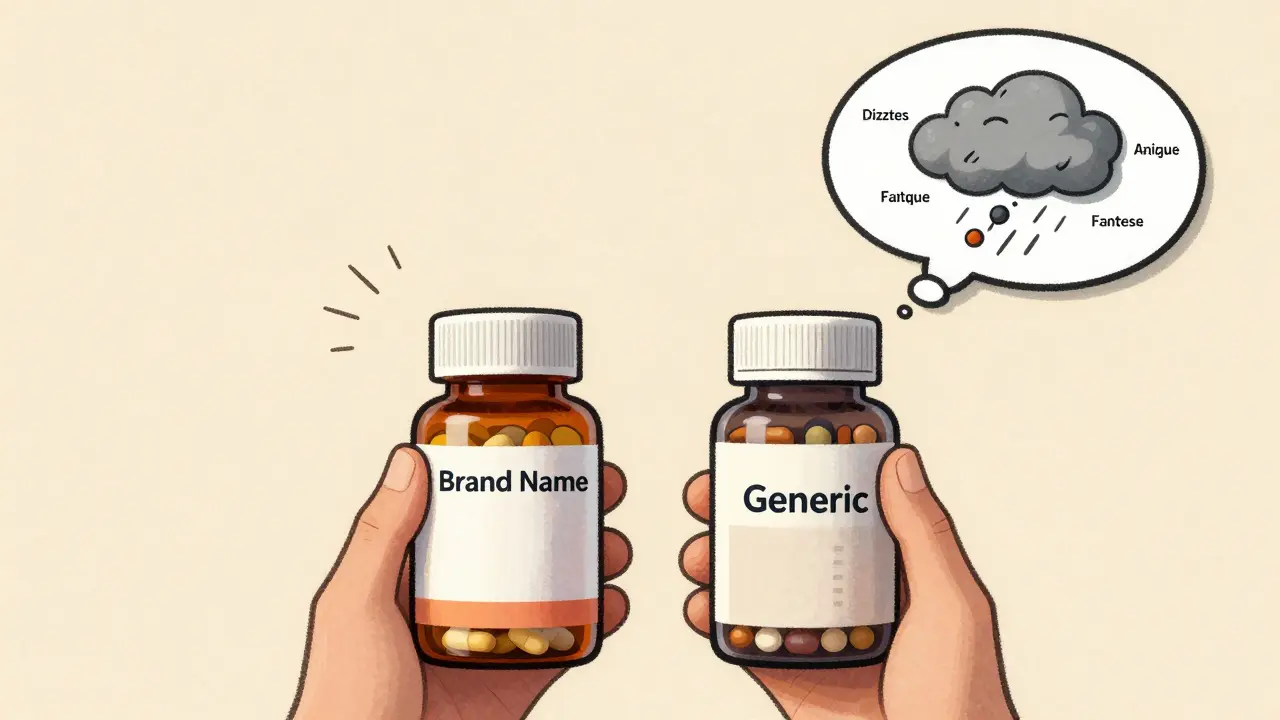
When you pick up a prescription, you might see a different name on the bottle than what your doctor wrote. That’s because your pharmacy filled it with a generic drug-cheaper, just as effective, and used by millions. But if you’ve ever switched from a brand-name pill to a generic and suddenly felt off-more tired, anxious, or dizzy-you’re not alone. Many people report this. So, are generic drugs actually riskier? Or is something else going on?
What Does ‘Bioequivalent’ Really Mean?
The U.S. Food and Drug Administration (FDA) says generics are just as safe and effective as brand-name drugs. To get approval, a generic must prove it delivers the same amount of active ingredient into your bloodstream at the same rate as the original. That’s called bioequivalence. The rule? The generic’s absorption must fall between 80% and 125% of the brand-name version. That sounds strict-but it’s not perfect. For most drugs, this tiny variation doesn’t matter. But for drugs with a narrow therapeutic index-like warfarin, levothyroxine, or phenytoin-even a small change in how your body absorbs the drug can cause problems. A 5% drop in absorption might mean your blood thinning level drops too low. A 5% rise might push you into bleeding risk. That’s why doctors sometimes write “Dispense as Written” on prescriptions for these medications.Are Generic Drugs Less Safe? The Data Says Mostly No
A major 2018 study in PLOS Medicine looked at 38 clinical trials involving heart drugs, thyroid meds, diabetes treatments, and antidepressants. It found no difference in hospitalizations, heart attacks, or deaths between patients taking brand-name versions versus generics. Another large analysis of over 136,000 older adults on blood pressure meds showed no clear increase in ER visits or hospital stays after generics became available. The FDA has reviewed thousands of studies and consistently concludes that generics are therapeutically equivalent. But here’s where things get messy. A 2020 study in Nature Scientific Reports found that patients on generic simvastatin were less likely to stop taking their medication than those on the brand-name version. Why? Because they had fewer side effects. That’s right-some people tolerate the generic better. Another study showed that generic amlodipine had fewer reports of swelling in the ankles than the brand name. So, if you’re worried generics are worse, the data doesn’t back that up. In fact, for some people, they’re better.Why Do People Say They Feel Worse on Generics?
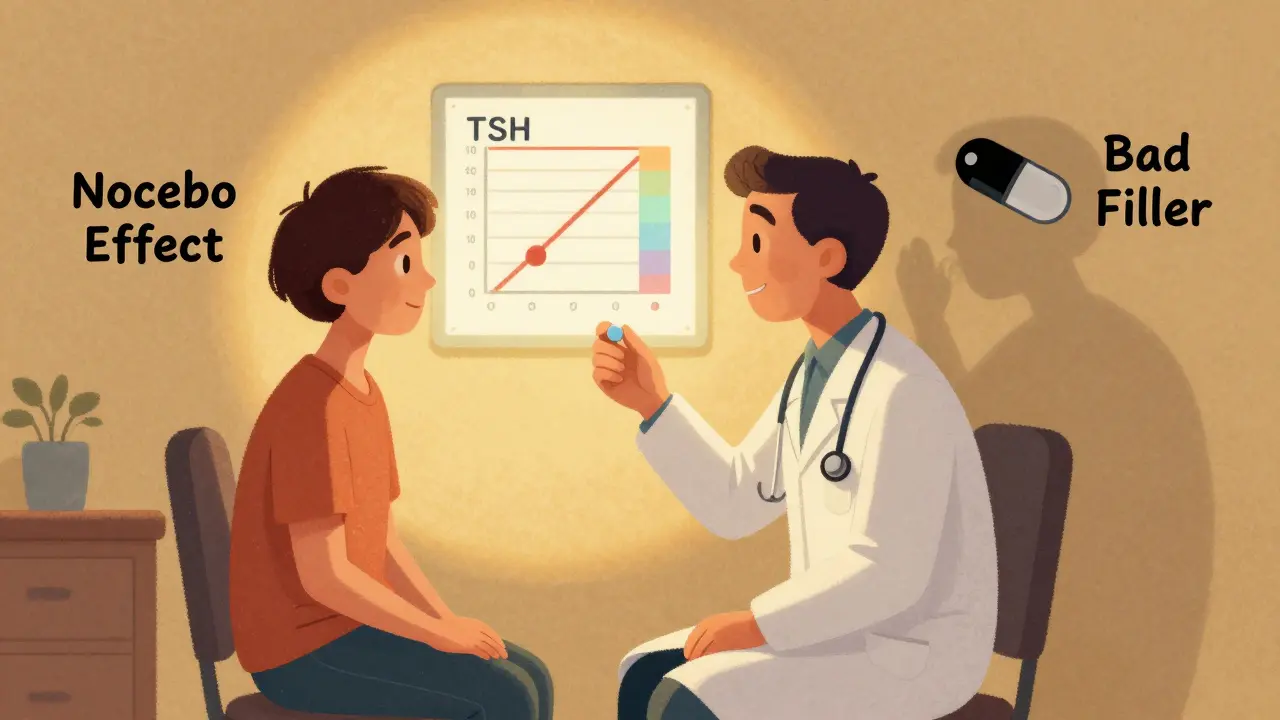
If the science says generics are the same, why do so many people swear they feel different? The answer might be in your head-or your pill’s color. One big factor is the nocebo effect. That’s the opposite of the placebo effect. Instead of feeling better because you believe a treatment works, you feel worse because you believe it won’t. A 2012 study showed that when people were given identical placebo pills but told one was a brand-name drug and the other a generic, the ones told they were taking the generic reported more side effects-even though both were sugar pills. The same thing happens in real life. If you’ve heard stories about generics causing problems, or if your pharmacist says, “This is just a generic,” your brain might start looking for symptoms. There’s also the issue of inactive ingredients. Generics can use different fillers, dyes, or coatings than the brand name. For most people, that doesn’t matter. But if you’re allergic to a dye like FD&C Red No. 40, or sensitive to lactose, you might react to the new version-even if the active ingredient is identical. That’s why some patients report nausea, headaches, or rashes after switching. It’s not the drug. It’s the filler.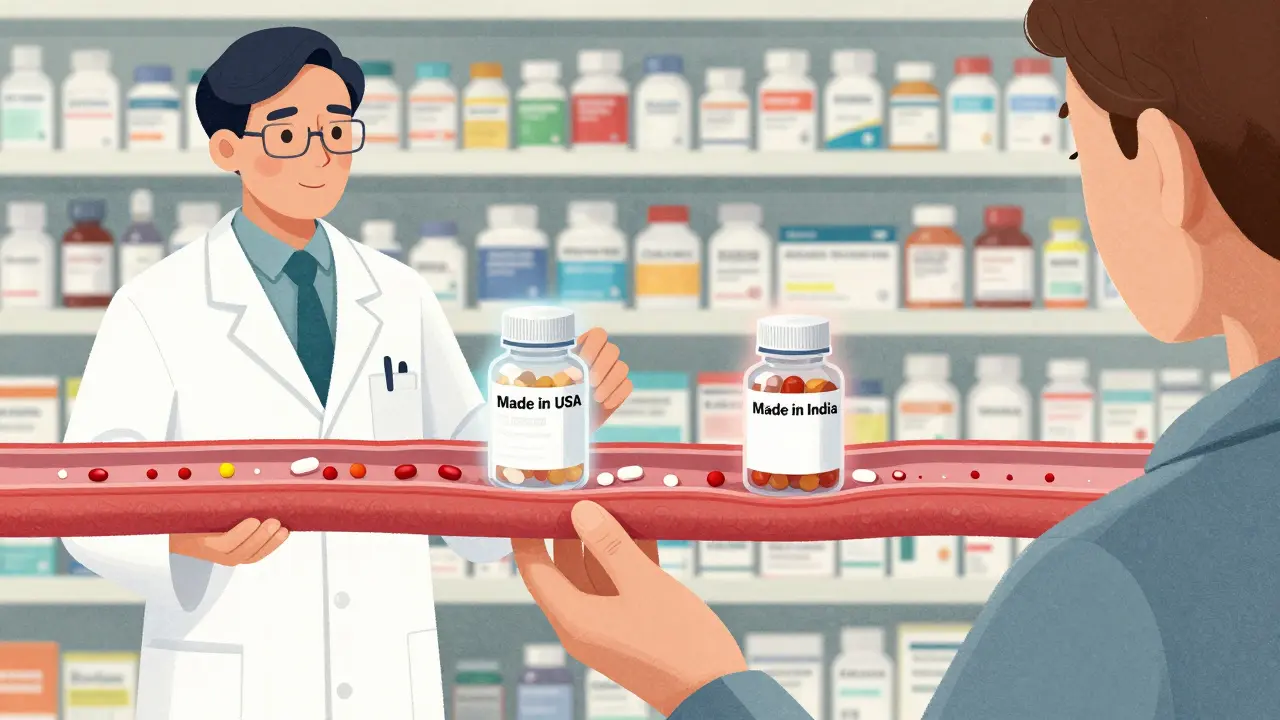
The India Factor: Manufacturing and Quality Control
About 63% of generic drug manufacturing happens outside the U.S. India makes up 32% of those facilities. A 2022 study from Ohio State University found that generics made in India were linked to 54% more severe adverse events-including hospitalizations and deaths-compared to those made in the U.S. The researchers pointed to older, well-established generic drugs as the main problem. These are drugs that have been on the market for years, with many manufacturers competing on price. When profit margins shrink, cutting corners becomes tempting. The FDA inspects over 300 foreign facilities each year. In 2022, 12% of them got flagged for serious violations. That’s a red flag. But the FDA says location doesn’t equal poor quality. A well-run factory in India can make safer pills than a sloppy one in Ohio. Still, the data suggests that for high-risk drugs, sourcing matters. If you’re on a long-term medication like metoprolol or levothyroxine, ask your pharmacist where it’s made. If it’s from a manufacturer you don’t recognize, it’s worth asking if there’s a more reliable alternative.When Generics Really Do Cause Problems
There are real cases where switching generics caused harm. The most common are drugs with a narrow therapeutic index:- Levothyroxine (Synthroid): Patients report swings in energy, weight, and heart rate after switching between generic brands. The FDA has received hundreds of reports of unstable thyroid levels after switching manufacturers-even though all versions meet bioequivalence standards.
- Warfarin: Small changes in absorption can cause dangerous bleeding or clots. Many doctors avoid switching patients on warfarin unless absolutely necessary.
- Bupropion (Wellbutrin): Patients report increased anxiety, insomnia, or mood swings after switching to generic versions. A Reddit thread with over 200 comments from pharmacists and patients describes this pattern repeatedly.
- Phenytoin: Used for seizures. Even tiny changes in blood levels can trigger breakthrough seizures.
What Should You Do?
If you’re on a generic drug and feel fine? Keep taking it. There’s no reason to switch back unless you have a reason to worry. If you started a generic and suddenly feel worse? Don’t assume it’s all in your head. Talk to your doctor or pharmacist. Ask:- Is this a drug with a narrow therapeutic index?
- Did the manufacturer change recently?
- Could it be a filler or dye causing a reaction?
Education Helps-A Lot
A 2020 study found that patients who got a clear explanation about how generics work were 37% less likely to report side effects after switching. Just knowing that the active ingredient is the same, and that differences in fillers are usually harmless, reduces anxiety. That’s powerful. If your doctor takes five minutes to explain this, you’re less likely to quit your medication out of fear.The Bottom Line
For most people, generics are safe, effective, and a smart choice. The vast majority of side effects reported after switching aren’t caused by the drug itself-they’re caused by perception, filler ingredients, or changes in manufacturing. But for a small group-those on critical medications like thyroid hormone, blood thinners, or seizure drugs-consistency matters. Don’t switch without talking to your doctor. And if you’ve had a bad experience, your voice matters. Report it to the FDA’s MedWatch program. Your report could help others.Generics saved the U.S. healthcare system over $300 billion in 2022 alone. They’re not perfect. But for most of us, they’re the best option we’ve got. The key isn’t avoiding generics-it’s knowing when to question them.
Are generic drugs less effective than brand-name drugs?
No. By law, generic drugs must deliver the same amount of active ingredient into your bloodstream at the same rate as the brand-name version. Studies involving hundreds of thousands of patients show no difference in effectiveness for the vast majority of medications. The FDA requires strict bioequivalence testing before approving any generic.
Why do some people feel worse after switching to a generic?
Often, it’s not the active drug causing the issue. Differences in inactive ingredients-like dyes, fillers, or coatings-can trigger reactions in sensitive people. Psychological factors also play a role. If you believe generics are inferior, your brain may interpret normal sensations as side effects-a phenomenon called the nocebo effect. Studies show patients report more side effects when told they’re taking a generic, even when the pill is identical to the brand name.
Are generics made in India unsafe?
Not all generics made in India are unsafe. But research shows that some older, widely used generics manufactured there have been linked to higher rates of severe adverse events compared to those made in the U.S. This appears to be tied to cost pressures and quality control issues in certain facilities-not the country itself. The FDA inspects foreign plants, but supply chains are complex. If you’re on a critical medication, ask your pharmacist where it’s made and whether a more reliable manufacturer is available.
Should I avoid generics if I’m on warfarin or levothyroxine?
For drugs with a narrow therapeutic index-like warfarin, levothyroxine, or phenytoin-consistency is key. Switching between different generic manufacturers can cause small changes in how your body absorbs the drug, which can lead to serious side effects. Many doctors recommend staying on the same brand or generic manufacturer. If you must switch, your doctor should monitor your blood levels closely (like INR for warfarin or TSH for thyroid meds).
Can I ask for a specific generic manufacturer?
Yes. Pharmacies can often order a specific generic brand if your doctor writes “Dispense as Written” or specifies the manufacturer on the prescription. This might cost more, but if you’ve had a bad reaction to one version and feel better on another, it’s worth asking. Insurance may cover it if your doctor explains the medical necessity.




10 Comments
Neil Ellis January 21, 2026
Look, I get it-generics save us a fortune, and most of the time they’re totally fine. But I had a friend switch from Synthroid to a generic and suddenly she was exhausted, gaining weight, and crying at commercials for cat food. She didn’t even know it was the pill until her endocrinologist asked, ‘Did you change anything?’ Turns out, different fillers mess with absorption in weird ways. Not everyone’s body is a lab rat. Sometimes ‘bioequivalent’ just means ‘close enough for the FDA to sign off.’
Lana Kabulova January 23, 2026
Okay but-why does no one talk about the dye? I switched to a generic metoprolol and got a rash. Not a little one-a full-on, itchy, red, ‘why-is-my-neck-on-fire’ rash. Turned out it was FD&C Red No. 40. Brand name? No dye. Generic? Bright red capsule. I asked my pharmacist-she said ‘oh yeah, that’s common.’ Common?! That’s not common-that’s a hidden allergen. People need to know this isn’t just ‘in their head.’
Rob Sims January 25, 2026
Oh wow, another ‘I felt weird on generics’ story. Congrats. You’re the 47th person this week to say this. Meanwhile, the FDA has reviewed 12,000 studies and not one showed a real clinical difference. You’re not ‘sensitive’-you’re just scared of saving $20. Stop romanticizing your placebo reactions.
Daphne Mallari - Tolentino January 26, 2026
One must acknowledge the epistemological framework underpinning pharmaceutical equivalence. The FDA’s 80–125% bioequivalence window is, by any rigorous scientific standard, an extraordinarily broad tolerance band-especially when applied to pharmacokinetic variables in polypharmacy patients. The notion that ‘it’s the same drug’ is a reductive fallacy, predicated upon an oversimplified model of human physiology. One cannot equate molecular identity with therapeutic equivalence across heterogeneous populations. The data may be statistically neutral-but individual outcomes are not.
Patrick Roth January 26, 2026
Actually, the Indian manufacturing data is misleading. Most of those ‘adverse events’ were from drugs manufactured in the 90s. Modern Indian plants are ISO-certified and produce 80% of the world’s generic antiretrovirals. You’re blaming the country, not the company. Also, did you know the US makes most of its own aspirin? And that’s a generic. So… what’s your point again?
Kenji Gaerlan January 27, 2026
bruh i switched to generic adderall and i couldnt focus at all. like at all. felt like my brain was in cotton. but i was too broke to pay for the real stuff. now im just sitting here wondering if i should’ve just stayed on food stamps and called it a day.
Margaret Khaemba January 28, 2026
I had the same thing with levothyroxine! I was doing fine on Synthroid, then switched to a generic and my TSH went from 2.1 to 8.7 in three weeks. My doctor was like, ‘Weird, that shouldn’t happen.’ But it did. Now I ask for the brand every time. It’s $40 more, but I’d rather pay than feel like a zombie. Also, my pharmacist lets me pick the manufacturer-so I always get the one from the same company. It’s a small thing, but it matters.
Hilary Miller January 28, 2026
My grandma’s on warfarin. Switched generics once. Almost bled out. Never again. Ask your doc. Seriously.
Oren Prettyman January 28, 2026
It is an incontrovertible fact that the pharmaceutical industry’s reliance on cost-driven manufacturing paradigms has, in certain instances, compromised the consistency of therapeutic outcomes for patients on medications with narrow therapeutic indices. The regulatory framework governing bioequivalence, while statistically robust, fails to account for inter-individual pharmacodynamic variability, particularly in geriatric and polypharmacy populations. Furthermore, the proliferation of generic manufacturers-many of whom operate under opaque supply chains-introduces an unquantifiable risk factor that is neither acknowledged nor mitigated by current FDA oversight protocols. The anecdotal reports of adverse events, while dismissed as nocebo phenomena, are, in aggregate, a legitimate signal requiring systematic investigation-not dismissal.
Alec Amiri January 29, 2026
Y’all are overthinking this. I’ve been on generic statins for 10 years. I feel great. My cholesterol’s perfect. My wife switched from brand to generic and said she felt weird-turned out she was just stressed about her job. Your brain’s the problem, not the pill. Also, if you’re on warfarin? Don’t switch. But if you’re on ibuprofen? Chill. It’s the same damn thing.