
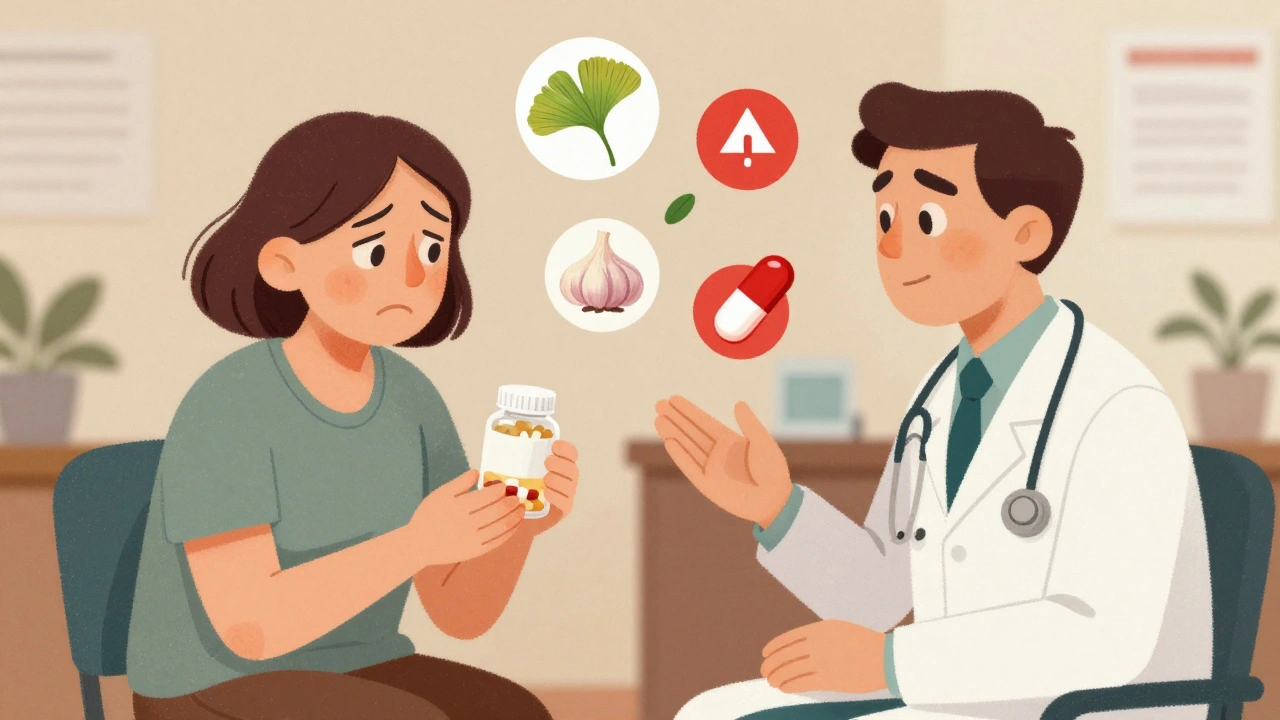
Every year, millions of Americans take dietary supplements - vitamins, herbs, fish oil, probiotics, or plant-based extracts - thinking they’re harmless because they’re "natural." But here’s the hard truth: supplements aren’t harmless. And if you don’t tell your doctor about them, you could be putting your life at risk.
Why Your Doctor Needs to Know What You’re Taking
You might think, "It’s just a multivitamin," or "I only take ginkgo for memory," or "St. John’s wort is herbal - it can’t interfere with my blood pressure meds." But that’s exactly how dangerous interactions start. The U.S. Food and Drug Administration (FDA) doesn’t test supplements for safety or effectiveness before they hit store shelves. Unlike prescription drugs, which go through years of clinical trials, supplements are sold under a 1994 law called DSHEA that treats them like food. That means manufacturers don’t need to prove their product works or is safe. They just need to label it correctly - and even that’s often done poorly. The result? A $50 billion industry with 85,000 products available in the U.S. alone. And according to the Council for Responsible Nutrition, 77% of American adults use supplements. That’s more than three out of four people. But only one in three tells their doctor. This isn’t just about missing information. It’s about hidden dangers. St. John’s wort, a popular herb for mood support, can make birth control, antidepressants, and even heart medications useless. Ginkgo biloba, taken for brain health, can cause dangerous bleeding when mixed with blood thinners like warfarin. Garlic supplements can lower blood pressure so much that they crash it when combined with antihypertensive drugs. These aren’t rare cases. They’re documented, preventable emergencies.What Happens When You Don’t Speak Up
In 2015, a study in JAMA found that dietary supplements sent about 23,000 people to the emergency room every year. That’s more than the number of ER visits caused by some common prescription drugs. And those are just the ones reported. Experts say less than 1% of actual adverse events ever get reported to the FDA. One patient, a 68-year-old man on warfarin for a history of blood clots, started taking ginkgo biloba because he’d read it helped memory. He didn’t mention it to his cardiologist. Two weeks later, he had a brain hemorrhage. He survived - barely. His doctors later found his INR (a blood clotting measure) had skyrocketed from 2.5 to 8.7 - a level that puts patients at extreme risk of uncontrolled bleeding. Another case: a 32-year-old woman on the pill for birth control began taking St. John’s wort for mild depression. She didn’t think it mattered. She got pregnant. The herb cut the effectiveness of her contraceptive by more than half. That’s not an accident. That’s science. The problem isn’t just the supplements. It’s the silence around them. A 2019 study in the Journal of Family Medicine and Disease Prevention found that only 33% of supplement users told their doctors. Among people with chronic conditions like diabetes or heart disease - the very people most at risk for interactions - the rate was barely 51%.Why Patients Stay Quiet - And Why That’s Dangerous
Why don’t people talk about supplements? There are a few reasons:- They think their doctor won’t care.
- They assume "natural" means safe.
- They’re embarrassed - "I shouldn’t be taking this stuff, right?"
- They’ve been brushed off before.
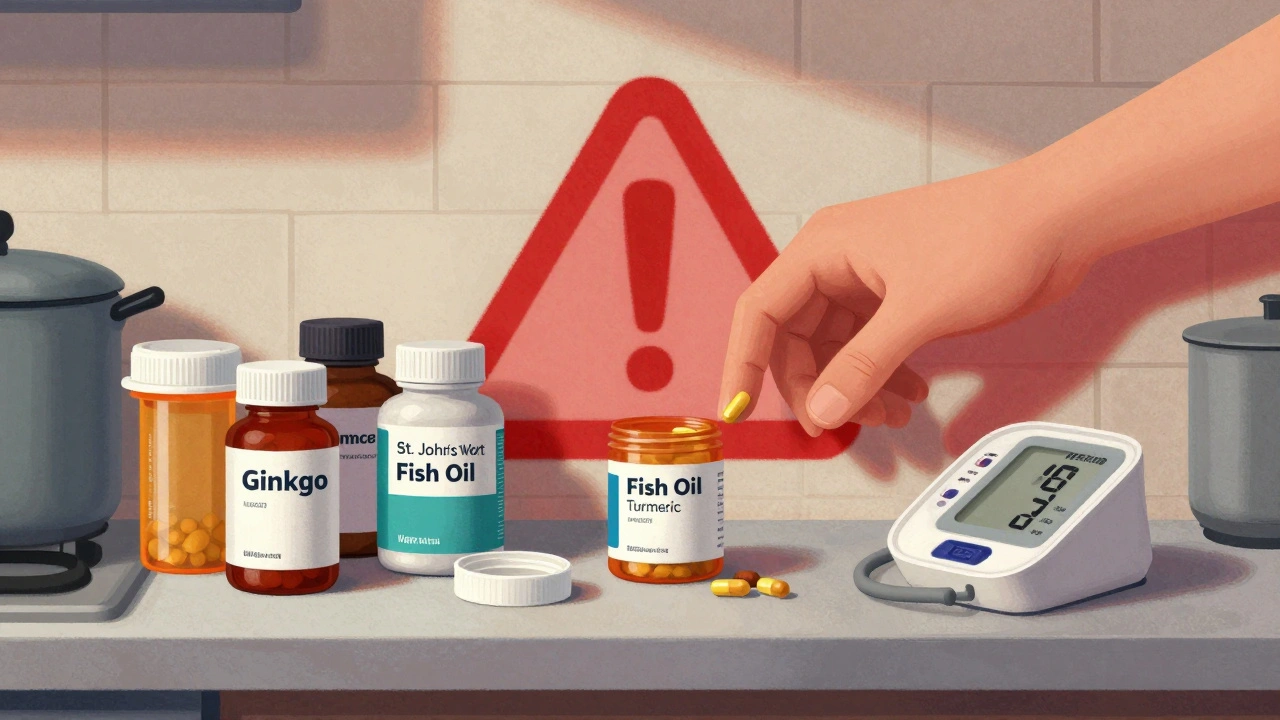
How to Talk to Your Care Team - Without Getting Dismissed
You don’t need to wait for your doctor to ask. You need to speak up - and here’s how to do it so you’re taken seriously. Start with this phrase: "I’m taking a few supplements and natural products to support my health. I want to make sure they’re safe with everything else I’m on. Can we review them?" Don’t say "I take herbs." Don’t say "I use natural remedies." Say exactly what you take: brand names, doses, how often, and why. For example:- "I take 500 mg of Panax ginseng daily for energy."
- "I take 1,200 mg of fish oil with 1,000 mg EPA/DHA every morning."
- "I use magnesium glycinate 400 mg at night for sleep."
What Your Doctor Should Be Doing
It’s not just your job to speak up. Your doctor’s office should be asking. The American Medical Association recommends that every provider screen for supplement use at every visit - not just once a year. And they should use open-ended questions:- "What supplements, vitamins, or herbal products are you using to manage your health?"
- "Are you taking anything that your pharmacist might not know about?"
- "Have you started anything new since your last visit?"
What You Should Track (And How)
Keep a simple log. Write down:- Product name (brand and generic)
- Active ingredients and amounts
- Dosage and frequency (e.g., "2 capsules twice daily")
- Reason for taking it
- Where you bought it (store or website)
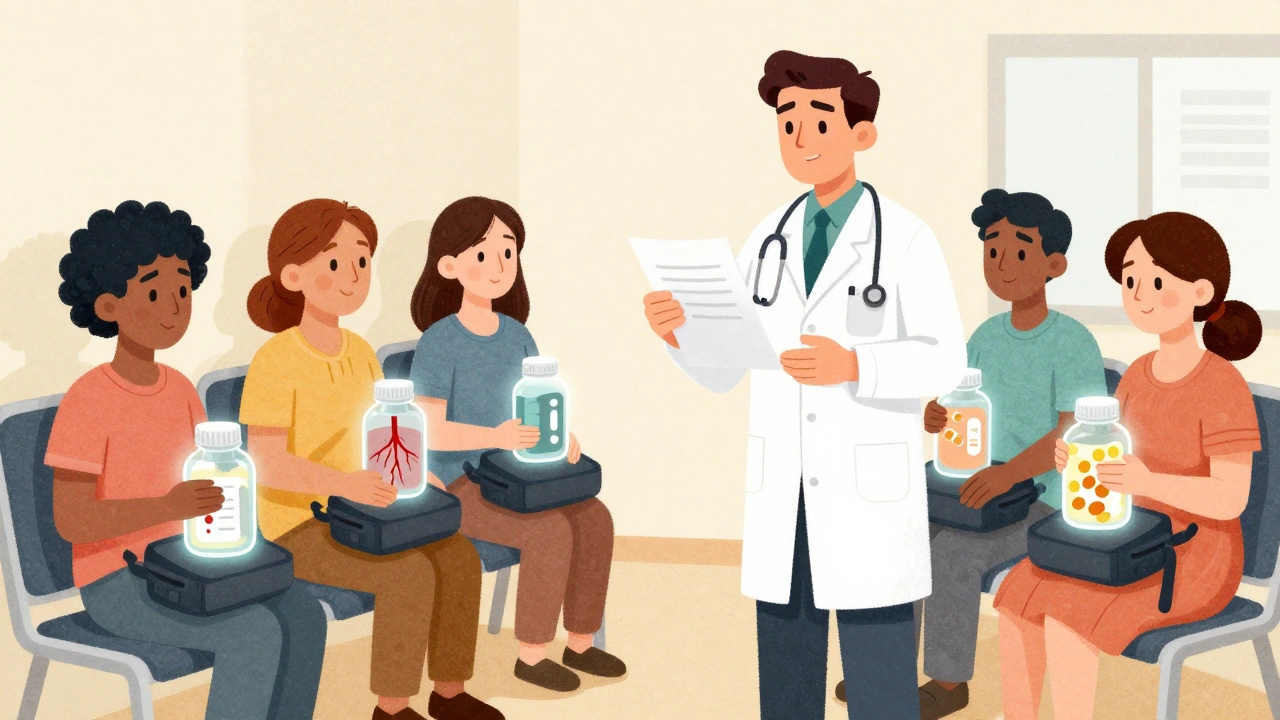
Red Flags: Supplements That Are High Risk
Some supplements have well-documented dangers. Here are the top ones to watch for:- St. John’s wort: Interacts with 57% of prescription drugs, including antidepressants, birth control, HIV meds, and blood thinners.
- Ginkgo biloba: Increases bleeding risk with warfarin, aspirin, NSAIDs.
- Garlic supplements: Can lower blood pressure too much and increase bleeding.
- Green tea extract: Linked to liver damage at high doses - especially in weight-loss products.
- Valerian root: Can amplify sedatives like benzodiazepines or sleep meds.
- Glucosamine/chondroitin: May interfere with blood sugar control in diabetics.
What’s Changing - And What’s Coming
There’s movement. The Dietary Supplement Listing Act of 2022 would require manufacturers to register all products with the FDA. The Supplement Safety Act, introduced in March 2023, would require pre-market notification - meaning companies would have to prove safety before selling. Epic Systems, the largest electronic health record provider in the U.S., is adding a dedicated supplement module in Q2 2024. It will automatically flag interactions between 1,200 supplements and prescription drugs. But none of this matters if patients don’t speak up.Final Thought: Your Health Is Not a Secret
Supplements aren’t the enemy. Many are helpful - when used safely and with full transparency. But secrecy kills. The same person who tells their doctor about every prescription, every allergy, every surgery, might hide their turmeric capsules because they think it’s "not medical." It is medical. Your body doesn’t know the difference between a pill from a pharmacy and a capsule from a health store. It reacts to chemicals - whether they’re synthetic or natural. If you take anything to improve your health - even if it’s labeled "herbal," "organic," or "all-natural" - tell your care team. Bring the bottle. Write it down. Ask the question. Because in this system, the only thing standing between you and a dangerous interaction is your willingness to speak up.Do I need to tell my doctor about vitamins and multivitamins?
Yes. Even common vitamins like vitamin D, vitamin K, or B12 can interact with medications. For example, vitamin K can reduce the effect of blood thinners like warfarin. High doses of vitamin C can interfere with certain cancer treatments. Your doctor needs to know everything you’re taking - not just the "strong" stuff.
Can supplements be contaminated with dangerous ingredients?
Yes. The FDA has found supplements containing undeclared steroids, weight-loss drugs, erectile dysfunction medications, and even stimulants like amphetamines. These aren’t mistakes - they’re intentional additions to make products seem more effective. Labels are often misleading. That’s why bringing the actual bottle to your appointment helps your doctor identify hidden risks.
What if my doctor says supplements are a waste of money?
Your doctor’s opinion doesn’t change the fact that supplements can interact with your medications or affect your health. Even if they think it’s unnecessary, you still need to disclose it. Say: "I understand you may not recommend it, but I’m taking it and want to make sure it’s safe with my other treatments." That keeps the door open for honest care.
Are online supplements more dangerous than store-bought ones?
Not necessarily, but they’re harder to track. Online sellers aren’t always regulated, and products may be shipped from countries with lax quality controls. The FDA inspects less than 1% of supplement facilities. If you buy online, check for third-party testing seals like USP, NSF, or ConsumerLab. But even those don’t guarantee safety - only that the product contains what it claims. Always tell your doctor about online purchases.
Should I stop taking supplements before surgery?
Yes - and tell your surgeon at least two weeks before. Many supplements, including garlic, ginkgo, ginseng, and fish oil, can increase bleeding risk. Others, like valerian or kava, can interfere with anesthesia. Your surgical team needs a complete picture. Don’t wait for them to ask - bring your list.
Is there a list of safe supplements?
There’s no official "safe" list. Safety depends on your health conditions, medications, and dosage. What’s safe for one person could be dangerous for another. The best tool is the Natural Medicine Database, used by hospitals and clinics, which tracks over 1,200 drug-supplement interactions. Ask your pharmacist or doctor if they use it.



14 Comments
Vivian Amadi December 11, 2025
This is why I stopped trusting doctors. They act like supplements are some kind of sin, but they’ll prescribe you a pill that makes you feel like a zombie. I take turmeric, magnesium, and omega-3s - all natural, all backed by science. My doctor didn’t even know what ginkgo was until I showed him the bottle. Now he’s the one asking me what I’m taking. Wake up, people.
Jimmy Kärnfeldt December 12, 2025
I get it. We all want to feel in control of our health. But the real win isn’t just taking something - it’s talking about it. I used to hide my ashwagandha like it was contraband. Then I told my doc, and she helped me adjust my thyroid med. No drama. No judgment. Just good care. We’re all trying to do better. Let’s stop pretending supplements are secret club stuff.
Ariel Nichole December 14, 2025
Love this post. So many people don’t realize how much their ‘natural’ stuff can mess with meds. My grandma took garlic pills with her blood thinner and ended up in the ER. She didn’t think it mattered because it was ‘just garlic.’ Now she keeps a little notebook. Simple. Smart. Life-saving.
matthew dendle December 14, 2025
lol so now we gotta tell our doc we took a vitamin b12? next theyll ask if we drank water. natural doesnt mean safe? bro i eat kale and drink green tea and i still have a 200iq. you guys are paranoid. the real danger is trusting big pharma who sells you pills that cost 500 bucks and dont work
Lisa Stringfellow December 15, 2025
It’s not just about the supplements. It’s about how doctors treat you like a child when you mention them. I’ve been called ‘woo-woo’ three times for saying I take melatonin. So now I don’t say anything. Why should I risk being laughed at for trying to feel better? This system is broken - not me.
Kristi Pope December 16, 2025
Bring the bottle. Say it loud. Write it down. No shame in caring for yourself - even if it’s with herbs or fish oil. I used to feel weird about it too. Then I realized: my body doesn’t care if it’s a pill or a capsule. It just reacts. So why hide it? My doc now keeps a sticky note on my chart: ‘Kristi takes magnesium + ashwagandha.’ Small thing. Big difference.
Sylvia Frenzel December 17, 2025
Supplements are a scam. America’s obsession with quick fixes is why we’re the sickest nation on earth. You don’t need ginkgo for memory - you need sleep. You don’t need turmeric for inflammation - you need to stop eating processed crap. This post is just giving legitimacy to a billion-dollar industry built on placebo and fear.
Paul Dixon December 18, 2025
My buddy took St. John’s wort for anxiety and stopped his SSRI cold turkey. Thought it was ‘natural healing.’ Ended up in a psych ward. I get why people do it - we’re tired of feeling like machines. But this isn’t about ‘natural vs synthetic.’ It’s about communication. Talk to your doc. Even if they seem clueless. You’re the only one who knows what’s in your body.
Jim Irish December 18, 2025
The FDA’s oversight gap is a public health crisis. But the real issue is cultural. We’ve been conditioned to see doctors as gatekeepers, not partners. When patients feel dismissed, they retreat. The solution isn’t more regulation - it’s more curiosity. Ask. Listen. Educate. Simple. But it takes time.
Mia Kingsley December 20, 2025
Wait so you’re telling me I can’t take my ‘immune booster’ from the gas station anymore? I’ve been taking that since 2019. It’s got glitter in it. I think it’s magic. Also I read that vitamin C cures cancer so I take 10g a day. If my doctor says no then he’s just scared of the truth. #NaturalIsBetter
Katherine Liu-Bevan December 21, 2025
Here’s what nobody tells you: supplements can mess with lab results. I had a patient on high-dose biotin who got false thyroid readings for months. Her doctor thought she had Graves’ disease. Turned out it was just her daily ‘hair, skin, nails’ pill. She didn’t mention it because she thought it was ‘just vitamins.’ We caught it because she finally brought the bottle. Always bring the bottle.
Aman deep December 21, 2025
in india we use turmeric and neem for everything since generations. no one goes to doctor for it. but here? people panic. truth is, context matters. if you’re on warfarin and take ginkgo? yes danger. if you’re healthy and take ginger tea? no problem. dont fear the supplement. fear the silence.
Eddie Bennett December 22, 2025
My mom’s on 7 meds. She takes a multivitamin, fish oil, and melatonin. She never tells anyone. I found out because I saw the bottles in her purse. I asked her why she hides it. She said, ‘They’ll just tell me to stop.’ So I made her a little card with everything listed. She showed it to her cardiologist last week. He thanked her. Said he’d never seen someone so organized. Small step. Huge win.
john damon December 22, 2025
BRING THE BOTTLE 🍃💊✨ I literally carry my supplements in my wallet. My doc laughs but then he checks the label. One time he spotted a hidden stimulant in my ‘energy blend.’ Saved me from a heart palpitation. This isn’t paranoia. It’s survival. And yes I use emojis. Deal with it.