
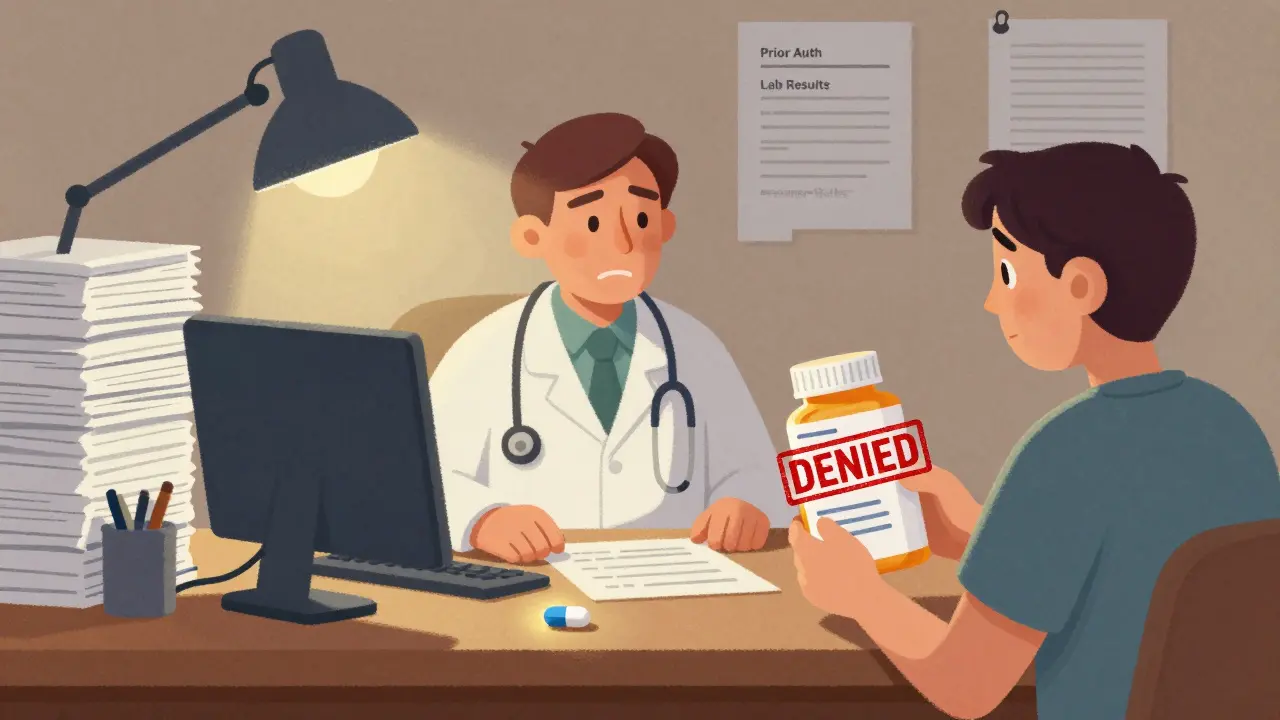
When your doctor writes a prescription for a brand-name medication, and the pharmacy tells you it’s not covered unless you switch to a cheaper generic - that’s not a coincidence. It’s the result of a deliberate, system-wide push by health insurers to cut costs. And providers - the doctors, nurses, and clinics on the front lines - are the ones left to navigate the fallout.
How Insurers Enforce Generic Substitution
Insurers don’t just suggest generics. They enforce them. The tools are built into how drug coverage works. Most plans use formulary tiers, where generics sit in the lowest-cost tier - often a $5 to $15 copay. Brand-name drugs? Those can cost $40, $80, even $150. For many patients, that price gap isn’t just inconvenient - it’s impossible to ignore. So they take the generic. And insurers count on it. But it’s not just about price. Many plans now include mandatory substitution rules. If a generic exists, the insurer will only cover the brand-name version if the provider jumps through hoops. That means prior authorization: submitting clinical notes, lab results, or proof that the patient tried and failed the generic. Some insurers even require step therapy - forcing patients to try two or three generics first, even if the doctor knows they won’t work. In 2022, 90% of all prescriptions in the U.S. were filled with generics. That’s not because patients prefer them. It’s because the system is designed to make them the only practical choice.What Providers Actually Face
Doctors aren’t resisting generics because they’re anti-cost-saving. Most support lower costs. But they’re frustrated by how these policies are implemented. A 2023 survey by the Medical Group Management Association found that physicians spend an average of 16.9 minutes per prior authorization request. That’s nearly three hours a week just on paperwork - time taken away from seeing patients. In some practices, staff are hired just to handle these requests. Medium-sized clinics now employ 1.8 full-time people dedicated to prior auth, costing over $110,000 per year per position. And it’s not just time. It’s uncertainty. Every insurer has different rules. UnitedHealthcare might require one set of lab values. CVS/Aetna might need a different form. A 2023 study found that 89% of physicians had to learn a new set of criteria for each major insurer. No two are the same. One insurer might accept a patient’s self-reported side effects. Another demands documented lab results from six months ago. And when a claim gets denied? Appeals can take weeks. One Mayo Clinic physician shared a case where a patient with a known sensitivity to a generic anticoagulant was denied coverage for the brand-name version. Three appeals. 22 days. Two emergency room visits for bleeding. By the time approval came, the patient was already in crisis.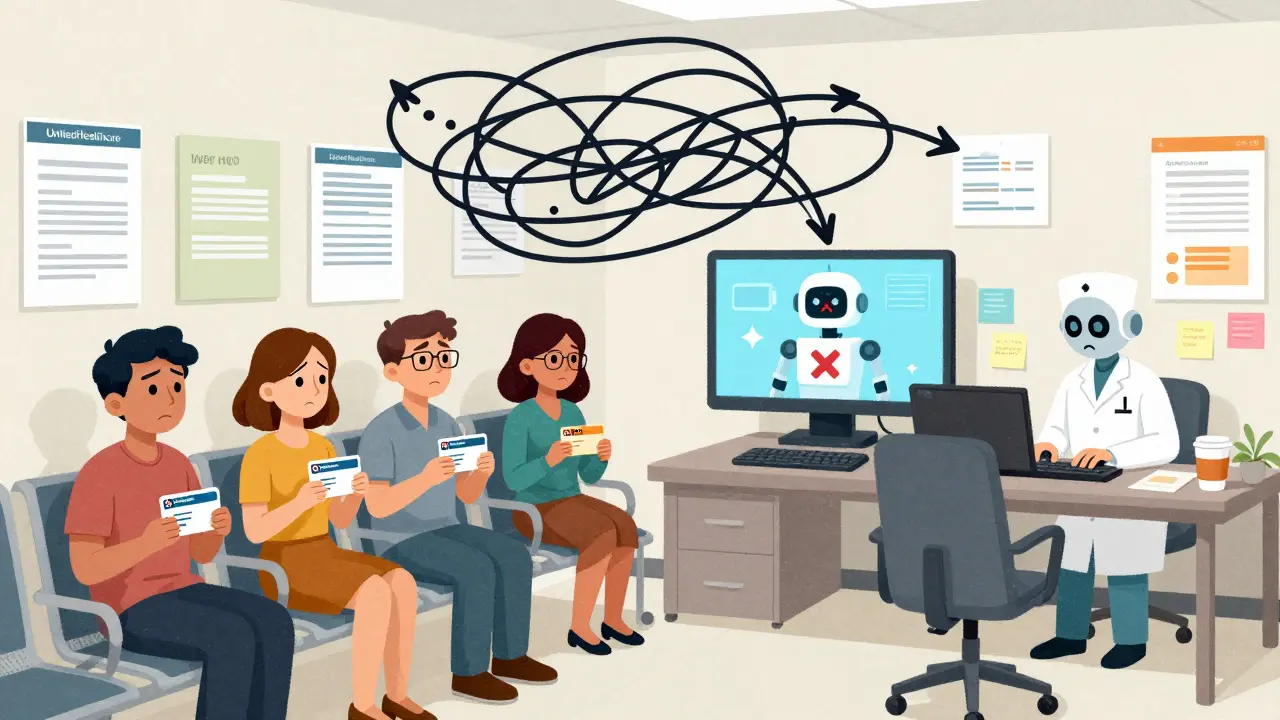
Where the System Breaks Down
The FDA says generics are bioequivalent - meaning they deliver 80% to 125% of the brand-name drug’s effect. That sounds fine. Until you’re treating a patient on levothyroxine for thyroid disease. Or warfarin for blood clots. Or certain seizure medications. These are drugs with a narrow therapeutic index. Tiny differences in absorption can mean the difference between control and catastrophe. The American Medical Association reports that 28% of physicians have seen adverse outcomes after switching patients from brand-name to generic versions of these drugs. Insurers argue that 98.7% of substitutions go smoothly. But that statistic doesn’t capture the ones that don’t. A single bad outcome can change a patient’s life. And providers are the ones who have to explain it. Even more concerning? The rise of AI-driven denials. Some insurers now use automated systems to flag “high-risk” prescriptions. A doctor in Arizona described how their prior auth request for a diabetes drug was rejected because an algorithm flagged “insufficient documentation” - even though the patient had been on the same medication for seven years. The insurer refused to let a human review it. That changed in May 2025, when Arizona passed HB 2175, banning insurers from relying solely on AI for medical necessity decisions. But most states still don’t have that protection.How Providers Are Fighting Back
Doctors aren’t passive. They’re adapting. Many now include preemptive documentation in every prescription for brand-name drugs. One cardiologist on Reddit said they now add a one-line note to every script: “Patient has documented intolerance to generic alternative.” It’s extra work - but it cuts down on denials. Their approval rate jumped from 52% to 88%. Others use templates. The American Academy of Family Physicians found that 68% of providers now use standardized letters for common exceptions - like “history of adverse reaction,” “therapeutic failure,” or “allergy.” These aren’t fancy. But they’re consistent. And they work. The biggest win? Electronic prior authorization (ePA). Since the CMS Interoperability and PA final rule in 2024, insurers have been required to integrate ePA with electronic health records. Practices using it report approval times cut by 55%. No more faxes. No more phone tag. Just a button click. California’s AB 347, effective January 2024, made things even easier. If a provider submits a step therapy exception with clinical documentation, the insurer must respond within 72 hours. One psychiatrist in Los Angeles said approvals went from two weeks to under three days - with a 92% first-time approval rate.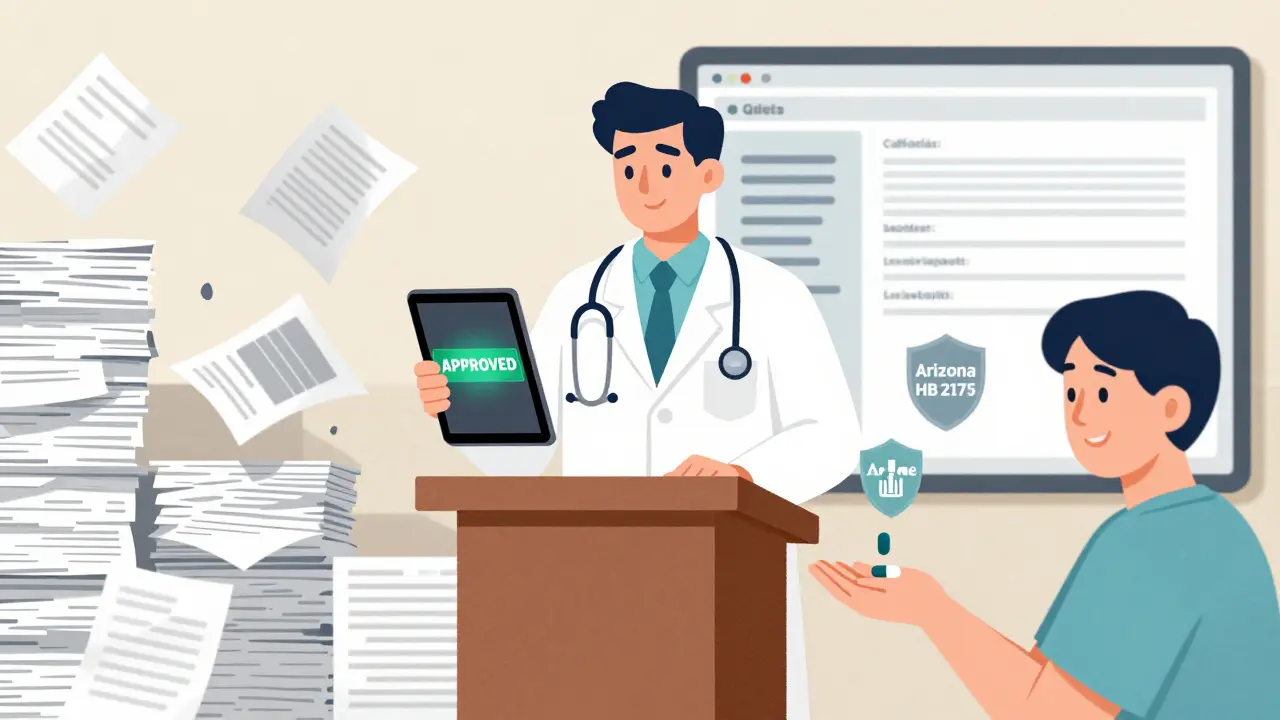
The Bigger Picture
This isn’t just about pills. It’s about trust. Patients come to providers because they believe their doctor has their best interest in mind. When a patient is told, “Your insurance won’t cover this,” and the doctor can’t help - that trust erodes. One survey found that 78% of providers say prior auth requirements sometimes lead patients to abandon treatment entirely. Meanwhile, insurers are pushing toward 95% generic utilization by 2030. The pharmacy benefit managers (PBMs) - CVS Caremark, Express Scripts, OptumRx - control 85% of formularies. They’re not just middlemen. They’re decision-makers. And their algorithms are built to minimize cost, not maximize outcomes. There’s a growing backlash. In 2024 and 2025, 34 states introduced bills to regulate prior authorization. The federal Improving Seniors’ Timely Access to Care Act already requires Medicare Advantage plans to respond within 72 hours for urgent cases. But these are patches, not solutions. The real question isn’t whether generics are cheaper. They are. The real question is: Who decides when a patient’s health is worth the risk? Providers aren’t fighting generics. They’re fighting a system that treats medicine like a spreadsheet - and patients like line items.What’s Next?
The FDA is expected to release draft guidance in Q3 2025 on how to handle generic substitutions for narrow therapeutic index drugs. That could mean stricter standards - or clearer exceptions. More states will likely follow Arizona and California. But until there’s a national standard - one that requires insurers to define medical necessity with actual clinical criteria, not vague policy language - providers will keep spending more time on paperwork than on patients. Until then, the burden stays with them. And the consequences? They’re carried by the people who need care the most.Why do insurers force generic substitutions?
Insurers mandate generic substitutions because generic drugs cost 80-85% less than brand-name versions, according to FDA data. This saves billions annually across the healthcare system. By steering patients toward cheaper options through tiered formularies and prior authorization rules, insurers reduce their own payout costs - and often pass savings to employers or government programs.
Do generic drugs work the same as brand-name drugs?
For most drugs, yes. The FDA requires generics to deliver between 80% and 125% of the brand-name drug’s effect. But for drugs with a narrow therapeutic index - like levothyroxine, warfarin, or certain epilepsy medications - even small differences in absorption can cause treatment failure or side effects. Studies show 28% of physicians have seen adverse outcomes after switching patients on these drugs.
How long does prior authorization take?
It varies. Before 2024, it could take 7-14 days. Now, under federal rules, Medicare Advantage and Medicaid plans must respond within 72 hours for urgent cases and 5 business days for standard requests. Some states, like California, enforce even faster timelines. However, many private insurers still lag, and denials often trigger appeals that can stretch for weeks.
Can providers appeal a denial?
Yes, but success depends on documentation. Appeals with objective clinical evidence - like lab results showing therapeutic failure, documented allergic reactions, or previous adverse events - have a 37% higher approval rate than those based on subjective statements. Many providers now use standardized template letters to increase their chances.
Are AI systems making prior authorization worse?
Some insurers use AI to automatically deny requests, often without human review. This has led to cases where patients were denied medications they’d safely used for years. Arizona’s HB 2175 (2025) banned this practice, requiring medical directors to personally review denials. But most states still allow AI-driven denials, contributing to provider frustration and patient harm.




15 Comments
Sharon Lammas March 3, 2026
It’s not about generics being bad. It’s about the system treating people like data points. When a doctor’s hands are tied by a form that doesn’t recognize a patient’s lived experience, that’s not efficiency. That’s moral laziness.
We’ve turned care into a cost-benefit spreadsheet. And the people who pay the price? They’re not on the spreadsheet.
I’ve watched patients skip doses because the system forced them to try three generics first. One woman stopped her seizure meds for six weeks. She had a fall. Broke her collarbone. The insurer approved the brand-name drug two days after she got out of the hospital.
That’s not saving money. That’s just moving the cost somewhere else-into emergency rooms, into lost wages, into broken lives.
marjorie arsenault March 4, 2026
I’ve been a nurse for 22 years. I’ve seen this play out over and over.
Patients don’t refuse generics because they’re stubborn. They refuse because they’ve been burned. One guy switched from brand levothyroxine to generic and started having panic attacks. He thought he was going crazy. Turns out his TSH went from 1.8 to 7.3. He lost 18 pounds in a month.
Doctors aren’t fighting cost savings. We’re fighting being silenced.
And yeah, ePA helped. But only if the insurer’s system doesn’t glitch and delete your note. Which it does. All the time.
Deborah Dennis March 6, 2026
This is why we can’t have nice things. Every time someone says ‘the system is broken,’ it’s just code for ‘I don’t want to do my job.’ You think insurers are the villains? Try being the one who has to pay the bills while the doctors complain about paperwork. Someone’s gotta cut costs. And guess what? It’s not the CEO. It’s you. And me.
Shivam Pawa March 7, 2026
In India we have similar issues but different context. Generics are the norm. No prior auth. No formularies. Just cheap, effective meds. But here? The system is overengineered. AI denials? That’s not innovation. That’s outsourcing ethics to a bot. The real issue? Profit motive disguised as efficiency. We need to stop pretending this is about healthcare.
Diane Croft March 8, 2026
I work in a rural clinic. We don’t have staff for prior auth. So the doctor does it. Between patients. During lunch. At midnight. I’ve seen her cry over a denied prescription. Not because she’s weak. Because she knows what it means for the patient. This isn’t policy. It’s cruelty dressed up as a spreadsheet.
Donna Zurick March 8, 2026
The fact that we have to fight just to give someone their medicine says everything. We’re not talking about luxury drugs. We’re talking about people who need to breathe, think, survive. And we’ve made it harder than it should be. Simple solution: trust doctors. They didn’t go to med school to do paperwork.
Ethan Zeeb March 9, 2026
Let’s be real. Insurers aren’t evil. They’re responding to market pressure. Employers want lower premiums. Patients want low copays. So the system optimizes for the cheapest option. The problem isn’t the policy. It’s the lack of accountability. If insurers had to pay the ER bills when someone gets hospitalized because they got the wrong pill, maybe they’d think twice.
Darren Torpey March 10, 2026
It’s like watching someone try to fix a leaky roof with duct tape while the whole house is flooding.
They’re slapping on ePA like it’s magic. But if the underlying structure is rotten? No amount of tech fixes that.
And don’t get me started on AI denials. That’s not automation. That’s abandonment. Imagine your kid’s asthma inhaler getting flagged because an algorithm read ‘insufficient documentation’ on a 10-year history. No human. No mercy.
We’re not just losing time. We’re losing trust. And trust? You can’t code that back.
Lebogang kekana March 11, 2026
Here in South Africa, we don’t have this madness. Generics? Yes. Prior auth? No. Why? Because we can’t afford the bureaucracy. And guess what? People live. They thrive.
But here? You’ve got a system that spends $110K a year per person just to fight itself.
It’s not about cost. It’s about control. Someone somewhere wants to decide who gets to live. And that’s not healthcare. That’s power.
Jessica Chaloux March 11, 2026
I just lost my mom because they denied her brand-name warfarin. She had a stroke. They said she "failed" the generic. She didn't fail. The system did. I'm still angry. And I'm not over it. 😔
Mariah Carle March 11, 2026
Are we really surprised? Capitalism turned medicine into a commodity. We treat bodies like balance sheets. The FDA says 80-125% bioequivalence is fine. But what is a human body? A statistical outlier? A cost center?
The real question isn’t about generics. It’s about whether we still believe healing is sacred. Or if we’ve reduced it to a line item on a quarterly report.
Raman Kapri March 13, 2026
The data shows 98.7% of substitutions are successful. The anecdotal cases are emotionally compelling but statistically insignificant. This is a classic appeal to anecdote. If the system is broken, fix it with better data-not outrage. And stop blaming insurers. They’re just executing the incentives given to them by employers and regulators.
Megan Nayak March 14, 2026
Let’s be honest. The entire system is a performance art piece designed to make everyone feel powerless.
Doctors play the martyr. Insurers play the efficiency nerds. Patients play the helpless victims. And the PBMs? They’re the ones laughing all the way to the bank.
Every time someone says ‘trust the doctor,’ I laugh. Because if you really trusted them, you wouldn’t have 17 forms, 3 phone calls, and a 12-day wait. You’d just give them the damn script.
This isn’t about healthcare. It’s about control. And the people who win? They don’t even show up to this conversation.
Tildi Fletes March 15, 2026
Based on clinical documentation standards and regulatory frameworks, the current prior authorization paradigm reflects a misalignment between reimbursement incentives and clinical autonomy.
Empirical evidence from the Journal of General Internal Medicine (2023) indicates that administrative burden correlates inversely with provider satisfaction and directly with patient abandonment rates.
Standardization of formulary criteria across payers, coupled with mandated electronic interoperability, reduces variance in decision-making and improves temporal efficiency.
Recommendation: Federal legislation should codify a single, nationally recognized set of clinical thresholds for therapeutic exceptions, eliminating insurer-specific criteria.
Until then, the burden remains on providers, and the cost is borne by patients.
Alex Brad March 17, 2026
ePA is the only real win here. Stop the faxes. Stop the phone calls. Just let the system talk. If the insurer’s API is down? That’s their problem. We shouldn’t have to beg for a patient to get their medicine. Just make it work.